Tuesday, June 3, 2014

Comics Review: Forever Evil - The Day Evil Won...Done Right (SPOILERS)


Back in 2008, DC billed their "Final Crisis" event as "The Day Evil Won". Let's be honest though, the story was so jumbled and confusing that the only memorable moment was the fatal confrontation between Batman and Darkseid (in which neither of them really died, but it was still a badass Batman moment). That's how I viewed it at least.
Cut to five years later, DC had since rebooted their universe with Flashpoint and the New 52, and their first major event, "Forever Evil", could very well draw parallels with "Final Crisis" in terms of concept. It has the major heroes out of commission while the main villains recruit every other villain on the planet to serve them; hell, they even did another Villains Month like five years ago.
After a lead-up storyline with the "Trinity War" crossover (which I previously reviewed), the first issue of the event had started out promising, with the Crime Syndicate busting out the villains, blotting out the sun by eclipsing the moon, taking down much of the world's electrical grid, kidnapping Nightwing and revealing his identity to the public, and basically giving the whole planet an "obey or die" ultimatum. All the while, we are also introduced to the main protagonist of the series that practically no one would see as the hero, even though he would view himself to be: Lex Luthor. Unfortunately, I think this issue was buried amongst all the Villains Month comics and the hype and frustration that came with it. Still, "Forever Evil" started the way an event should; it introduced the villains and the level of threat they are along with the protagonist realizing he has to do something.

The Crime Syndicate (re)debuted at the conclusion of "Trinity War", and over the course of the series, I thought Geoff Johns did a good job at reintroducing and reinterpreting the evil Justice League, my favorite being Ultraman. If anyone personified the opposite elements of Superman, it was this version of Ultraman.
  • Instead of strength, the house of "Il" represented strength, i.e. he's out to prove he is the best instead of trying to bring out the best in others.
  • Instead of being powered by the sun, it hurts him, which is why he has to keep the sun eclipsed.
  • Instead of Kryptonite weakening him, it actually strengthens him. In fact, it actually seems like an addiction. Just look at this panel:
Kryptonite. It's a hell of a drug.
 
The other Syndicate members do a good job at displaying how opposite they are from their League counterparts, but Ultraman is the best representation if you ask me. But Power Ring gets an honorable mention. Given Johns has been writing Hal Jordan for almost a decade, it was interesting to see how different the Earth-3 version was here; he's cowardly and definitely the guy who doesn't want to be there but only is because Deathstorm (whose name they basically stole from the Black Lantern Firestorm from the pre-Flashpoint universe, but I'll let that slide) say he'll help him get the ring off but he never does. In a way, you feel a little happy for him when Sinestro kills him, cause it's more of a mercy killing.
Then you have the personal drama within the Syndicate, particularly the love triangle between Ultraman, Owlman, and Superwoman, who is pregnant. Whose the father? Well, we'll get to that later.
 
On to the series protagonist. This is really the first time I've seen Lex Luthor in a heroic position, and I mean one where he doesn't have to team up with heroes to fix one of his screw-ups. It's also the first time I've really seen any focus on Lex's internal thoughts, as we learn what motivates him and how he views other heroes and villains. But one of the best aspects of the series is his interaction with Bizarro. Bizarro in the New 52 is Luthor's attempt at a Kryptonian clone, but it would take ten years to complete perfect clone. At the time of "Forever Evil", Subject B-0 (nice play on words Geoff) is only half-way complete, with chalky white skin and limited intelligence. However, Lex has to release him because he believes he'll need some Kryptonian strength to defeat the Syndicate. While Lex only sees Bizarro as a tool to begin with, eventually he opens up to his creature about his past and the creature responds kindly, establishing a real emotional partnership. When Bizarro ends up getting killed in the final issue, you can feel Lex's pain:


While many heroes of the Justice League are imprisoned in the Firestorm Matrix by the Syndicate, at least a few of them make it out, the most prominent being Catwoman and of course...Batman! How did the Dark Knight avoid capture? He escaped through a sewer grate. Yeah, the big bad Crime Syndicate got outsmarted by a sewer grate. That's how badass Batman is.
 
As the story progresses, Lex and Bizarro are joined up by other major DC villains like Captain Cold, Black Adam, Black Manta, Deathstroke, Sinestro, Catwoman, and even has to make an uneasy alliance with Batman. Unfortunately for Batman, he's outnumbered by the villains and has to let Lex be in charge. Even so, it's up to this Injustice League to bring down the Syndicate.
Now a lot of people complain about the pacing of the story and how it involves more talking than action. While I find that statement stands, I've tried to look at him from the characters perspective. They're essentially going up a Justice League that doesn't take shit from anyone; if Lex plans to take them out, it's basically a "one shot"/"do or die" situation for the fate of the world. So for those expecting tons of action and battles, there's not a lot, but when it's there, it is definitely on.
 
Speaking of the pacing though, due to the delays of the main series, it was another reason many found this series lived up to its name by going on "Forever". The last issue was supposed to be released in March, but wouldn't end up coming out until May. The thing is though that April was meant to be a "catch-up" month for DC's books, but those still released on time and a majority of them hardly talked about the repercussions of the event. Hell, there was this whole big tease DC had going during the event on whether or not Dick Grayson would die. But that surprise was ruined due to the announcement of the new "Grayson" series starting in July. So by that point, I was wondering if the final issue of a series I had generally been enjoying would even be worth the wait or have a satisfying ending. Well, even despite the wait, Geoff Johns managed to pull it off.
 
I've said before in my "Trinity War" review that even if you know something may happen, Geoff Johns would be able to throw in some surprises you may not see coming. "Forever Evil" is no different. For one example, at the end of the penultimate issue, it was revealed that the hooded prisoner the Syndicate brought with them from Earth-3 was indeed their Lex Luthor. The big twist though? Earth-3's Luthor has the powers of Mazahs, the Earth-3 equivalent to Shazam. The former may not have been a surprise, but I don't think anyone expected the latter. But it turns out that Earth-3 Lex can actually absorb the powers of the villains he kills, sort of like Rogue from X-Men, saying that he took the Mazahs powers from Will Batson and eventually killed and stole the powers of both Johnny Quick and Deathstorm. Not only that, but it turns out that he's the actual father of Superwoman's baby. I'll be honest, I did expect it to actually be Owlman's.
 
While the Injustice League was battle Mazahs and the other Syndicate members, Batman, Catwoman, Dick, and Cyborg had to save the Justice League from the overloaded Firestorm Matrix before it explodes. To do so, someone with a personal connection with Wonder Woman had to use her lasso and put it around Firestorm to depower him and free the League members. The person to use the lasso is of course...Batman! It's this moment I really find interesting in the series. People who watched "Justice League Unlimited" saw Bruce and Diana had feelings for one another. It's possible that has transitioned over to the New 52 universe. I have to wonder the details though. Before she got with Superman, did she and Bruce already have a thing, or is Bruce burying his feelings deep like he always does? Besides that, during the climax of "Trinity War" where all the heroes were fighting due to the influence of Pandora's Box, Clark spoke out of jealousy that Diana and Bruce would be together if he was out of the picture. Maybe Clark senses something between the two or knows that Bruce cares for her. But perhaps the biggest takeaway I got from this was Catwoman's reaction when Batman says him using the lasso would work. Unlike the pre-Flashpoint universe, Catwoman's feelings for Batman have gone unrequited in the New 52. Along with "Forever Evil", there are also moments where Batman has to rebuke her feelings in the recent "Gothtopia" storyline in Detective Comics and in the new weekly series "Batman Eternal." Not only that, but in a flash-forward issue of Batman #29, we see that Selina, the new kingpin of Gotham, has a real grudge against Batman now, which we will see plan out in the "Eternal" weekly. I guess Selina could only be rejected so many time. I'm just saying that Batman being able to use the lasso has opened up many potential storylines.
 
But there are plenty more potential storylines being set up. For one, Lex Luthor is able to deduce that Bruce Wayne is Batman after doing some research on Dick Grayson. Of course with comic book logic, Lex will probably be the only villain to figure that out. I would applaud Lex for that, but it's just too bad he can't figure out the very most easily-to-figure-out secret identity of Superman. But I guess one superhero identity at a time.
Then there's the big, big, BIG set-up. In the middle of the series after Power Ring is killed, the Syndicate find out that the ring has sent out a beacon, one that would end up drawing the being that destroyed Earth-3 to the prime Earth. By the end of the storyline, Ultraman and Superwoman are imprisoned, Owlman is on the run, and the other Syndicate members are dead. The League try to interrogate Ultraman and Superwoman about what destroyed their world, but the former is too emotionally distraught from being defeated to stop weeping while the latter just won't talk, only to laugh when she feels her baby kick. During my "Trinity War" review, I discussed how I believed that being was Darkseid. In fact, it's Superman's theory as well. But as the book ends, we are introduced to the true being, and while it's not Darkseid, he's apparently a rival and he's definitely a multiverse level threat. Who is it? Hey, I've spoiled some details in this review, but this is one thing I'll leave unsaid. I will say though that this probably does tie-in with DC's current "Futures End" weekly, the upcoming "Earth 2: World's End" weekly, and whatever event those two books will be leading up to next April.
 
So despite delays potentially hurting the impact of the series, the finale really saves it, not only closing out the first phase and major event of the New 52, but placing clues to future storylines for the second phase and another event with a year's worth of build-up. But with characters insights and plenty of twists, Geoff Johns delivers another quality crossover event like he has before with "Blackest Night" and "Flashpoint." I will say though that I think to really enjoy the story, you would have to read it back-to-back with "Trinity War" as we see both how exactly the Crime Syndicate arrive and the state of our heroes before the main event.
 
STORY RATING: 9/10
RECOMMENDATION RATING (in conjunction with Trinity War): 9/10
 

Friday, May 23, 2014

Movie Review: "X-Men: Days of Future Past" - A Return to Former Glory and More


After the disappointments of "X-Men: The Last Stand" and "X-Men Origins: Wolverine", the mutant franchise got the desperately needed shot in the arm it needed with 2011's "X-Men: First Class", which served as both a prequel and a soft reboot to the franchise. In a box office battleground that included a still budding Marvel Cinematic Universe and Christopher Nolan's acclaimed Batman films, the X-Men were on track to being relevant again, thanks in part to the return of Bryan Singer to the franchise since leaving it after "X2". When it was announced that the "First Class" sequel would be based on "Days of Future Past", one of the greatest X-Men stories of all time, the biggest thing fans took from that was that we would finally see Sentinels in an X-Men film. But then it was announced that in addition to returning "First Class" actors, the film would also see the return of cast members from the original trilogy, including Hugh Jackman, Patrick Stewart, Ian McKellen, and many more some thought we'd never see again. Things were shaping up to make this film the ultimate X-Men film. Now the "future" has arrived in theaters, and has delivered a film that could even stand up to the Avengers.

Firstly, the film is for the most part a "First Class" sequel, as it was intended and believed to be. It still acts as a continuation from the events of "Last Stand" however, so even though the franchise's continuity is convoluted to say the least, the two timeframes are able to mesh together perfectly in this film.
When comparing the two films though, some might see "First Class" as the more lighthearted of the two, as we get to have some fun watching the training montages, while "DOFP" takes on a more darker tone similar to the first two X-Men films. That's not to say it's so bleak that it'll make you want to kill yourself though. If anything, Fox has taken some cues from the Marvel films, keeping with a serious tone but able to inject some humor every now and then. Along from that, the special effects, action, and choreography has really evolved since the original films, to reflect a more comic book tone, and downplays some of the realism seen before in the franchise. The best example I can think of is seeing Iceman finally using his powers to his fullest, not only having a full ice look, but performing his signature ice bridge technique.
The action scenes also seem to take on a more brutal approach than ever before, specifically the battles with the Sentinels in the future. Honestly, this is the first time that I've ever seen Sentinels as a real threat to mutants and actually scared me as much as they would the X-Men, especially during the climax scene in the future, because you knew that this was the biggest all or nothing moment of the whole franchise. I mean, yeah, giant robots would be freaky, but the idea that they would be able to adapt to the mutant they were hunting makes it even more scary.

Just like their previous film together, James McAvoy, Michael Fassbender, and Jennifer Lawrence continue to shine as their characters. Even though we know how these characters end up turning out, the fun of seeing how they get that way makes it so much more interesting. Let me examine each one.
  • JAMES MCAVOY AS CHARLES XAVIER: For the first time ever on film, we see Charles having no clue what's to do. In both the original trilogy and "First Class", he's been seen as the guiding mentor to everyone, so what happens when the Professor needs guidance himself? He turns to, well, the Professor. Future Professor to be exact. The interaction between McAvoy and Stewart made for an amazing moment, with a pep talk that could inspire everybody.
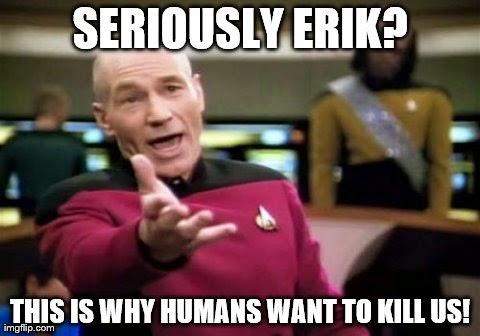
  • MICHAEL FASSBENDER AS MAGNETO: In "First Class", I could feel real sympathy for Erik and even rooted from him, something I never did for Magneto before. In "DOFP" though, while Fassbender continues to make the role his own, you can definitely see that he was becoming the Magneto we see in the original trilogy. To quote Wolverine in one scene of the film "So you were always an asshole." An accurate statement actually, because with the climax scene in the past, you can see that Erik is a fucking hypocrite. He doesn't want to see his species be hunted down, but he's not above hunting down the opposing species, like what he did in "X2" to make Charles kill all the humans after stopping Stryker's plan to kill all the mutants. Maybe if Erik was able to meet his future self, he could have lightened up. I made this meme that I feel is accurate of the situation:
  • JENNIFER LAWRENCE AS MYSTIQUE: What I really like about seeing a younger Mystique is that we see her motivations as opposed to just being Magneto's second-in-command in the original trilogy, which is why I feel Jennifer Lawrence is better in the role than Rebecca Romijn, and even gives a better performance in this film than in her previous outing. You really feel for her, especially when you're really hoping she'll end up doing the right thing.


If there's one breakout star in the film though, it's definitely Evan Peters as Piet-, ahem, I mean Peter Maximoff, better known as Quicksilver. When it was first announced Quicksilver would appear in the film, a lot of people thought Fox just decided to add him in because Marvel was going to use him in their next Avengers film. I didn't expect much from Fox's Quicksilver, given their track record with their character adaptations compared to Marvel's. But I was pleasantly surprised by how much I enjoyed this version. He added some great moments of humor and one of the best action scenes in any comic book movie in my opinion. I really look forward to seeing him return in "X-Men: Apocalypse", especially if they decide to further explore his relationship with Magneto. Aaron Taylor Johnson's performance as Marvel's Quicksilver is going to have to be pretty special to top Fox's.

Just like "First Class", from a first glance, it would seem like there were too many characters involved, but this was another film that was able to make it work, where characters were able to have some shining moments and weren't just thrown in there for the sake of appearances. Even characters that were there for just a cameo didn't feel pointless. It goes without saying that original trilogy actors, such as Halle Berry, Ellen Page, and Shawn Ashmore, haven't missed a beat and personify their roles. Hugh Jackman of course nails it once again as Wolverine. Patrick Stewart and Ian McKellen are able to keep the Xavier/Magneto frenemy bromance alive as well, including an emotional moment during the film's climax. You can even get attached to new characters Sunspot, Bishop, Blink, and Warpath, and feel they're actually worth having in the film.

As the final moments of the film show, essentially, the X-Men franchise has pulled a "Flashpoint." What that means is is that almost everything is fair game again in the series, and you'll get that feeling once you see some familiar characters alive and well. Fox has been able to restart the X-Men but without pissing off people who hate reboots and recastings. I must say that this opens a lot of opportunities for the franchise again. I'm also willing to bet that after "X-Men: Apocalypse", which is supposed to be another "First Class" sequel, Fox's mystery Marvel movie of 2018 will see the original cast return again, but as the main stars of a new X-Men film, possibly acting as the start of a new era in the franchise.

This new X-Men film has done for their franchise what Avengers did for Marvel. It has energized the series, is drawing in a big crowd that may not have been interested before (or in this case lost it), and even teases a villain that casual fans will probably have to look on the internet to find out who that was. All the credit must go to Bryan Singer though. I mean, I knew the film would be amazing, but because it started the way Singer's first two X-films did with a Patrick Stewart/Xavier narrative opening and a pretty badass opening title sequence, it really pumped me up and brought back a sense of nostalgia. Seriously though, Bryan Singer is for Fox and X-Men what Joss Whedon is for Marvel and Avengers in terms of direction of the universe. Considering he's been involved with every successful X-Men film, with the exception of "The Wolverine", Fox would be smart to not let Singer go again if they don't have to (taking his legal situation into account but I won't go into detail on that here).

Along with everything I've talked about, anything that basically says "Fuck you Brett Ratner!" for his derailment of the X-Men franchise in the first place is a win in my book.

RATING: 9.5/10

To close out, here are my current rankings of the X-Men series:
  • X-Men: Days of Future Past
  • X-Men: First Class
  • X2: X-Men United
  • The Wolverine
  • X-Men
  • X-Men: The Last Stand
  • X-Men Origins: Wolverine

Wednesday, May 7, 2014

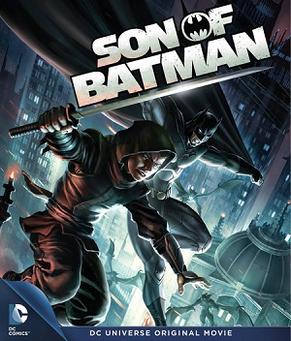
Movie Review- Son of Batman: Double Edged Sword of Ridiculous


When this was announced as one of DC's future animated films, I was kind of surprised, given that after the "Flashpoint" movie, films after that would be based on the New 52, and the "Batman and Son" story arc which was the basis of the film was pre-Flashpoint. Then it was stated that while future films would be connected and based on the New 52, they would still adapt stories from past continuity and work it to fit their new universe. Since the New 52 comics do make references to stories pre-Flashpoint, it made sense that those stories had to happen very differently than how they actually happened. The same argument could be made for the films as well. When the trailer for "Son of Batman" was released, even though they were going to be making many changes from the comics story, it got me very excited, especially to see Damian. While this isn't the first time Damian has been adapted for animation (the first being an episode of "Batman: The Brave and the Bold as being the son of Bruce Wayne and Selina Kyle and having a normal childhood), this would be the first time he would be depicted the way he was in the comics, with his mother being Talia al Ghul and being trained by the League of Assassins. As it turns out though, Damian is the one thing that saves this film.

It goes without saying that Damian isn't your normal kid. Even besides the fact that he's Batman's son, being the grandson of Ra's al Ghul and trained with the League of Assassins, it means he's matured very fast, even more than Bruce after his parents were killed. Damian knows how to fight, hack into databases by NORAD and the Batcomputer, and apparently even how to drive. I remember when Damian first appeared in the comics in 2006 and a lot of fans found him annoying, but it wasn't until he officially became Robin under Dick Grayson's Batman that he started to win people over. When I watched the film and see how smug and badass Damian was for a kid, I couldn't help but enjoy it because I knew how his character would develop. I think that some people who watch this film but don't know who Damian is beforehand may find him ridiculous. Then again, the film really condenses Damian's six year character development from bastard to sidekick to son in less than eighty minutes, so it may make it hard to appreciate him.
Speaking of ridiculousness though, there's one scene I really want to talk about. While searching the lab of Dr. Langstrom, who most fans know as Man-Bat, Batman fights an Ape-Bat experiment, basically an ape with bat wings. At first, I thought "this is really happening?", but then I remembered that this was based on a story by Grant Morrison. If I know Morrison, he would have included something like that if he had the chance. It just seems something up his alley.
Along with Damian though, the one thing that helps this film is the action. It's pretty top-notch and the violence is on par with what was depicted in "The Flashpoint Paradox." The best example I can think of is during the final battle between Damian and Deathstroke, where Deathstroke stabs through both of Damian's arms and pins him to the wall. Damian though, the badass he is, slides his arm straight through the knife, still sticking to the wall, to escape. Even after that, Damian still continues the fight without missing a beat, as if nothing happened. Plus, there's one part where Batman rips off Killer Croc's tail. Given the tail was falling off anyway, but talk about an enhanced interrogation.

That's about where the positive things end. Let me start on the negatives, things that may not bug some, but do me.
In this film, Slade Wilson, better known as Deathstroke, was portrayed as Ra's al Ghul's former right-hand man and was in line to be his successor before Batman came along. Feeling betrayed, Deathstroke gathers his own army and plans to take over the League of Assassins by force. Based on my knowledge of Slade, this makes him look like a very petty man. In all past depictions I've seen of Slade, he either does things for money, being a mercenary, or if he has a personal vendetta. Even though he does have a grudge against the al Ghuls, I doubt Slade would have ever given a shit about the fate of the planet, and wouldn't have even joined the League of Assassins to begin with. If you think about it, Slade would like a world where people still felt the need to hire a mercenary, and that means money for him. It really makes me feel that Slade in this movie is like a child throwing a tantrum because you took his toy or video game away.
Next, apparently in this new DC animated universe, Dick has been the only Robin before becoming Nightwing, meaning Jason and Tim never took the role before Damian. I really just think that's disrespectful to the history of the Robins, but based on past animated depictions, I shouldn't be surprised. Aside from appearances and references on "Young Justice", Tim and Jason have each only been depicted one other time in other media. For Tim, it was "The New Batman Adventures", and for Jason was the "Batman: Under the Red Hood" animated film. I'm just saying, Dick may be the best known Robin, but Jason and Tim are great characters that deserve the spotlight as well. Besides that, the relationship between Dick and Damian in this film is more reminiscent of Tim and Damian from Grant Morrison's actually story, in the way it feels like a sibling rivalry. I always enjoyed how Dick was more like a mentor to Damian in the comics, but you don't get that here. One last note here: apparently even though this is based on the New 52, in this animated universe, Dick still didn't wear pants as Robin and wore the classic Robin suit. While a nice reference, it just doesn't fit in this kind of universe in my opinion, especially since Dick's Robin suit in the New 52 comics was more similar to Chris O'Donnel's Robin suit in "Batman Forever."

Then there's Talia, particularly her character design. Look, I know sex sells, but they really overdid her cleavage in this film. I probably wouldn't have minded it, but you think that with her son around, she'd zip up that jumpsuit at least a little bit. Hell, she even tried to seduce Batman in a dress that showed off her legs and had a "viewing window", and Damian was watching and waiting behind a curtain the whole time before she introduced him. I know Damian's really mature for his age, but a kid should not be looking at his mom in such a sexual way.
Lastly, there's the underwater base cliché. You know what happens? It gets destroyed. Imagine that.

For the most part, the voice cast for this film was pretty good. The breakout star was newcomer Stuart Allan as Damian. Being an actual child, Allan seemed a natural fit for Damian and was able to interact well with Dick, and especially Alfred, who he'd refer to as "Pennyworth" and treated like a servant. Even with Jason O'Mara, who I'm still getting used to as the voice of Batman, had some good moment with Allan's Damian; he actually showed some emotion as a father angry with his son. The one person I thought just didn't fit was Thomas Gibson as Deathstroke. I tried to like him, but compared to Ron Perlman on "Teen Titans" or JG Hertzler in "Injustice", he just didn't sound badass like Slade should. But Gibson just didn't pull it off. I guess I shouldn't have expected much from Greg from "Dharma and Greg."

Unlike "Justice League: War", there was no teaser for a future film. All we get is flashes of the fight between Nightwing and Damian, which wasn't actually shown in the film. It makes me wonder why they wouldn't have just showed the fight. Did they blow through the rest of the animation budget? Besides that though, Ra's al Ghul supposedly died in the film, but like Batman, I was very skeptic, given the nature of his continuous resurrections. A hint that he survived would have been nice. A hint to anything would have been nice. I mean, if I had my pick, the next Batman animated movie would be based on either "Court of the Owls" or "Death of the Family."

While not as good as "Justice League: War", the true animated debut of Damian Wayne really shines in an otherwise forgettable film along the lines of past DC animated films like "Superman/Batman: Apocalypse" and "Superman Unbound."

RATING: 6.5/10

Monday, May 5, 2014

Video Game Review: The Amazing Spider-Man 2 - Edge of Time Redux


In 2012, the release of the first "Amazing Spider-Man" film also lead to a video game based on it. However, unlike the previous Spider-Man movie games, rather than adapt the movie's story while adding in new things, Beenox decided to set the first game after the movie with a whole new story. That was one of the reasons I enjoyed the first game. It had a good story, emotional moments like one between Peter and Gwen, and did a good job at building a universe that I thought could have fit well within the new movie series canon. The facts that Sony gave them a list of certain villains they could use and they asked them to give Spider-Man a belt for his webbing also helped fuel that idea. Not only that, but the controls gave me what I felt was the ultimate Spider-Man experience than ever before. In short, I considered it the "Arkham" of Spider-Man games. When the game based on the second movie was announced, it was said that it would be its own story, and that the games were a separate timeline from the movies. So to clarify that, you have the first "Amazing Spider-Man" movie, then it branches into 2 directions: the movies and the games. It should have been expected though, since characters like Rhino and Smythe were going to be used in the second movie, and their character directions were very different from how they were used in the first game. Given how much I enjoyed the first game, I really looked forward to the second. Unfortunately, it just didn't "wow" me this time around.

First off, I applaud them for working on their own story, and they stuck with it for the most part. However, the one thing I didn't like was how they still decided to touch upon the actual movie plot. Since I played the game before seeing the movie, when it actually used some of the movie's plot, it left me totally confused. When I think about the original movie games, we would actually see moments from those films adapted into the games. In this game though, we only briefly meet Max Dillon, and then the next time we see him, he's already turned into Electro and there's no explanation given in the story. I'll give them that there are audio journals detailing what happened to Max and why he blames Spider-Man, but some people would like to finish the story before looking for collectibles. I think it would have been better if they really tried to keep the game story completely original, and stuck to characters like Kingpin, Kraven, and Carnage as the main villains, and left out Electro and the Goblin. I would have at least liked the allusion of the game being canon with the movies, either as a prequel to the film or a sequel. If they wanted to adapt the film's story, they should have went all out like they have in the past, then we could have gotten more out of the experience.

For the most part, the voice cast was pretty good, but there were two characters that just sounded weird: Kingpin and Green Goblin. Kingpin basically sounds like John Goodman. I'll admit, after seeing him as a drug dealer in "Hangover 3", I could believe him as Kingpin, but Kingpin shouldn't sound like a stereotypical fat guy. As for Green Goblin, based on his actual movie appearance, there was no reason he should have sounded the way he did in the game, when his transformation was more physical than anything else. He basically sounded like Garlic Jr. from "Dragon Ball Z", especially when he laughed. Pretty damn annoying.

Control wise, they didn't really introduce anything new, but at the very least, they overcomplicated things compared to the first game. For starters, the webswinging mechanic has been modified to actually attach to buildings. I'll admit, I liked that aspect, but it took some getting used to use both triggers on the controller when it's always just been the right trigger. Another thing is that whenever you would swing into the building, you had to press a button to actually stick to it. Shouldn't that just be automatic? Then there's the Web Rush system. It was pretty straight-forward in the first game, but in the second, they don't really give you any indication that you're locked on the target you're after, whether it be an enemy, an object you can interact with during battle, or a comic book collectible you can find in the city. It made it really hard to strategize and do what you wanted to actually do. Lastly, the Spider-Sense and dodging system was also complicated. In the first game, you had your basic "white warning", when you could just press the button to avoid being hit, and the "red warning" where you actually had to move to avoid the attack, usually with the Web Retreat button. In this game however, you actually have to move while using the dodge button for every kind of attack, and you have no retreat option. For stealth missions, it made it really hard when you were spotted to get away. I mean, at least in the "Arkham" games, you can zipline to a gargoyle and hide out for awhile. With Spidey's webs, you should be able to do the same. I also didn't like that while you would heal over time in the first game, you actually had to take time to heal yourself in the new one, even in the middle of a battle. There's a real learning curve, but you eventually get used to the updated mechanics, even if they didn't need to be changed in the first place.

Besides that though, it seems like this game has drawn on a lot of aspects used before in past Spider-Man games.
  • With Black Cat, you get the same "Black Cat wants to be with Spider-Man, but not know who he is, but he rejects her because he has responsibilities" plot we've seen before in "Spider-Man 2" and "Spider-Man: Web of Shadows." It gets old.
  • The Goblin fights are part-glider and part-hand-to-hand like in the first movie game, but you can actually ram him into buildings like in the third. I'll admit it was fun to do that part, but it wasn't new.
  • Kingpin has an army with special suits and some even have gliders, just like in "Web of Shadows." Again, nothing new.
  • Like in "Spider-Man 2", you have perpetual crimes to deal with in the city. While it's been updated and features new things like fire rescues, just like "Spider-Man 2", it really gets repetitive, and you're essentially playing to unlock achievements and collectibles and earn enough points to acquire all the upgrades.
While the game continues to build a universe and plays well, the new mechanics and toe-dipping into the actual movie plot of what was billed as an original story doesn't leave the same impression that the first game did. It's fun, but you should just enjoy it for what it is and not expect too much.

RATING: 5.5/10

Sunday, May 4, 2014

Movie Review: The Amazing Spider-Man 2 - Critics Just Don't Understand (SPOILERS)


In 2012, Marc Webb and Andrew Garfield brought about a new beginning for Spider-Man with a reboot film that was just like its namesake: Amazing. With a sequel set even before the first film was released, it showed how much faith the studio had in the new film. Even before the second film was released, Sony even set dates for the third and fourth movies. As Sony released more and more info about the second movie, the more excited I was. The new suit alone was enough to get me excited; it looks like Spidey jumped right off the comic into real life, even more than the suit from the original trilogy. But with that excitement, there was worry as well. Worry that even if they were setting things up for future films, that they were trying to do too much in one film, and that we'd have another "Spider-Man 3" on our hands. The fire of that worry was stoked as a lot of negative reviews started to surface. But even with the negativity, I found just as much positive that gave me some hope. Based on the mixed reaction, it seemed that this film would be this year's "Man of Steel", in the aspect that critics just won't get it. After seeing the film myself, my assumption was correct. While the latest film may divide people, as a lifelong Spider-Man fan, I have never been blown away by film in this franchise like I was when watching "The Amazing Spider-Man 2."

It goes without saying that Andrew Garfield has become one with and embraced his character as his own. His performance in the first film showed that, but the second one makes it all the more certain. The one thing that makes Garfield feel so natural as Spider-Man is his sense of humor. Even through the most intense situations, he would still make jokes that would annoy the villain but also give the audience a laugh. That's something that was sorely lacking with Tobey Maguire's Spider-Man. To put it in comparison, between two movies, Garfield's Spidey probably quintupled the amount of jokes Tobey made in all three of his movies. But it's not just his quips that makes him Spider-Man. Garfield's chemistry with his co-stars shows that he knows how to be Peter Parker as well, as he delivered some good emotional scenes with Aunt May and Harry Osborn. And of course there's Emma Stone as Gwen Stacy. It probably helps that Andrew and Emma are dating in real life, but when I was watching Peter and Gwen together, it feels like I would be watching a real couple. Even with their real life relationship, some credit has to director Marc Webb. Before the first film was released, I watched his previous film "500 Days of Summer", which I really developed a personal connection with, and realized that this guy had what it takes to bring emotion to the Spider-Man films, which is very important. Compared to Tobey and Kirsten, Andrew and Emma make the romance feel real.

But the cast is only half the equation with superhero movies like this. The special effects were top-notch, especially with the way they made Spider-Man move. Like the previous film, Spider-Man just feels more natural with the way he swings and fights. If you looked back on Tobey's Spider-Man and compare, it just seems so obvious that if feels staged and choreographed, that that Spider-Man was forcing himself to act so agile.

Let's talk about the villains now. Yes, there were three in one movie again. After "Spider-Man 3", there's the idea that too many villains can ruin a film. However, I think Webb has one upped Raimi in how to make the idea work. When you look at "Spider-Man 3", you can tell that they were trying to make all 3 villains seem like the main threat, and it ended in disaster. With "Amazing Spider-Man 2", the main focus was on 2 main villains who got their story fleshed out, while the other one was there to help set up the future. I mean, with plans being made to use the Sinister Six, you need to establish you can handle multiple villains, especially when you plan to have six in one movie.
Even then, some critics still complained about the film being overcrowded and that the villains weren't that well developed. I respectively disagree and feel each of them served a purpose.
  • ELECTRO: I understand how some may feel about Max Dillon when he's first introduced, that he's the stereotypical geek who's wimpy and doesn't get respect. But I think it was necessary to see that first before he gets his powers, the way in which was pretty damn cool and violent in my opinion. In the Times Square scene, you really get to see Max snap, and I felt for him. This was a guy who just wanted to feel needed, like he actually mattered to people, and Spider-Man's pep talk really built him up. Though it was a big misunderstanding and he couldn't control himself, Max felt betrayed by someone important who made him feel matter. Potentially, Electro has the power to rule the whole world, but he's usually portrayed as weak minded, and it's what made him easy for Harry to manipulate later on.
  • HARRY OSBORN: While he was only really the Green Goblin for a few minutes, Harry's character development through the movie does make him a villain even without being in costume. Harry became desperate and its what drove him over the edge to become the Goblin. Besides that, there's his relationship with Peter. Despite their awkward reunion at the start, you eventually see them as long-lost friends that pick up where they left off. Then Harry feels betrayed by Peter when he finds out he's Spider-Man, and despite taking away Peter's "hope" (I'll say more on that later), it seems like he really wants to make Peter suffer more, which explains why he would rather form the Sinister Six instead of just revealing Peter's secret to the public.
  • RHINO: At first I was a little miffed when I realized Rhino would end up being the closing villain in the film, but when it actually came to that point, I realized it was necessary. I would have thought including him would have been unnecessary, but it ended up letting the film close out on a more positive note, which I see now as the best way it could have gone.
With the exception of Rhino, I really did feel some emotion for Max and Harry. In fact, I felt more for those two than any other Spidey film before. I think that's a testament to Marc Webb's directing abilities that you can feel so deeply for the villains.

Probably the most important thing about Spider-Man is that he gives people off a sense of hope. That's an aspect that really plays out in this film compared to the others, while it is touched upon at the end of the first "Amazing" film. I myself have always seen Spider-Man in that way, that even with all the crap he goes through, eventually everything will work out in the end and that you'll wind up where you need to be. There's one character in the film that isn't that big of a role, but Spider-Man really inspires him, and it leads to a great moment between them in the final scene.

Now it's time to get to the scene that really made the film for me: Gwen's death. A lot of people speculated it would happen and Sony teased the hell out of it in the previews, but even with all that, it was that scene that made my heart pound, my lungs short of breath, and almost cried, especially when Peter realized what happened. It's something that never really happened to me while watching a movie. I knew it was going to happen but it still made me emotional. And even though I knew he wouldn't, part of me still wanted to see Peter save her. It was a scene that was handled really well, especially since they added the mystery element to her death like there was in the comics. The big question: would it had mattered if Peter's web caught her, or was if the sudden stop that caused her death? It was pretty graphic too; I'll admit I looked down when she stopped. The one thing I didn't like though was that just like the first film with Uncle Ben, we have Peter listening to a speech by his lost loved one posthumously in order to help himself move on.

I did enjoy the way they wrapped up the storyline with Peter's parents. They used the traitors aspect from the comics and made it work in their own way. I didn't even mind the reason Peter's the only cross-species who's relatively normal. At least it wasn't the whole "father did something to his blood and passes it down to his son who got his powers activated later on in life" like they did in Ang Lee's "Hulk" movie. There were rumors they were going to go this route for the first "Amazing", but we should be glad they didn't go that route.

I think it's obvious that Aunt May knows that Peter's Spider-Man. She probably just doesn't want to make him worry about her worrying about him. It's kind of like what they did with Amazing Spider-Man #400. You know, before they made it so that it was an actress hired by Osborn and made up to look like May.

Much like last year with "Man of Steel", despite how much I enjoyed the film, I have been trying to figure out why many critics didn't. I have a few theories:
  • When you think about it, all the other Spider-Man films have been relatively self contained and focused on one villain and critics got used to it. This time though, they took the MCU approach and wanted to help set up plans and characters for the future. While that tactic made critics think that they were using too many characters and stories, when you think about it, it's all connected and OsCorp is the focal point of it all.
  • I talked about before how Spider-Man was really on with the comedy in this movie, but apparently Spidey making corny jokes through the whole movie made some critics consider it campy. Newsflash: SPIDEY IS SUPPOSED TO MAKE FREAKING JOKES. I blame the Raimi films' non-quipping Spidey affecting people's perception.
  • The use of the slow motion through out the movie. Like I said before, this is the most natural moving Spider-Man than any other movie. In a way, the slow-motion was seeing things from Spidey's point of view when his Spider-Sense is activated. Let's face it, if they actually showed those scenes in real time, critics would have complained that things were moving too fast for them to understand what was happening.
I guess the overall complain from some critics was that they actually treated a comic book movie LIKE A FREAKING COMIC BOOK.

But of course, the negative reaction may lead to some repercussions for the franchise. As I've learned, Sony's goal for the film's box office was for $800 million, to make up for the $255 million budget, $180 million for marketing, and still make a good profit. By the look of things, they may not reach their goal. The last time a Spider-Man movie didn't meet expectations, it ended up leading to a reboot. But comic book movies today are different from then. Studios like to plan out the future and build a universe now. Film wise, "Amazing Spider-Man 3" may not be affected, but Sony will probably try to rework their marketing campaign. Besides that, they may have to hold off on their spin-off plans for the Sinister Six and Venom. If they can't bring in a big audience for Spider-Man himself, what hope could there be for the villains? Right now, the focus should be on making "Amazing Spider-Man 3" an overall success as the first film was. In my opinion, if Sony were able to do just one spin-off, Venom would be the best bet. He's already an anti-hero with a fanbase, and Carnage would be the perfect villain for it. Even when it was announced, I thought a movie focusing on the Sinister Six would be a tough sell. You got a team of villains, guys who are supposed to lose. What audience would be interested? While the "Superior Foes of Spider-Man" comic book has received a lot of praise and could be the basis of the film, it still may be best to put that film on the shelf for now.

Spin-offs aside, there's still a lot of potential to be done with the main Spider-Man series and the third movie. Based on the blueprints teasing the Sinister Six line-up, it will include Dr. Octopus, Vulture, Green Goblin, and Rhino for sure, as well as either Black Cat or Kraven, and Mysterio or Chameleon. I can't say for sure about the last two spots, but right now I can only speculate how Ock and Vulture will join up. For Vulture, I think they may use the younger Vulture, Blackie Drago. If Harry's building a team to take down Spider-Man, he'd probably want a young criminal and not an old man like Adrian Toomes. They could still make Drago bald too, like his Ultimate version is. As for Ock, I could see OsCorp sabotaging one of Octavius' experiments and making him believe Spider-Man was responsible, thus giving him reason to join them.
Aside from the villains, we also have Mary Jane's introduction to look forward to. Mary Jane was originally supposed to appear in this film and be played by Shailene Woodley (from "Divergent"), but ended up being cut from the film so they could focus on Peter and Gwen's relationship (which was probably the first clue she was going to die). While Woodley may not be back and the role will likely be recast, I could definitely see Peter meeting Mary Jane and developing feelings for her, but afraid to get close after what happened to Gwen.
This last idea is purely speculation. The third film should introduce the symbiote and black suit, which would lead to Venom as the main villain the fourth. Venom's supposed to get his own movie, so it only makes sense they're planning to introduce him in the main series. I mean, you can't have Venom without Spider-Man first.

So to wrap a bow on this puppy, Marc Webb has doubled down on what made the first Amazing Spider-Man film so great. For some, that means an even better Spidey than before, but for others, well they'd probably feel better watching the Tobey Maguire movies for some reason. Then again, it could probably still win over those still mad about the reboot in the first place. In my view though, to quote Saint Walker, "all will be well" when it comes to what's next for Marc Webb and Andrew Garfield's friendly neighborhood Spider-Man.

RATING: 10/10

Next up will be my review for the Amazing Spider-Man 2 game, which is based on the film. It was released before the movie, but I wanted to hold off on writing about that until I could compare the two, since the game does touch on some movie details while still being its own story for the most part.

Sunday, April 27, 2014

Series Review: The Superior Spider-Man - A Love Letter to Peter Parker (SPOILERS)


2012 was Spider-Man's 50th anniversary, but I don't think any fan expected how it would end. In the 700th and (then) final issue of The Amazing Spider-Man, a dying Dr. Octopus switched minds with Peter Parker, and while Peter tried his best to undo the process, Ock had taken precautions to ensure his victory. However, unlike other body-swapping stories, Octavius was able to access Peter's memories, making it very easy to pose as him, and it was those memories that made the villains see the error of his ways. Before Peter died in his body, Octavius promised Peter he would carry on his legacy and be a better man than Otto Octavius and a better hero than Peter and become "the Superior Spider-Man." It was a concept that divided fans from the start, and even earned writer Dan Slott death threats. How could Marvel make Doc Ock Spider-Man? But like many things, you can't judge something without even trying it, and when it comes to the Superior Spider-Man, it was considered by many, self included, to be the best book at Marvel.

A few issues in, my thoughts on Ock as Spider-Man was that he was actually doing a good job. While Peter started using more tech in his arsenal in recent years, Ock took it even further. For one, I really liked the updates he made to the costume, including the new lenses that could have special functions like a heads-up display and the claws on his fingers that could inject enemies with nanite spider-tracers. Not only that, but for a time, the Spider-Bots patrolling the city gave Ock a real leg-up on crime in the city. And while I'm usually in line with Peter's "no kill" policy, the only time I really saw Ock killing an enemy excusable was with the psychotic mass murderer Massacre in issue 5. Given all the mass shootings in the United States in recent years, it isn't hard to feel a little happy when someone gets what they should, and Massacre did. But I think what made me like Ock as Spider-Man was that he reminded me of Lelouch Lamperouge, the main character from one of my favorite animes, Code Geass. Like Ock, he was calculating and had a goal he would stop at nothing to accomplish. Lelouch even had an army at his command like Ock would starting in issue 14.
While Ock as Spider-Man was fun to read, Ock acting as Peter was very different. To be blunt, Ock made Peter look like a douche on several occasions. The one thing that really irked me was that Ock was upset that Peter didn't have a doctorate that he went back to school to get one.

While Spider-Ock, or SpOck, made an interesting read, what really made this book so interesting is that it was really unpredictable, and even if you think something will happen, Slott turned it into something else. The best example I can think of is issue 9, which featured a mind battle between Peter and Ock for control of his body, and that ended with Ock wiping out all of Peter's memories, and essentially "killing" Peter again. You'd think that would be the point Peter would be back, but nope, it gave fans a moment that would be just as upsetting as what happened in Amazing Spider-Man #700. While fans knew Peter would have to come back at some point, this moment brought on the question of exactly how it would be done. Issue 19 brought about the first clues though.
Another favorite example was SpOck's meeting with Black Cat. The cover to issue 20 showed her trying to seduce Spidey like she always does. What actually happens in the issue though? SpOck punches her square in the face, knocking out one of her teeth, and leaving her for the cops. As you could imagine, she's pissed. That's also example of another thing though. Since we all knew Peter would be back at some point, it would be fun to see how much of a mess Ock would make for both Peter and Spider-Man, and how Peter would have to deal with the consequences of "his" actions.
Other things I didn't see coming as the series progressed were Ock setting up his own headquarters (Spider-Island II) and starting up his own company with Parker Industries.

One of the aspects of the book was the tension of whether or not someone in Peter's supporting cast would figure out something was different with him. While Ock did try to get with Mary Jane, Peter's memories of her actually brought him to call off their relationship to protect her, something Peter would probably have never done. Now MJ got a lot of flak throughout this series for not being able to figure it out, but considering how much Ock ignored her through the book, I can see how she wouldn't have been able to. Then there's Aunt May, who should know Peter best since she raised him, right? But let's not forget, that even as Otto Octavius, Ock was able to charm May into thinking he was a good person. Hell, they almost got married at one point! So, even as Peter, Ock would have been able fool her.
But those are just civilians. When it comes to the other heroes Ock would interact with, like the Avengers. Now I know this series had to last awhile, but Slott kind of made the Avengers look like idiots. I mean, the Avengers did try to find out if Spidey was under mind control or a Skrull in issue 8, but even when those proved negative, they didn't really do anything to follow up on it. Hell, they saw Spider-Man with henchman and piloting giant spider robots, and they were still like "Hmm, he's acting different but I'm sure he's the same guy." Then there was the final part of the "Darkest Hour" storyline where SpOck was using the Venom symbiote but lost control, and when he got free, he acted like the symbiote was what was making him a dick the whole time. They almost bought it, but after they tried to confront SpOck about his actions again, he decided to quit the Avengers and jumped out the window. What do the Avengers do after that? Nothing. They were basically like "Oh, he quit the team. Nothing we can do now." I mean, come on! I really hope that Peter calls them out for being such idiots for not totally realizing he was different for some big reason.

Perhaps the biggest breakout character of the series was Anna Maria Marconi, Otto's classmate at grad school and later love interest. What makes her different in this supporting cast was that she was a little person, which we don't see a lot of in comics. When I first saw her when Otto met her, I was kind of surprised. I mean, as soon as I saw her, I pretty much knew right away she would be his love interest. I'll admit, the idea kind of made me uncomfortable, not because she was little, but that she would be involved with Peter even though it wasn't really Peter. But as their relationship developed, I really started to enjoy it and she became a character I started to care about. Even so, I thought at some point in the series, she would die. Over the course of the series, Ock had experienced a lot of the Parker luck Peter usually would, like not being able to honor some commitments to loved ones or losing his job at Horizon Labs. I thought Otto losing a love interest would have been the last thing he needed to really know what it was like to be Spider-Man. By the end, Anna Maria made it through the series alive. Since Otto is gone now, he kind of leaves Peter with the ball that is the relationship with Anna Maria. It should be interesting how that goes. I'm not sure how many people spotted it, but in issue 27, Otto as Peter was seen holding a ring box, meaning he was planning to propose to her. It's a good bet that Peter doesn't know about that, and I think Anna Maria will find the ring, and that will definitely lead to an awkward moment.

While Ock as Spider-Man was the main focus, there were many moments in the series that featured the newly returned Green Goblin building an army from the remnants of criminal henchmen left unemployed after Spider-Man had taken out their bosses. It would lead to the book's final storyline, "Goblin Nation". In that story, we saw that while Otto, and to some extension I as a reader, thought he was doing a good job, he only made it easier for the Goblin to take control of the city. Besides that, the final story arc brought about a few emotional moments. There was one moment involving Don Lamaze, who was Otto's classmate back when he was actually Otto, but as Peter, he was his grad school teacher. When the Goblin had hacked into SpOck's spider legs and trying to kill him, Lamaze had gotten in the way of one of the legs and sacrificed himself to save SpOck. In his last moments, Lamaze told SpOck that he wanted to make up for his past cowardice from issue 21. In essence, Ock was able to inspire someone to be a hero, which is what Spider-Man was meant to do.
The other emotional moment from this arc, and perhaps the most emotional scene through the whole series, was what everyone expected to happen: the return of Peter Parker in mind and body. When Ock realized both that he had failed the city and that Peter was still alive in his head, he decided relinquish control back to Peter, calling him the true Superior Spider-Man. To do so, Ock wiped out all his own memories, so Peter would have all his wits about him, so that he could save the city, and Anna Maria, who had been kidnapped by the Goblin. While Ock had been trying to play the hero in this series, it was this moment that I felt brought about his true redemption. In order to save the woman he loves, Ock erased all that he was so that a true hero could do so. It was also this moment that made me realize that while I have always related to Peter Parker, it turns out I relate to Octavius in some way too. While talking to Peter, Otto described himself as knowing that he's flawed and tries to compensate (which explains all the tech he's used as Spider-Man throughout the series), and he describes Peter that while he has potential, he always sets himself up to fail. In a way, I'm like Ock because I worry that I'm not good enough for anyone so I sometimes try too hard to be a part of  something. And I'm like Peter because while I do feel like I have potential, and others see it in me too, I'm afraid to fail that I sometimes don't even try. My own life aside, it's cool to see how opposite, but similar Peter and Otto were.
Since the Goblin first reappeared in the book, there was some speculation that it may not have been Norman Osborn since we never saw him unmasked. It wasn't until the final issue that he was unmasked, and it was one of those moments where the unpredictability that always kept readers on the edge of their seats kicked in again. It turns out it was Osborn, but he got plastic surgery and became "Mason Banks" so that he could remain in the public and help set up Alchemax and create a new industrial empire to leave behind for his grandson to inherit. I really like this twist Slott used for Alchemax's creation, because it shows that even in 2099, the Osborn legacy is still a thorn in a Spider-Man's side, the future web-slinger in this case being Miguel O'Hara.

While I enjoyed Ock as Spider-Man for the first 30 issues, the final issue showing Peter back in the driver's seat and in his classic costume made me realize that I did miss Peter, his jokes, and his way of doing things. I love the fact that the instant Peter made a quip that Osborn automatically knew he was dealing with the real Spider-Man again. A lot of people may not get the point Dan Slott was trying to make with this book was that Peter Parker is the one true Spider-Man. Yes, Ock's tactics did gets results, but the final arc showed that everything fell apart because Osborn was able to use Ock's system to his advantage. I wouldn't say Peter's unpredictable, but the way he has gotten things done in story arcs like "Spider-Island" and "Goblin Nation", shows that he is a true hero that will rise to the occasion.

This whole series was the shot in the arm the Spider-Man series needed. While it divided the fan base in the beginning, it eventually won a lot of people over. I really think that anyone who says they didn't enjoy it probably didn't even give it a chance. There will be some who complain that comics rehash old ideas, but then complain when something completely different like this happens. This was the most fun I've had in a long time reading Spider-Man comics. I do kind of worry about things getting stale again with Peter totally back, but I think with everything that happened in the Superior era, it gives me two things to look forward to: 1) Peter will have learned a few things from this experience and work to become an even better Spider-Man than Ock and himself before. 2) Ock left some pretty big messes that Peter will have to deal with eventually.

With that, here are my ratings for Dan Slott's 31 issue "Superior Spider-Man":
STORY RATING: 9/10
RECOMMENDATION RATING: 10/10

Now this is the first of 3 Spider-Man related reviews I have planned for awhile. Stay tuned for my reviews for both "The Amazing Spider-Man 2" film and the video game based on it over the next week or two.

Friday, April 18, 2014

Coming soon: Superior Spider-Man series review

This week marked the end of an era, as the Superior Spider-Man comic book series, which followed Otto Octavius taking over Peter Parker and Spider-Man's body, life, and duties, finally reached its conclusion. I won't be able to get to my comic shop until next week though to pick up the final issue, but sometime after that, I will write about the whole 31 issue series in what will be the biggest review I have undertaken on my blog so far. I'm not sure how I'll go about it yet, but I'll probably take it arc by arc for the most part but will jump ahead to other points of the series for things like story and character development. Anyway, stay tuned.