Thursday, February 2, 2017

Rebirth Review Month Week One: Superman, Wonder Woman, Hal Jordan and the Green Lantern Corps, Aquaman

Welcome to Rebirth Review Month! For those who don't know, this is a series of reviews looking at the eponymous one-shots of DC's "Rebirth" initiative, the goal of which is to reincorporate elements of the DC universe lost in the wake of "Flashpoint" and the New 52 reboot, providing new jumping on points for new or lapsed readers. Last year, I've already reviewed one-shots for series I read regularly: Batman, The Flash, Justice League, Nightwing, and Batman Beyond. But now I have the large DC Universe Rebirth Omnibus, collecting all the one-shots in one place. With five down, this month will be looking at the other sixteen, four each week. All that said, let's begin.


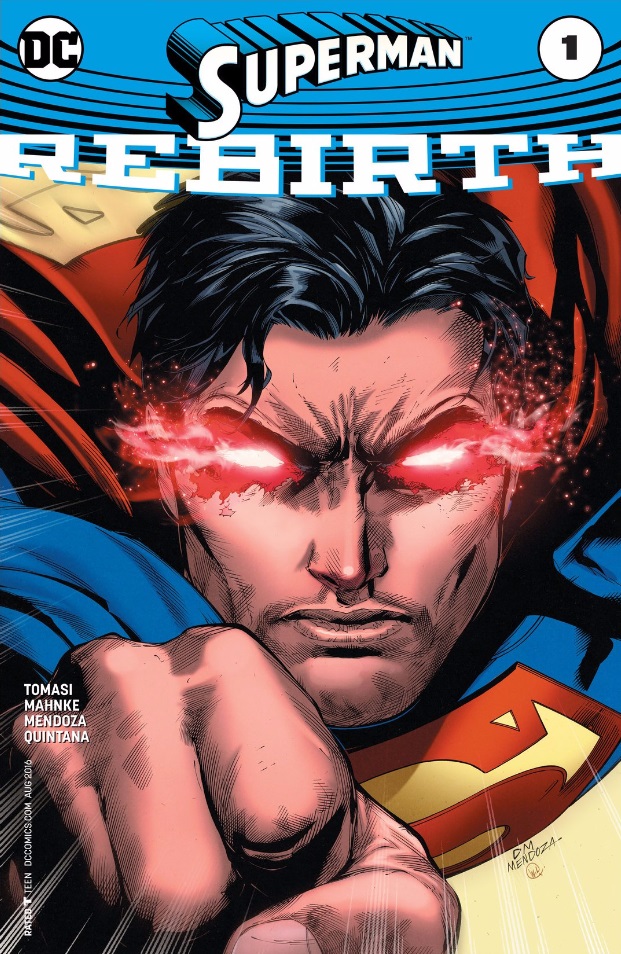
Written by Peter J. Tomasi and Patrick Gleason
Art by Doug Mahnke

One of the biggest aspects of Rebirth was that the Superman of the pre-Flashpoint DCU was returning to the forefront while the New 52 Superman was going to die. For those unaware, one of the repercussions of DC's "Convergence" event was the pre-Flashpoint Superman along with his wife Lois and newborn son Jon ending up on the New 52 Prime Earth, living in secret for years, even before the Justice League formed to fight Darkseid. Until this point, their story had been covered in the eight issue run of "Superman: Lois and Clark". Eventually, the two different Supermen would meet, although it would be unfortunately brief due to the New 52 Superman's untimely death.
Putting the pre-Flashpoint Superman back in the focus along with his family was a great move in my opinion. While I didn't start reading Superman until the New 52, most of my experience with the character outside of comics had been based on the classic version, right down to his relationship with Lois. In the New 52, Superman's main romantic relationship was with Wonder Woman. Since part of Rebirth was reestablishing past relationships lost before, having Clark and Lois together again (a version we're already familiar with to boot) was great. Though I did, for the most part, enjoy the New 52's take on the character, something always felt a bit off. The best story to come out of it was Scott Snyder's "Superman Unchained", which as I mentioned in my review of the story that it had been in the works for years even before the New 52, so it makes sense that it still had a classic Superman feel.
When it comes to Superman's Rebirth issue though, it feels more like an epilogue issue to the "Final Days of Superman" storyline, which featured the New 52 Superman's death. This issue deals with pre-Flashpoint Clark and New 52 Lana Lang discussing the aforementioned death, meeting by accident for the same reason: to retrieve New 52 Clark's body. Pre-Flashpoint Clark tells Lana that her Clark may be able to come back from the dead as he had done and we get flashbacks to his fight with Doomsday way back in the 90's. Unfortunately though, what was used to bring back the old Superman isn't available on this Earth to revive the new one. They both accept that New 52 Clark may be gone for good. Something I noticed that I may have overlooked or forgotten about is that New 52's Superman's Fortress of Solitude included a statue of Jonathan and Martha Kent holding up the Earth next to Jor-El and Lara holding up Krypton, which is a nice touch, and by the end, Clark carves New 52 Superman in between the Kents holding up the Earth.
Like I said, this serves as more of an epilogue, but it features a lot of talking, particularly referring to past and important storylines: "The Death and Return of Superman", "Superman: Lois and Clark", and "The Final Days of Superman". To be fair, the issue does a good job at feeling self-contained and referring to those stories without feeling necessary to actually read them. The art by Doug Mahnke is top-notch as always, especially in his recreation of the battle between Superman and Doomsday.
Much like how I felt about Batman Beyond's Rebirth issue, Superman would have benefited from an issue spotlighting pre-Flashpoint Clark's transition from the bearded black suited secret Superman into the new official Superman in a more traditional suit.
Overall, this issue feels more like an ending than a new beginning, but it's still nice to have the old Superman back.
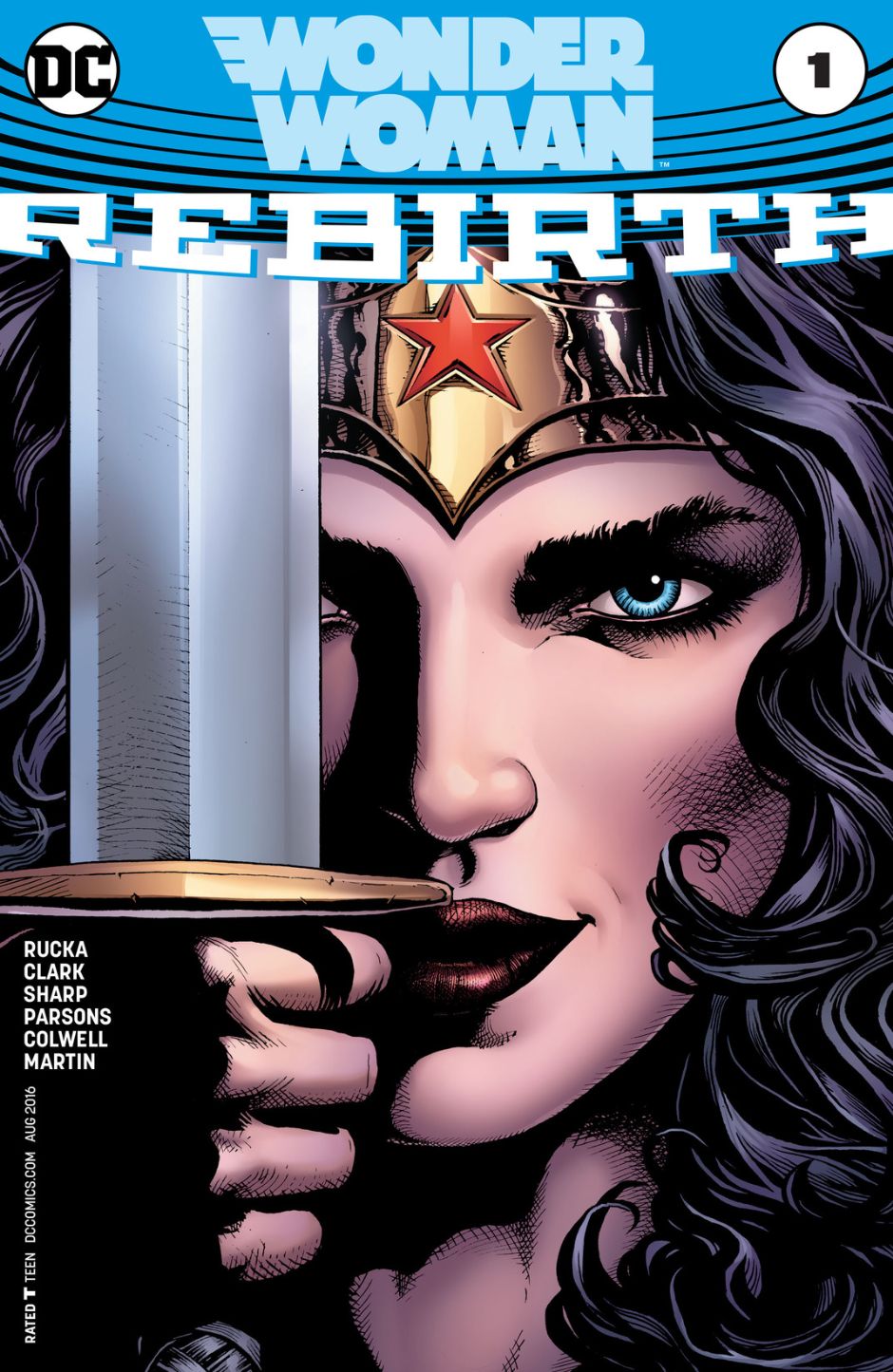
Written by Greg Rucka
Art by Matthew Clark and Liam Sharp

This is the beginning of new territory for me. I've never read a Wonder Woman solo comic in my life, though I am familiar with some aspects of her history. But that's the point of Rebirth, right? To try out things you hadn't before.
This issue focuses on Wonder Woman questioning her past, remembering different versions of her origins. There's the classic version where she was made out of clay and given birth by the Gods, and the more recent New 52 version where she is the biological daughter of Zeus and Hippolyta, Queen of the Amazons. While it's not explicitly stated here, Wonder Woman's existential crisis can probably be rooted to the end of the "Darkseid War" storyline in Justice League where she discovered that she had a twin brother. Her doubts are further founded when she succeeds in crushing the helmet of Ares, which should be impossible. An interesting aspect of the story is that she uses her Lasso of Truth on herself where she discovers that she has "been deceived", but we don't get much more than that. There's a nice touch where in a rage, she smashes a mirror, and in the shards, we see past scenes from not just the New 52, but the pre-Flashpoint DCU as well. She then goes to what she believes to be Olympus, only to be attacked by automatons made by Hephaestus. In the New 52, not only is Diana the daughter of Zeus, but she also became the God of War after besting Ares. Her being attacked, even though she is in all respects "one of [their] own" as she puts it, further confirms deceit has been at hand.
As we know from the proper DC Universe Rebirth one-shot, not only had continuity been altered from Flashpoint, but it had also been manipulated by unseen forces. This is just another example of the old continuity pushing its way through, which raises the question of how powerful this manipulator can be if he can even affect mythological beings as well.
For what's a jumping on point, I feel like it does a good job at presenting the history, or historIES, or Wonder Woman. If you read the classic stories, the New 52, both, or only one of them, you get a sense of who the character is or has been. And if at any point you get confused, then you're right there with Wonder Woman.
If I had to fault this issue for anything, it changes artists for the last third. For the most part it's done by Matthew Clark and then suddenly it's done by Liam Sharp, who would be the main artist for Wonder Woman's solo book following this one shot. It feels a little weird though to have a consistent art style, only to have someone else come on to finish it. However, I will say that there's significance in the change, as Wonder Woman sheds her New 52 costume in lieu of the new Rebirth design (which also resembles Gal Gadot's costume in the DCEU; hooray for synergy!).
Overall, this issue succeeds as an interesting new start for Wonder Woman and makes me excited to pick up the first volume of this series, figure out what the hell's going on with her past, and how it relates to the overall mysteries of Rebirth.


Written by Robert Venditti
Art by Ethan Van Sciver

While I don't regularly follow Green Lantern comics, I've grown to learn much of the lore. That can be attributed to the boost the franchise got in 2011 thanks to the movie and the animated series. Of course, the movie was an overall bomb (though I didn't think it was as bad as many make it out to be), and the animated series, while a critical success, only lasted one season due to the movie's failure and the ridiculous aspect that toy sales were a factor in the series' continuation (that's what also got Young Justice cancelled until recently). In actuality though, it was the Lantern focused "Blackest Night" event in 2009-10 that got me interested in the broader DC universe outside of Batman, and that was before the New 52 reboot. So in some aspect, I owe a lot to Green Lantern.
Geoff Johns had revitalized the Green Lantern franchise starting in 2004, but when he left the book, from what I heard, that specific line of books had taken a dive in quality with endless crossover events. Then in the period between Convergence and Rebirth, trying to figure out DC's continuity became a mess. On the Lantern side of things, the Green Lantern Corps had gone missing after being blamed for acts of atrocity in the universe while Hal Jordan took the blame on himself, becoming a 'renegade' and using an ancient Oan gauntlet, a precursor to the power ring, belonging to Krona, one of the Guardians of the Universe who went bad. Again, I hadn't really kept up on the whole of Green Lantern comics, especially after Johns left, but again, Rebirth was a good time to clean things up.
The issue tells the story on two fronts. Sinestro apparently has control of the planet sized ship of Warworld (which belongs to Mongul) and has traveled to the spot Oa once resided at the center of the universe. I can only assume that like always, Sinestro wants to set up his Corps as the ultimate authority in the universe. An interesting aspect is that Sinestro is using Parallax as the battery to power Warworld.
Meanwhile, Hal Jordan is apparently becoming consumed by Krona's Gauntlet, transformed into a construct and only holding onto himself with his own willpower, constantly reminding himself of who he is (going through his origin story to boot, most likely for the new readers). He also talks about what I did above about how the Corps went missing and he became a renegade. He'll disappear unless he gets rid of the Gauntlet, but he needs it for one more task: combined with his willpower, he's able to forge his own Green Lantern ring, an act that creates a boom heard around the universe by anyone connected to the emotional spectrum, including the missing Corps, the remaining Guardians, and even members of the other different color Lantern Corps. Hal states that only the Guardians could create rings, so I love this idea that with one's own willpower, a ring could be created; I mean, technically he's using another a weapon made by the Guardians to make it, but it's still cool nonetheless. It ends with Hal reciting the oath, becoming a full-fledged Green Lantern again with the goal of finding the rest of the Corps and reclaiming their rightful place in the universe.
As these Rebirth one-shots are supposed to act as prologues to the upcoming series, this issue succeeds very well in that aspect, introducing Hal as the main protagonist, signaling the rest of the Corps as the cast, and setting up Sinestro as the upcoming threat. I guess if there's any villain you want for the first arc of a new era, it's the one who represents the antithesis to our heroes: fear. In a way, this makes me think of how Geoff Johns started on the book; back then, the Corps was gone with Kyle Rayner as the only Green Lantern before Hal Jordan was resurrected and the rest of the Corps came back in tow. This issue talks about the dark times the Corps have been under and we get the sense that things are about to get cleaned up, which means its a good time to jump on if you have any interest in the Green Lantern franchise. It does talk about past events that I mentioned, but for me personally, it doesn't particularly make me want to go back and look at them in depth. It's time to make way for the future with the Lantern's light burning bright once again.
For a final note, I'm glad Ethan Van Sciver was back to draw this. Since he was part of the Green Lantern book with Johns when he revitalized it, so it just seemed right for him to be part of it once again. Besides that, the dude's a really good artist. He even did some work on Batman, but unfortunately kept having to get fill-in art even in the middle of stories, which made it hard to really appreciate them.


Written by Dan Abnett
Art by Scot Eaton and Oscar Jimenez

For some reason, Aquaman has a reputation of being joke hero. He's been the subject of jokes on shows like Robot Chicken (which can be forgiven since that show makes fun of everything) and on the Big Bang Theory when Raj dressed up as Aquaman for a group costume contest, and it didn't help that this costume apparently included a sea horse to ride like he did in the old cartoons. Aquaman wasn't my favorite hero, but I never got the hate. A lot of the ridicule seems to stem from the fact that he talks to fish, which I think is what a lot of people think that's all he does. There's more to Aquaman than that. For starters, he can breathe underwater and he's the king of Atlantis. Come on, that's cool. He also has dense skin (allowing him to survive under water and take more damage than a normal human) and he's super strong (once even giving Superman a punch that sent him flying). But besides that, would you really want to make fun of a guy who can summon sharks to eat people?
Again, Aquaman isn't a character I really followed closely in the comics. From what I heard though, when the New 52 began, they decided to take the idea of him as a joke to the public and apply make it canon in a very meta way. Aside from that, apparently Aquaman has had a tough time being accepted by both humans and Atlanteans, being he's a half-breed. Going into Aquman's Rebirth issue though, I wasn't exactly sure what would be new or different from before. What I found though was very basic.
The main antagonists of this issue are an Atlantean terrorist cell known as the Deluge, who Aquaman is trying to stop from using Fusion Bombs against the surface, as Aquaman is trying to build bridges between the two worlds. Aquaman's battle is being watched at an Atlantean embassy on the surface in Massachusetts by Mera and a few other Atlanteans (including Garth/Tempest). One of the guards takes note that "Our king fights his own people to spare the dry-landers", to which Mera replies that they are terrorists and not their people. After defeating them, he goes to eat at a nearby restaurant that he apparently frequents and is joined by Mera. All the while, we have a narrator throughout the whole issue talking about Aquaman, his upbringing, the perception of him by Atlanteans and humans (both being a joke and a menace), and his relationship with Mera. Though we do learn that his power to talk to fish is more of a mental command, like a Jedi mind trick of sorts. The narrator is then revealed to be classic Aquaman villain, Black Manta, vowing to destroy every aspect of his life, starting with Mera, who he believes lightens the burdens Aquaman carries. It's not a bad plan. If we learned anything from the Flashpoint universe, kill Mera and you get an Aquaman with no sense of morals. While it's still early to find a pattern, between Sinestro and Black Manta, they seem to be bringing in the well-known villains for a series' latest relaunch, which was the opposite of when the New 52 began with introducing brand new villains.
Like Wonder Woman's issue, this is a book with two artists, and it really hurts the flow in my opinion. For the most part, it's drawn by Scot Eaton, who does good but nothing special. But the weird thing is that the issue's first three pages and last two are done by Oscar Jimenez, and it's kind of bad in my opinion. While I'm not that familiar with his overall work, I get the sense that he's one of those artists who adds to much detail and ends up making it look messy (like Joe Quesada), especially in the faces of both Aquaman and Mera. I do give him props on his full costume shot of Black Manta on the final page though. But art styles aside, I don't understand how or why they structured the art this way. It's not even like when Wonder Woman's book changed artists because there was significance, or even a chapter break of sorts.
Like I said before though, it's very basic. If you never read Aquaman before, this would be a good starting point for you. But if you're familiar in any way with him, you really get nothing new here. He's the king of Atlantis, he's half-human, wants to keep peace between the two worlds, and Black Manta hates him. Unlike the other one-shots I've reviewed thus far, nothing is introduced that adds to the character or the overall mysteries of Rebirth. I'll still be getting the first volume of this series, but at this point, I don't really have any expectations.

Next week, we deal with an emerald archer, a half-robot, a couple rookie space cops, and a team of young heroes.

Monday, January 2, 2017

Comics Review: Civil War II - The Death of Marvel Events (SPOILERS)


The original "Civil War" event in 2006 is one of Marvel's most popular and well known events. Like the heroes of the story, readers were asked to choose a side on the divisive issue of superhero registration with the government, with Iron Man leading the supporting side against Captain America's opposition. But what some may not know or remember is that at the time, the story was controversial and received much criticism. Among Spider-Man's public unmasking (which put the character on the road to his character assassination in "One More Day") and the abrupt ending, one of the complaints toward the book was its depiction of Iron Man and how he was leading the Pro-Registration side. He made a clone of Thor, used mind controlled supervillains, and even locked up his (former) allies in the Negative Zone without due process.
So what makes "Civil War" more liked now? I have a few theories. First, the overall divide of the heroes and stronger government oversight wouldn't be resolved until the "Siege" event in 2010, so it might be an issue of being better in hindsight knowing things do work out eventually. Secondly, even if people didn't like its execution, the overall idea was brilliant. But I think the main thing is that it's had time to perfect itself. The "Marvel: Ultimate Alliance 2" video game of 2009 adapted the storyline, and while it did follow the comics closely, there were some changes, mainly the ending, that improved on the story. And of course most recently, we had "Captain America: Civil War", what many consider to be the best Marvel film yet. In my opinion, it finally succeeded in what the comic set out to do in portraying a conflicting issue and making both side appear to be right and wrong depending on your own views.
As the film was about to be released though, Marvel decided to launch a new comic event in conjunction with, what else, "Civil War II", written by Brian Michael Bendis and drawn by David Marquez. A comic story coming out to tie in with a movie is nothing new (pretty much every year a Spider-Man movie came out also featured a comic story involving the film's villain), but never before had one been done in the vain of a line-wide crossover. It can be most certainly seen as a "cash-grab", but that didn't mean there couldn't be a good story to come out of it.
"Civil War II"'s conflict centered around a new Inhuman, Ulysses, who has the ability to see the future.

(No, not that guy. That would have made this a lot more fun.)
This divided the heroes on how best to use this power, with Carol Danvers/Captain Marvel wanting to use the power to prevent crimes before they take place, opposed to Iron Man believing punishment shouldn't come before a crime. Even before the series started, I found myself on Iron Man's side, because if I've learned anything from other stories in trying to control the future, 1) trying to prevent a certain event could actually lead to it happening, 2) changing the future could have unintended consequences, and 3) preventing something bad could actually lead to something worse later on.
So ten years after the original "Civil War" and knowing the mistakes that were made, surely Marvel had learned from the past and would come out with a superior sequel, right?

We'll go through this issue by issue of the main stories, pretty much ignoring tie-ins unless they're relevant and I'm aware of certain events.
The first issue begins with the Avengers battling a giant Celestial in the middle of New York and it isn't going well until back-up arrives in the form of almost every Marvel hero you can think of, with the magic users combining their powers to transport it away. A celebration party occurs afterward with Tony and Carol thanking the Inhumans for giving them warning of the threat right down to the specifics. It's here that the Inhuman Queen Medusa introduces them to Ulysses, who explains his power to see the future. What's interesting is that he's apparently immune to telepaths, as Jean Grey attempts to project his story mentally to the others but is unable to. While Carol is offering Ulysses to come work with her and the Ultimates, Tony isn't so accepting, questioning the accuracy of his predictions and the morality of acting on them, essentially setting up the conflict of the series. Some time later, Ulysses has a vision of Thanos looking for a Cosmic Cube on Earth and relays the information to the Ultimates to try and stop him. It goes array though with War Machine being killed and She-Hulk laying in a coma in critical condition. Tony, already irate over Rhodey's death, becomes even more upset when he learns of Ulysses' involvement in the events.
Like with most Marvel events, the first issue is basically set-up and shows promise with the series. But again, that's the case with most Marvel events. It's how it goes after that that matters.

Issue two begins with Tony, acting on emotion, invading New Attilan and kidnapping Ulysses, fighting off some Inhumans along the way. The Inhumans declare this an act of war and even consider bringing down all of Stark Tower before being talked down by Captain Marvel to get a more peaceful situation.
So this is another reason I don't really care for the Inhumans in the comics. A kidnapped citizen equates to destroying a building in their minds. They're just so uppity and detached from the rest of society. It makes it less relatable. I'm not saying Tony was right in what he did, but he's not in his right mind to begin with after losing his best friend. I don't think he needs to be demonized for his actions like I've seen people do online.
Tony has taken Ulysses to a secret facility of his to scan his brain and figure out his predictions work. The Avengers and Ultimates then burst in to get Ulysses back and chastise Tony for his actions, which leads to another argument between him and Carol (get ready for A LOT of those). Amidst the tension, Ulysses has another vision, which he is able to project into the minds of every other hero there: a savage Hulk standing over the bodies of fellow heroes with the city burning in the background.
This leads to issue three, where Carol and Tony coming to Bruce Banner's secret lab bunker, asking him to come outside, where he's greeted by even more heroes and a few Quinjets. They begin to explain the situation to a nervous Bruce, who as expected, begins to get agitated, which leads to probably the most controversial moment of the series: out of nowhere, Bruce is impaled with an arrow to the head in mortifying fashion (with a panel of a tear dripping from his eye as he lays dead on the ground), shot by Hawkeye, who surrenders himself to be arrested. At his trial (where he's found not guilty), we find out that Bruce had entrusted Hawkeye with a special arrow to kill him if he ever lost control; at the time of the murder, Hawkeye claimed he saw Bruce's eyes begin to flicker green, which is when he fired.
Oh where to begin with this. I guess first off, the death of a character had already been teased going into issue three, and it was clearly going to be Banner. Now I'm not that upset with death in event comics; it's pretty much a given by now. My problem though is that this case was poorly executed (no pun intended). A hero's death is supposed to be a shining moment where they lay their life on the line for the greater good. Bruce's death, if anything, was anti-climactic. The death aside, the WHOLE situation could have been handled better by the heroes involved. First off, when has trying to keep Bruce from Hulking out or placing him in lock-up EVER worked out? But more importantly, they didn't have to come at Bruce with every hero in tow expecting a fight. Tony and Carol should have just gone to Bruce on their own, explain the situation, and at least have everyone standing by ready to step in if they had to.
It was by this point that I pretty much knew how the rest of the book was going to be. Tony's reaction when blaming Carol for both Rhodey and Banner's deaths pretty much said enough, especially since she was going to keep using Ulysses' powers anyway; "Who's next on your hit list, Danvers?!" It's not a bad question considering trying to work on his predictions has lead to two heroes' deaths at this point. Believe me though, it gets worse storywise.

Issue four begins with Carol going to see She-Hulk, who has just woke up from her coma, and has to tell her the bad news about Bruce in what has to be some of the worse dialogue I've read in a comic.
CAROL: It's Bruce, Jennifer.
SHE-HULK: Bruce Banner? My cousin Bruce Banner?
CAROL: He's--he's gone.
SHE-HULK: He left the planet again?
CAROL: No, Jennifer. He's--dead.
SHE-HULK: No.
CAROL: I'm sorry.
SHE-HULK: He's not. He's the Hulk.
CAROL: I'm so sorry, Jennifer.
SHE-HULK: How?
Okay, first off, it felt like they had to make it clear that Bruce and Jennifer are cousins in case some people didn't know. I almost expected She-Hulk to continue by saying "Who is also the Incredible Hulk? Created by Stan Lee in 1962?" But more importantly, I got no sense of emotion here. She just found out her cousin died and we don't even get an "Oh God. No." It's treated like she's finding out her phone doesn't have a signal. Also, notice Carol left out the fact that Ulysses was involved in what lead to Bruce's death.
But now for the real meat of the issue. Tony displays his findings from scanning Ulysses mind to Danvers, as well as other heroes including Beast, Medusa, and Steve Rogers. Tony has discovered Ulysses takes in energies from around the world which leads to his mind calculating a probable future, but not THE future. "It's profiling. It's profiling our future. And by Carol acting on it as if it were the bible...she is, by any definition, profiling individuals [...] She's betting on the math being absolute. But...it's not."
With this information given, Danvers says she wants Beast to look over Stark's work. Beast already has, and he agrees. So what does Carol do now that Stark has hard evidence that Ulysses' visions aren't concrete and that theory is backed up by Beast? THE SAME DAMN THING SHE WAS DOING BEFORE. This comes back to bite her though, as when she acts on one of Ulysses' visions to apprehend a possible HYDRA agent, they find no hard evidence on her. She's taken into SHIELD custody, where even a psychic evaluation finds nothing on her. Carol then goes straight at her, accusing her of working with HYDRA and wanting a confession, claiming she can hold her indefinitely. It was at this point I felt Carol had gone too far. She has such blind faith in Ulysses that she can't admit he could be wrong, even when the fact is staring her right in the face, and verified by on-hand psychics. At this point, it seemed this wass more about making sure Tony isn't proven right...and given some secondhand knowledge I've been told about in a tie-in issue of "Ms. Marvel", making sure Tony isn't proven right ACTUALLY IS part of her thought process. What a hero, am I right, folks? I really couldn't understand how anyone, characters or readers, could be on her side at this point.
Thankfully, the woman is saved by Nightcrawler, who teleports in and gets her out of the Triskelion. Tony and his team have arrived and it's here we get the face-off between the two sides of heroes.
We get a clear indication of who's on whose side, although it would have been nice to know the reasoning for these characters without having to read the tie-ins. In the original "Civil War", it simply came down to how the heroes felt about the Registration Act. Here, we can probably just assume it's due to blind faith in Carol or respecting Tony's analysis of Ulysses' mind. But there could also be the emotional factor and seeing firsthand the danger of Ulysses' visions, because back in issue three following Banner's death, Miles Morales/ Spider-Man, Ms. Marvel, and Nova all immediately declared themselves to be on Iron Man's side.
As the issue wraps, Carol's back-up arrives in the form of the Guardians of the Galaxy, leading into the huge superhero melee for issue five.

As the battle begins, there's something to note on this double page spread:

Old Man Logan, the Wolverine of alternate dystopian future, is shown on Iron Man's side. First off, you'd think the character from a bad future would want to use Ulysses' powers to avert it. And you'd be correct, as the X-Men tie-in series to "Civil War II" shows Logan, Storm, and the rest of the Extraordinary X-Men team (except Nightcrawler, who defected) siding with Carol in hopes of building bridges with the Inhumans. I don't know if this error was on the writer or artist's part, but it bothers me.
Something else to note in that double page spread is Tony and Carol basically going "This is all your fault!" "Nuh-uh! It's your's!" This is an UNBEARABLE constant for pretty much the whole story. Aside from that though, the battle in this issue is pretty entertaining from the different character interactions and action moves.
Something I wondered about at the end of issue four is how the Guardians could really pick a side here when they've been off-world until this point, and apparently going off Carol's word since she's been a Guardian as well. Well that apparently is the case as Star-Lord refuses to listen to Stark.
TONY: Did Danvers explain to you that these future-visions are just algo--
STAR-LORD: I know all about them. I think they're great.
You know how some people have an opinion on something even though they don't know all the information about it? This is one of those cases. I'm not done on Quill yet, but we'll get there.
The battle rages on as Ulysses looks on from the shores of New Attilan when he receives another vision which he projects across the waters to all the heroes, showing Miles Morales having killed Steve Rogers on the steps of the Capitol. Everyone stops fighting and stares at Miles, visibly distraught and falling down to his knees. Only Ms. Marvel comes to his side to comfort him and ensure him that him killing Rogers would never happen. And what does Carol do? She tells the teenage superhero he is under arrest for a crime he has not, and for all intents and purposes would not, commit. It's like this comic is straight up going out of its way to assassinate Carol's character.
It was at this point that I began to question Ulysses' mind-set through all this. This kid's visions have resulted in the deaths of two heroes and caused another civil war among the superhero community. How does he feel? Does he care? But not only that, it seemed suspicious that he would have his visions about Hulk and Miles during times when the heroes were arguing/fighting over him. On one hand, you'd think knowing he's responsible for all this would make him want to remove himself from the situation. But then there's the thought of if there's something more nefarious going on here. Unfortunately, none of this gets explored. What ends up happening...well we'll get there.

Issue six begins with, you guessed it, more arguing between Carol and Tony. Even though she just said Miles was under arrest, she tries to backpedal and say they want to put him in protective custody. But in an actually nice moment involving common sense in this series, Steve steps in and talks with Miles himself.

Carol protests that they shouldn't let Miles go, to which Steve responds that Miles didn't do anything wrong, just like Banner and Rhodey, essentially calling her out on her shit. Thor then carries Miles off as Carol continues to protest, who is then stopped by Ms. Marvel, who idolized Carol and even took her old codename (never meet your heroes, right?). "He's my friend. He didn't do anything."
Black Panther then speaks up and also calls Carol out on her shit and switches sides. "I can no longer defend any of this. [...] I have grown more and more uncomfortable with my part in this. And long ago I learned that if you are on Captain America's side...you can rest easy knowing you are on the right side. And if he, even after we have all experienced, would choose to protect that child Avenger's right to be...then that is what I should have been doing this entire time." This buys Doctor Strange enough time to charge a spell to teleport everybody on Tony's side away to one of Nick Fury's old secret bunkers. Even the Inhumans leave instead of helping Carol go after them (it's more about going to check on Ulysses rather can having enough of her shit though).
The rest of issue six is mostly talk. On Carol's side, Star-Lord assures that's he's still on her side. "If you can stop something bad from happening, you do it. Boo-hoo if someone gets their feelings hurt." Yeah, who cares if people needlessly have to die or can just be imprisoned without hard evidence or having done anything at all? Quill, you seriously haven't been around to get a bearing on the whole situation, so please shut up. Carol and Storm even talk shit about Panther. "I can't believe you were married to that man, Ororo." Yes, how dare someone change their opinion from your own on something after acquiring sufficient knowledge to do so? Christ, when it comes to Carol's side, there seems to be a limit on how much they need to know and feel about the situation or they wouldn't be there at all. Not much happens on Tony's side other than a plug for the next volume of "Invincible Iron Man".

Issue six ends and seven begins with Miles standing on the steps of the Capitol and has a brief encounter with police before they're radioed to stand down and disperse (we learn later on Carol's orders) before he's stands face to face with Steve Rogers. They're both there hoping to prove that the vision doesn't happen. It's a pretty good interaction between the two, with the living legend and the rookie, both trying to figure out what to do in their current situation.
Elsewhere, the Inhumans try to communicate with Ulysses, who is lost in a trance. In actuality, in a kind of body experience, Ulysses is transported into the future (the one from "Old Man Logan" it appears) and encounters an older Logan. Asking what happened, he discovers that the Inhumans had left Earth and Stark had pushed "her" too far. He doesn't find out the identity of "her" as he's pulled back to the present, but it can be assumed to be Carol. What's interesting about these future segments is that they're done by a different artist, Andrea Sorrentino, who is the current artist on the current "Old Man Logan" book, which is a nice touch to keep with continuity among the line.
Back at the Capitol, Carol arrives and tries a more gentle approach (yeah, imagine that), but still wanting to put Miles in protective custody. Did it ever occur to her that maybe she should put Steve in protective custody instead? He's the one in danger, and usually you would put the person in danger of being killed under protection. But despite Carol's more gentle approach, Stark arrives in a giant armor (think of a cross between War Machine and Hulkbuster) and creates a forcefield around Miles. Stark and Carol begin to argue and fight (again) like the short-fused brats they've been the whole story as the final battle begins.
While I've been on Tony's side the whole story, this is the part where I can see him going too far, about on par on when he kidnapped Ulysses in issue two. While he began his crusade from an emotional response to Rhodey's death, for the most part, he's approached this from a logical standpoint, even figuring out how Ulysses' visions work. But in this instance, he definitely went gung-ho when a calm discussion should have occurred. Of course that would be too boring for a comic. But another way to look at it is that Tony's motivated by emotion rather than logic once again. War Machine and Hulk, two veteran heroes, have already died as a result of Ulysses' visions. Tony would rather put himself on the line rather than let a young rookie like Miles be the next to be killed based on that track record, and that's what makes him the true hero of this story in my opinion.
Issue seven ends with Carol delivering a massive, life-threatening energy punch right in the center of Tony's armor.

It should be noted that originally, this series was going to be seven issues, but was extended to eight to give a better conclusion. That said, issue eight begins with Tony still in the fight as the battle continues with Carol. So it's clear that the end of issue seven was done just to be a cliffhanger for the final issue, making us think Tony may have been killed going in. This was just clearly a case of creating drama when it wasn't needed all because they decided to split the final issue in two, when a longer book would have sufficed.
So Carol and Tony continue to argue and fight, and at this point, it's just not fun anymore. Everyone from Steve, Miles, SHIELD, and the Inhumans try to talk some sense in them to end the fight. Hell, Steve even gets knocked out by some of Stark's rockets after Carol dodges them. Eventually, Carol obliterates the armor completely, leading to Tony free-falling, getting caught by Miles after Karnak breaks him free from Stark's energy field.
But here's where things really jump the shark. Ulysses, enveloping the other heroes in his vicinity, has multiple visions. This leads to eight splash pages (seven of them unlettered), done by seven different artists. After all that, Eternity, one of Marvel's cosmic characters (who I had no idea who it was in this story until I looked it up), appears before everyone, telling Ulysses he has shown Earth all he can, that he's part of a greater universe, and asks him to join "them" (whoever they are). Ulysses goes with Eternity and leaves everyone behind. Apparently Ulysses' powers had kept evolving until they reached a cosmic level to the point where he could hang out with other cosmic entities like Eternity. As for the visions, I'm guessing these are teases for future Marvel events or just many possible futures. Honestly, it's not clear and it's really confusing, especially the Eternity thing. It really just seems out of place in what until now had been a pretty straightforward, somewhat grounded, but still infuriating, story.
In the aftermath, upon inspection by Beast, we find out Tony has gone into a coma, thanks to experiments he had been doing to himself, essentially saving his life and keeping his blood off Carol's hands. Carol still can't let it go as she says "I didn't start this." (Um, yes. You kind of did.) Beast then explains Tony's reasoning that if he didn't stop Carol using Ulysses then, he would have had to stop someone less noble later on. Maybe that's something Tony should have lead with and avoid this whole thing. On the plus side, she finally admits that Ulysses' visions were A future.
In the final scene, Carol meets with the President (covered in shadows as Marvel usually likes to do, though we can assume it's Obama) to discuss the future of the superhero community. We get a two page spread of multiple panels that are basically teases for the post-Civil War II books (including an as of yet announced Defenders book starring the Netflix heroes). But the main point of this is that the President wants to fund Carol, because she apparently handled everything with "incredible grace", so she can build a better future for the superhero community and the country.
I'm going to be honest: after reading this last issue, I threw the book across the room. Eternity taking Ulysses away to wherever was one thing, but what really pisses me off is that Carol gets a free pass and the President's approval. While the deaths had been played out by this point in the series, they should have just killed Tony. Hell, you could argue what Carol did WAS attempted murder. Then again, it would probably be considered self-defense since Tony started this particular fight. But I could tell Carol was so full of rage and using her full strength that I wouldn't past her going for the kill rather than just incapacitate Tony. But after everything that happened, I just can't believe that Carol faces no repercussions for her actions (again, the woman they accused of being a HYDRA agent without evidence is never brought up) or that she can be made the face of the superhero community when I doubt half of them even trust her anymore.

I hate to borrow Linkara's catchphrase again, but THIS COMIC SUCKS! For an event done just to be a cash-grab for the movie, it actually feels a cash-grab for the movie. But it didn't have to be like that. It suffers from the same problems the original "Civil War" did, but this time resulting in an even lower quality. As Carol's essentially made to be the villain like Tony before, she's way worse. Where Tony's previous actions could be seen as "the ends justify the means", Carol was acting on blind faith and not listening to any logic. In both cases though, they failed to make both sides seem right and wrong. This makes me think that in these situations, two writers should be on the project to balance things out. Where the original "Civil War" was relevant for its argument of "freedom vs. security", I don't believe "Civil War II"'s use of profiling hit its mark, or it was at least overshadowed by how the characters were acting. And while one would expect the main draw of this book to be multiple superheroes fighting each other, we only get the one huge battle in issue five, whereas the rest of the story is focused mainly on Carol and Tony's squabbling. You can argue the film only had one huge battle with the main focus being on Steve and Tony, but it had a much smaller cast with each character having some reason to be there instead of just for the sake of it like this comic.
I've began to notice that every time I review a comic by Brian Michael Bendis, the previous ones being Age of Ultron and Ultimate End, they're some of the worst things I've ever read. When it comes to Bendis, his writing is usually hit and miss with me. He does have good stuff, but apparently I keep picking his crap work to write about. (Note to self: find a good Bendis story to do a Retro Review on.)

Something that really hurt this book though were the delays, especially with the extra issue added on. By the time the final issue came out, the aftermath books had already been coming out for three months, although they were careful to not spoil the book's finale. But by this point, people were just waiting for it to end for ending's sake. Before the series ends, we already know nothing happens to Steve or Miles, which was the main focus of the last third of the series, although there was some mystery about where Tony was and if he was dead or alive. This is the second year in a row where post-event books began before the actual event ended. The difference is "Secret Wars" was still good. My point is, if Marvel doesn't care to finish their events on time and decides to put out the aftermath books anyway, why should we as readers care, either? As someone who's always wary going into Marvel events (especially when there's usually a never ending onslaught of them), I now question whether it's worth picking up issue by issue or wait to get the trade if it's any good.
If I had anything positive to say, the art was still nice (but that doesn't help the story), along with the other good moments I mentioned before.

From a story perspective, I give it a 4/10 in that they had an interesting concept but bad execution, especially with the finale. As for whether I'd recommend this to anyone, that's a big 0/10. This series was just infuriating, especially if you're a fan of Captain Marvel, Hulk, or even the Guardians of the Galaxy (even though they have little bearing on the plot). Who knows though. Maybe they can perfect on this story by adapting it into a video game and then a movie...except as I explained before, "Civil War II" just doesn't have the same appeal as the original.
Overall, avoid this like the plague and you'll have a much brighter future, and I don't need powers to know that's right.

Saturday, December 17, 2016

Video Game Review: "Batman: The Telltale Series" - A New Kind of Knight


Ah, my first video game review in over two years. The reason for that is that I don't play as much as I used to. I only got one video game in all of 2015, Arkham Knight, and there was just so much to process that I couldn't really put it in words, not to mention it was really a slow year for me. Next year will pick up for me though in the games department with new sequels to Injustice and Marvel vs. Capcom. But let's focus on today's game.
What may surprise people is that for the longest time, I've completely avoided online gaming, even when it came to DLC. Part of the reason is I didn't always have the best connection and I thought that DLC wasn't important enough if it wasn't already available on the physical disc. It wasn't until I got my Xbox One, which required an internet connection, and the Arkham Knight expansion pack came out that I finally gave in.
Which brings us to "Batman: The Telltale Series". When it was announced, I didn't really care since it was an online game. But when they announced a season pass disc, I thought I'd give it a shot. I'm a guy who prefers to physically own things rather than digitally; comics, movies, games, you name it.
For those who don't know, Telltale Games creates what you would call "choose your own adventure" games, where choices you make along the way impacts what happens later on.
Knowing this, going into this Batman game, I expected something like the Arkham games but with less button mashing. After getting the game back in September and just finishing the season finale this week, I have to say that if you're looking for a new kind of Batman experience, this is right up your alley.

First off, some key aspects of Batman's history get turned upside down in this series. So if you're well knowledged in that department, best forget that with this game (or remember and be prepared for some surprises). I kept expecting one specific twist that I won't spoil to be revealed as a hoax by the end, but it doesn't. In that respect, I give props to the story writers for taking such a twist, and adding an extra layer to this version of Bruce Wayne, as well as how it relates to the game's main villain. Coincidentally, while this isn't an Arkham game, the Asylum still plays a major part. I guess if it ain't broke, right?
I will talk about a few characters in how they've been re-imagined though. First off, Oswald Copplepot, AKA Penguin. This version is a lot more slender and is able to put up a fight than what we're used to; he even wears a penguin mask, which may sound ridiculous, but actually works within the context. He's also a childhood friend of Bruce; the comics, and even the Arkham games, have referenced before about a relationship between the Waynes and Copplepots, so the two being old friends is a nice addition.
At one point in the game, Bruce ends up in Arkham and interacts with three well-known Batman villains: Zsasz, the Ventriloquist, and as you probably expected, the Joker. Apparently though, Bruce has not had any interaction with any of them, or if he has as Batman, is just playing dumb. That applies to Zsasz and the Ventriloquist, but with this version of Joker, he has yet to make a name for himself, only being known as "John Doe", and appears to be a model patient, despite his eccentric behavior and nihilistic views. I guess it's plausible for Joker to lay low before making his public debut, but it does kind of feel weird to see him interact with Bruce in Arkham and knowing his fame isn't preceding him. I prefer to see Batman's villains as a response to the hero's presence in Gotham.

The voice acting is pretty top notch in the game, many of whom I recognize from various other projects. Bruce/Batman is voiced by Troy Baker (Joker in Arkham Origins, Hawkeye in Avengers Assemble), Selina Kyle/Catwoman is voiced by Laura Bailey (Kid Trunks in Dragon Ball Z, Black Widow in Avengers Assemble), Harvey Dent is voiced by Travis Willingham (Thor in Avengers Assemble, Roy Mustang in Fullmetal Alchemist), and Penguin is voiced by Jason Spisak (Razer in Green Lantern, Wally West in Young Justice). Other characters like Alfred, Gordon, and Vicki Vale also have some good voices behind them. Joker's voice, provided by newcomer Anthony Ingruber, is...interesting. It might be that it's hard not to compare anyone who voices Joker to Mark Hammil, but Ingruber's Joker is a different take, reminding me of Michael Emmerson's in the animated Dark Knight Returns adaptation. It would have been nice if Troy Baker had provided the voice again, but given how much the game deviates from the Batman norms, how it was done probably for the best.

It should be worth pointing out that this game has an M rating, which it rightfully earns. Right off the bat (no pun intended), a security guard is shot right in the face with blood splatter to boot, and it doesn't end there. Given the game's stylistic approach similar to that of a comic book, showing more graphic imagery goes right in line with that, much like DC's animated film line has done. This also makes for some pretty intense fight scenes. While they're only quick time events (as in having to push the right buttons at the right time) as opposed to direct combat in the Arkham series, the gamemakers did a great job at immersing the players into the situation. It made me feel like I was Batman, and that if I didn't act quickly, who knows what could happen. The final battle of the game probably the most epic out of all of them.

But let's get right to what makes this game so unique: choices. It's this aspect that makes the Telltale Series better than the Arkham games at least in one way. While the Arkham games are pretty much a straight path (aside from having the option to do side missions during the main story and earning upgrades along the way), the Telltale Series offers many paths. This is your chance to be the Batman, as well as Bruce Wayne, you want to be. It's definitely a thinking man's game.
Personally, the choices I made during my playthrough were based on a number of factors. Will this make for a better story? How will this make me (as Bruce and Batman) viewed by others? Overall, the choices I made had more to do with emotion or restraint, because that's the way I see Batman, something along the lines of Kevin Conroy or Christian Bale's versions. There are some opportunities for Batman to take a more brutal approach, such as breaking a mercenary's arm even after he gave you the information you needed. When it comes to a brutal Batman who does whatever it takes, the most extreme case that comes to mind is Frank Miller's version from "All Star Batman and Robin", who enjoys hurting criminals and corrupt police officers and often refers to himself as "the Goddamn Batman", earning his designation from comic book reviewer Linkara as "Crazy Steve". Just for fun, at some point, I'll play through the game again through what I felt were the "wrong" choices. But aside from that though, there are choices in the game where I feel like Bruce or Batman can come across as a dick, even when it's not necessary, and considering what Bruce is going through in the game, he needs as much good PR as he can get.
But that's just my take. How you play Batman is your business, which makes this game so unique.

In a way, I see the Telltale Series similar to the Dark Knight trilogy, taking a more realistic approach while offering it's own spin on things, whereas the Arkham series adhered mostly to the comics with some cinematic quality. As far as comic book inspirations I sensed from the game, I definitely noticed the spirit of The Long Halloween coming through, as well as a more obscure Batman story "Jekyll and Hyde", which I highly recommend.
It's worth noting that since they referred to the last episode as the "season finale", which makes it a safe bet that a sequel is already in the works, with hints that it will be Joker as the main villain, and who knows how far the soon to be Clown Prince of Crime will go to top the craziness that's already happened.
As this was my first Telltale game, I'm really excited for what they'll do with the Guardians of the Galaxy game they'll be putting out next year.

Overall, this is a must-buy/must-play for any Batman fan, especially for those wanting something different from the Arkham series. Considering it's the Holiday season, the Season Pass disc would make the perfect gift for the Bat-fan in your life.

RATING: 9/10

Thursday, November 17, 2016

'Never-Ending Reboots': The Cinematic Future of the X-Men


So we've had quite a bit happen since my "Inhumans vs. X-Men" post in regards to the X-Men's place in Marvel's future. But now we're not just talking about comics, but film as well.

Starting with the big news, it's looking possible that Fox has plans to reboot the X-Men as Bryan Singer steps away from the franchise. On one hand, I feel this is disappointing because I really would have liked to see where the young X-Men shown at the end of "Apocalypse" would go. If anything, they could have done a soft reboot. But I guess this would give them more of a fresh start and drop the "each film takes place 10 years later" pattern they've gone through. Besides that, now would be the best time. Not only did "Apocalypse" bring things full circle, but Hugh Jackman's last performance as Wolverine is slated for next year's "Logan" film.
Here's the thing though. Fox needs to tread carefully. I applaud the X-Men franchise for lasting this long without fully hitting the restart button, despite the revitalizations of the "First Class" trilogy. Audiences are wary when it comes to reboots. As much as I loved the Amazing Spider-Man franchise, it was never fully accepted, mainly because some felt it was too soon after the original trilogy, leading to many compare and contrast debates. But of course, this lead to Spider-Man being rebooted again into the Marvel Cinematic Universe with a much warmer embrace. I've already mentioned before about a rumor of Marvel consulting with Fox on their future movies, but let's come back to this later.

Another major announcement this week was an Inhumans TV series set to debut next September. Originally, Marvel had been planning an Inhumans film at the tail end of Phase Three/beginning of Phase Four, but was taken off the schedule for unknown reasons. While Inhumans have been appearing on "Agents of SHIELD", the actual Inhumans spin-off will most likely do what the movie would have and feature the main characters of the Royal Family such as king Black Bolt and queen Medusa. Despite the Inhuman presence on "SHIELD", they haven't exactly taken off in the comics like Marvel has hoped for. This could be a factor to why the movie was scrapped and moved to TV. This is probably a good thing though. Despite the connective nature of the MCU, events of the TV series, even the Netflix shows, have yet to be mentioned in the films. So chances are a character like Daisy Johnson/Quake probably wouldn't even had made an appearance in an Inhumans film.

Lastly, it was revealed that there was deal made between Marvel and Fox. Nothing too big, just a character swap. As James Gunn was writing the script for "Guardians of the Galaxy Vol. 2", he was doing so with a major focus on Ego, the Living Planet. However, he would find out that Fox, not Marvel actually had the rights to the character. This really put him in the bind because he didn't have back-up plan, which would have been problematic for the cosmic sequel. But as luck would have it, Fox would approach Marvel to use Negasonic Teenage Warhead for the Deadpool movie, and thus a trade was made, and one that's most likely to work out best for both studios.

Considering that the Inhumans have been "downgraded" to TV, and that Marvel and Fox are working together to some capacity (including the "Legion" TV series), you're probably wondering where I'm going with all this and what this has to do with an X-Men reboot? Here's a couple more things: the Doctor Strange movie has introduced the multiverse concept, and the originally two-part "Avengers: Infinity War" has been settled to just one with "Avengers 4" being its own entity (as of the end of July).

The conclusion I'm reaching: Marvel and Fox are working to make a new X-Men film universe separate from the main MCU but will include crossovers, with "Avengers 4" becoming an "Avengers vs. X-Men" film to introduce said universe.
Fox knows they're gambling with a reboot, but a reboot with Marvel's seal of approval would benefit both sides. You're probably thinking "why don't they just bring mutants into the main MCU?" Well as I said in a previous post, Marvel has already positioned the Inhumans into the mutant role, and it's too late to turn back on that now. I've always seen the X-Men franchise as being able to sustain its own universe, but seeing it interact with the main MCU would bring about something new. In the main MCU, heroes like the Avengers are seen as role models, despite criticisms they face like in "Civil War". But with the X-Men, considering their evolutionary stance, people do have reason to hate and fear them, not fully accepting them as heroes. The X-Men could view the Avengers and their world as an ideal to strive for.
Imagine this: considering the Infinity Stones are all in play in "Infinity War", it's possible the Space and Reality stones could open a portal to the X-Men's world, and in a post-credits scene, we're introduced to Cyclops, Jean Grey, Iceman, Beast, and Angel stranded in the MCU.
The fact that the Inhumans are stuck on TV gives more credence to Marvel shifting that focus toward an X-Men franchise, especially since the Inhumans were supposed to fill the X-Men role, although they could still on TV. As an acquaintance on a message board has pointed out, given the results of this year's presidential election and the prejudices that have escalated since then, the need for heroes like the X-Men in both comics and movies will probably be stronger than ever.
Now even if the X-Men do start from scratch, it's still possible for the Deadpool movie to remain in tact (keeping Ryan Reynolds in the process). If you think about it, that movie had such a different feel and mostly disconnected from the other X-Men movies, as evidence by how different Colossus was from previous installments. Even the "Legion" TV series could work in the same way, especially with Marvel involved.

Of course, this is all just speculation. But anything could happen, right? The evidence does point to some good will between the two studios. How far that good will go is hard to say. The way I see it though, there would be no downside to this kind of deal with Marvel having some part in the X-Men while Fox retains the rights but allowed to do their own thing without interfering with MCU plans. Everyone would win, especially the fans. Time will tell I suppose.

Sunday, November 6, 2016

Movie Review: Doctor Strange - Every Little Thing He Does is Magic


When it comes to a character like Dr. Strange, producing a movie based on him is a no-brainer. Even when the MCU was still beginning, it was something people wanted. Sure enough, the film was slated for Phase Three with Benedict Cumberbatch of "Sherlock" fame in the role.
So I'll be honest. I wasn't as hyped for this film compared to everything else I've seen this summer. Part of it is when you see a Marvel Studios film, they've done no wrong so far so you just expect it to be good. I mean, you know that Cumberbatch will be good and so will the visuals. Even going in after knowing about the great reviews, I still didn't think it would be up there with Cap, Avengers, or Guardians. Well, consider my face red because my expectations were GREATLY exceeded.
I have to hand it to Marvel firstly for not giving away too much in the trailers and TV spots; that's part of the same reason why Winter Soldier blew me away, and it repeats itself here.

Starting with the actors, I don't think there was a bad one in the bunch, and the interaction between them was amazing.
Cumberbatch was beyond excellent in the lead role. I mean, I knew he'd be good, but I wasn't expecting him to give one of the best performances in the MCU yet. His character arc is amazing, from the confident yet arrogant surgeon, to his downward spiral after his accident in a pretty heart-breaking montage of his recovery and rehab, to becoming a well versed sorcerer. In some ways, I saw a bit of other Marvel heroes in his story. Like Tony Stark, he's super sure of himself (as you'd probably expect from one-half of the Awesome Facial Hair Bros). Like Thor, he becomes arrogant and has to learn some humility (not to mention he even has someone close to him who dresses in green). Like Cap, he has something to prove, wanting to help people but try not to kill anyone. What was also nice to see was how green Strange was. In my experience with Strange, I'm used to seeing him at the peak of his abilities. Even if they talk about his beginnings, they usually skim over the training. He doesn't become the Sorcerer Supreme yet, but he's well on his way.
The Ancient One was pretty much what you'd think of when it comes to an all-powerful teacher. I know there was a lot of flack when it came to Tilda Swenton being cast in a traditionally 'old asian man' role (I think they even poke fun at that expectation in the film itself), but seriously, I couldn't see anyone doing any better in the performance she gave.
Brother Mordo is usually seen as a villain, but this film shows us his own beginnings as a fellow student with Strange with the two forming a friendship. I think it was a great move to save him as the villain for a sequel, as this film does a great job of foreshadowing Mordo's dark path after all he goes through.
Benedict Wong as...Wong (seriously, someone did that on purpose) was another fun part of the film. In some stories, Wong is usually seen as Strange's servant, like the Alfred to his Batman. Honestly though, I always thought Wong was more of a sidekick, able to hold his own but not as strong as Strange himself. If anything, the film shows the two on even ground, not to mention the interaction they have is also pretty fun. I think what makes it most interesting is that Wong is the one who's more knowledgeable in the mystic arts instead of Strange. It may be a long shot, but I do hope Wong makes some sort of appearance in "Infinity War", just to see how the two's relationship has grown, saving us from waiting on a sequel.

Now the visuals. I knew this film was going to be trippy and worth the 3D viewing, but it took things further than I expected. Think "Inception" meets "Ant-Man", but cranked up to 10. I reference "Ant-Man" because some of the strange dimensions we see, like the Dark Dimension, actually remind me of the Quantum Realm Scott shrank down to (I'm not too sure, but I think the Quantum Realm was actually shown here too). The best comparison to "Inception" was the skyscrapers being manipulated, but with magic instead of being a dream, making me feel that if "Inception" had gone a little further, it could have been similar to what we saw here. The use of magic by individuals was also interesting as well, from the creation of portals and weapons (making me think of Scarlet Witch's hand motions), not to mention a pretty cool astral projection fight.

In a way, "Doctor Strange" is another game-changer as magic and the supernatural, while being teased with The Hand on "Daredevil" and Ghost Rider on "Agents of SHIELD", has now been fully introduced into the MCU. I wouldn't say it's the same game-changing level as the Avengers or Captain America movies though, as magic isn't actually revealed to the public, but for the audiences, it was still something brand new and amazing.

I really don't want to say much without spoiling anything, I really recommend seeing "Doctor Strange", especially in 3D. Even if you're not sure about it, trust me, you will NOT regret it. Plus, you might as well get familiar with him before "Infinity War".

My Marvel Cinematic Universe Film Rankings:
1. Captain America: Civil War
2. Avengers: Age of Ultron
3. Captain America: The Winter Soldier
4. The Avengers
5. Guardians of the Galaxy
6. Doctor Strange
7. Ant-Man
8. Iron Man 3
9. Thor
10. Captain America: The First Avenger
11. Iron Man
12. The Incredible Hulk
13. Iron Man 2
14. Thor: The Dark World

Tuesday, October 25, 2016

The Frustrations of a Marvel Reader: Inhumans vs. X-Men Edition


At the time of this writing, there's one element of Marvel's comics that's just out of reach of becoming part of their cinematic universe: X-Men, and by extension mutants, due to their film rights being owned by 20th Century Fox. However, Marvel has one property that can fill that void: the Inhumans. For those who don't know, Inhumans are super powered beings who are descended from primitive humans that were experimented on by the Kree alien race, who have for the most part secluded themselves from the rest of the world in the hidden city of Attilan ruled by the Royal Family. Inhumans are born normal until they are exposed to Terrigen mists, which triggers a process known as Terrigenesis that activates their Inhuman abilities. However, it is a very selective process and not everyone is allowed to have powers. As you can tell, there's quite a few differences between Inhumans and mutants. While an Inhumans movie is in the works, they have already been introduced in the MCU on the "Agents of SHIELD" TV show. I really enjoy what they're doing with this concept, even though in some instances you could easily swap out "Inhuman" for "mutant".

But in the comics, Marvel still has mutants, but they have been pushing the Inhumans into the mainstream in recent years. During the "Infinity" event in 2013, the Inhuman King Black Bolt set off a Terrigen Bomb which dispersed Terrigen Mists into Earth's atmosphere, causing any human with Inhuman DNA to go through Terrigenesis and gain powers, leading to a slew of new characters and books focusing on these new Inhumans dealing with the big change they've gone through and what they do with their new gifts.
Now, I don't mind the Inhumans getting the spotlight shown on them, because Marvel is known for doing this when it comes to characters becoming part of the MCU (see Guardians of the Galaxy, Ant-Man, and Black Panther). My problem is that the X-Men appear to be getting the shaft in the process.

There has been much bad blood between Marvel and Fox over the years over the rights to certain characters. Over the years, Fox has owned the rights and produced films based on not only X-Men, but Fantastic Four and Daredevil as well. When Fox was about to lose the rights to Daredevil for not producing a film before the deadline, they asked Marvel for an extension only to be refused; Daredevil's rights returned to Marvel, which later lead to the critically acclaimed Netflix series. While this is not the root cause of their feud, it's one example. Others have included Fox using Quicksilver in "X-Men: Days of Future Past" (in a scene that had originally been written for Juggernaut) before he appeared in "Avengers: Age of Ultron" (the character is in a gray area that allows both Marvel and Fox to use him). In addition, Marvel also cancelled (or at least put on hiatus) the long running Fantastic Four series some time before Fox's "Fant4stic" was released (honestly though, would you want to be associated with that movie?). But just before that, in an issue of The Punisher, the cast of said film was apparently blown up.

Immature? Probably. Funny? Well I know I laughed when I saw that.

Because of this bad blood though, this has lead to a number of conspiracy theories that Marvel has been slowly killing off the X-Men franchise. For example, some people actually believe that Marvel ordered that no new characters be created in the X-Men books because that would mean Fox would gain their film rights; that is pure crap though as new characters are still being introduced. For example, there is a new young mutant Sapna being mentored by Magik. In addition, the fact that Marvel doesn't immediately announce any X-Men books in the aftermath of an event like "Secret Wars" and "Civil War II" leads to the belief that Marvel is cancelling the books like they did Fantastic Four.
Despite a part of me that worries, I never believe rumors like this. The X-Men and mutants have been around for over 50 years and are such a pivotal part of the Marvel universe for them to be just gotten rid of. And besides that, the idea that they would cancel to the comics to try and hurt the movies is ridiculous as what happens in the comics has little bearing on whether or not people will see the movies.

But even if they are still part of the comics, what's happening in them does seem to show Inhumans overshadowing the X-Men. As the Terrigen Mists becomes integrated in Earth's atmosphere, this has resulted in a side effect in mutants, killing them, striking them with a disease deemed "M-Pox", and making them sterile. In summation, mutants are (once again) facing extinction as the Inhumans thrive.
As I said, I enjoy that Marvel is doing with the Inhumans on TV as part of the MCU. In the comics though, I just don't care. I'm sure they're finding an audience and that's good for Marvel and fans, but it's just hard for me to be interested. Part of it is that I find Inhumans, particularly the Royal Family, to be too uppity and don't seem to work well with other heroes, easily taking offense. They're "super people with attitude" as Hulk once described them on an episode of "Avengers Assemble." But I think the fact they have a hierarchy is what makes them less relatable than mutants. The only aspect they share are that they have powers due to their genes. Mutants however have always been a metaphor for puberty, with the changes teens go through and having to deal with them, and bigotry, that people hate others for something that have no control over, in this case having powers in place of race or sexual orientation. Even though mutant villains like Magneto have global aspirations, they're still, in a way, normal people.
The main part of my trouble with Inhumans though is the fact that WE STILL HAVE MUTANTS IN THE COMICS. I and many others have grown up with the X-Men and they are well known in pop culture. Not everyone would want to read the apparent 'knock-off' while the original is still around. The only X-book I have on my pulllist at the moment is "Extraordinary X-Men", which is the current flagship book of the X-line, and I enjoy it for the most part because of the character line-up, even if they are dealing with the threat of extinction due to the Terrigen. The best way to describe it is that the Inhumans are the stepdad of the Marvel universe; no matter how hard they try, the Inhumans will never have the same impact as the X-Men, even if you do take the X-Men's trademark "Uncanny" adjective for the main Inhumans book. (Note: I don't mean that to be an insult to stepdads; I'm just using that whole "you're not my real dad" line some kids say for a comparison.)

In a few months time, Marvel will begin the "Inhumans vs. X-Men" miniseries, where the tensions between the two finally explode as the Terrigen is about to saturate the Earth to a point where it will be uninhabitable for mutants. I was planning on reading this, but the solicits for January were released and left a bad taste in my mouth:

• New Attilan is conquered. Medusa and her generals are being held prisoner as the X-Men prepare to cleanse the world of the Terrigen Cloud. • Could this be the end of Inhuman progeny? • Now, the only hope for the Inhuman legacy rests in the hands of an unlikely crew of young Inhumans.

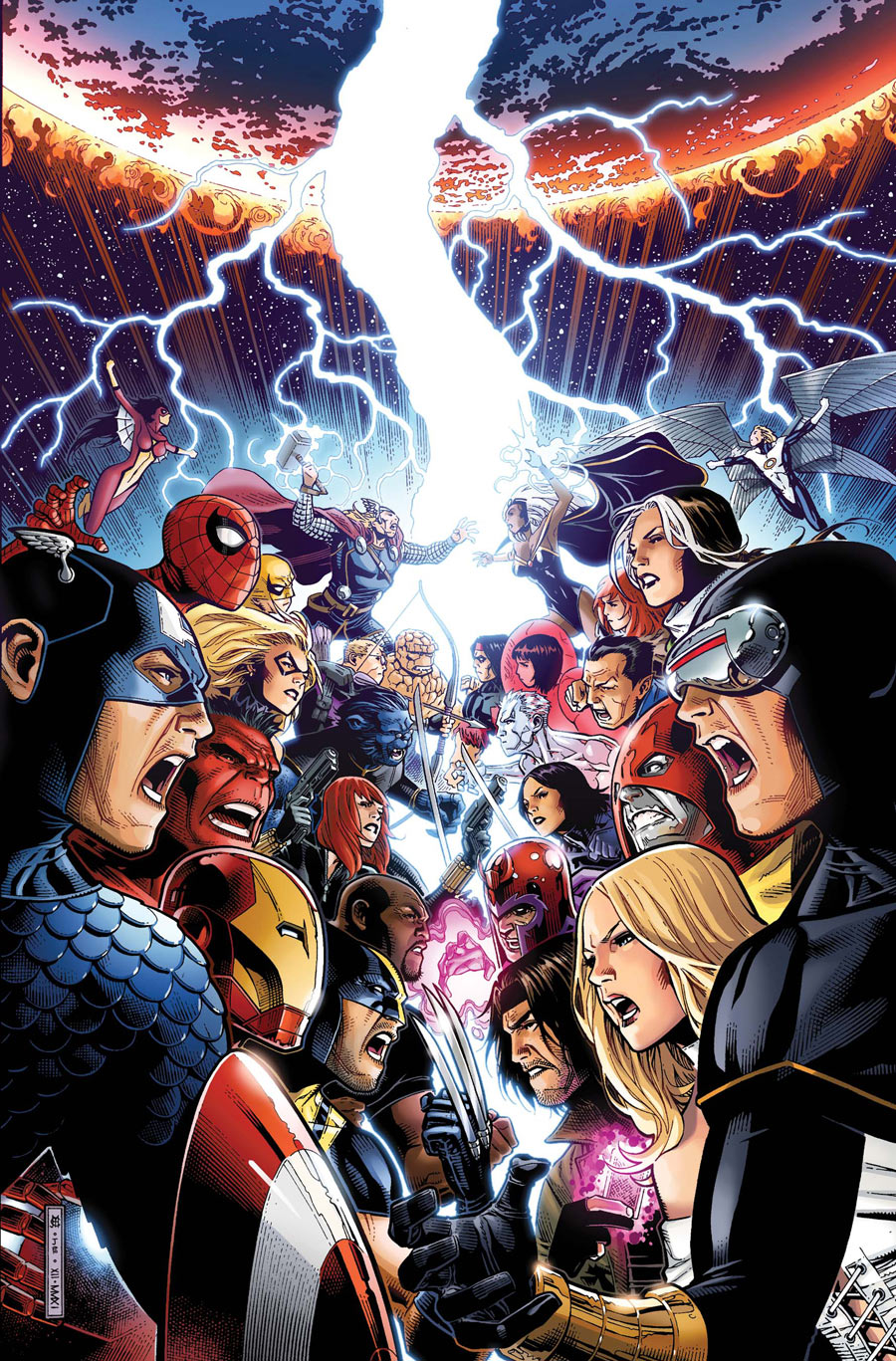
It was at this point I realized two things. The first is my already indifference to the Inhumans, that I hardly know any of the characters of their side, let alone these young ones. I mean, in the image at the beginning of this post, I probably know only half the characters on the Inhuman side. But the most damning thing is that they're portraying the X-Men as the villains, when they're the ones fighting for their lives. While I'm just going by the solicit info, even if the X-Men do cleanse the Terrigen in the atmosphere, I don't think that would do anything to the already existing Inhumans who have powers. The only problem I could see is if they no longer have any Terrigen Crystals, which probably would end the Inhuman lineage (if anyone knows what the deal is with that, feel free to let me know). My point remains the same though that Marvel seems to be playing favorites again with Inhumans defending themselves against the X-Men, even though they have every reason to fight. And this isn't the whole "their existence could lead to our extinction so we have to strike first" argument humans in any X-Men story use; the threat to the mutant race is clear and present. At least back in 2012's "Avengers vs. X-Men" event, the real antagonist was the Phoenix Force with the two teams arguing over how to stop or use it. The conclusion I reached was to skip "Inhumans vs. X-Men" all together, even the "Extraordinary X-Men" tie-in.

But there is a light in the distance. Last week, Marvel announced "ResurrXion", the post-IVX revitalized line of X-Men titles:
""Extinction is no longer staring them in the face, so the X-Men can exhale and turn their attention back to doing what’s defined them since the beginning: Protecting a world that hates and fears them," said the editor. "These new titles won’t cast the X-Men as members of a species fighting for their survival but rather as big, bright, colorful super heroes who want to demonstrate to the world that they want to walk with them hand-in-hand into the future. They’ll have costumes with capes, a school, and softball games. Oh, there will be softball games. The goal is to tell exciting new X-Men stories while keeping an eye on the tropes and touchstones that longtime X-Men fans cherish.""

Well things are obviously going to work out for the X-Men at the end of IVX, and I couldn't be happier. Not only have they admitted the X-Men haven't gotten the best treatment, but they're about to flourish again, and I haven't been this excited for the X-line since "Regenesis" back in 2011. I have a feeling this will accomplish what "Rebirth" is doing for DC. While very little is known about these titles at this moment, the ones I'm looking forward to most are the Blue and Gold books.
I hope that this news will finally put to rest the conspiracies of Marvel killing off the X-Men. In fact, this actually fuels reports of Marvel and Fox patching things up. Not only are they working together on the "Legion" TV series coming to FX in February as well as another series coming to Fox, but there's rumors that Fox will be seeking Marvel's consultation on future films. Will this lead to a deal similar to the one with Sony over Spider-Man? We can only hope; just keep Ryan Reynolds as Deadpool.

So if you like the Inhumans, good on you. As for me, I'll be waiting for "ResurrXion."

Tuesday, October 11, 2016

Rebirth Reviews Part 3: Batman Beyond

A bit late on this since I've been watching and writing up my review on Luke Cage, but we're back with my Rebirth Review series. Since my last post in the series, I've made a few decisions: I WILL be buying the first volumes of each Rebirth title, but I've decided not to do full reviews for each story arc. I worry that there may be some cases where I may not have enough to say for a write-up and I'd prefer to do an all or nothing approach. So now I'll just be reviewing the Rebirth one-shots, such as today's issue...


Written by Dan Jurgens
Art by Ryan Sook

Batman Beyond's history in the New 52 universe has been...interesting. The "Futures End" 2014-15 weekly featured Terry McGinnis traveling back in time to prevent an apocalyptic future with the world controlled by the artificial intelligence Brother Eye. Unfortunately, Terry would end up dying on his mission, passing on his suit and mission to that timeline's Tim Drake. Tim was able to alter the future and ended up being transported back to the year Terry came from, only to find Brother Eye still in control, but to a lesser extent. It's a distinction without a difference, which in my opinion makes the whole of "Futures End" pointless. This would lead into the new "Batman Beyond" series with Tim in the lead. The first arc wrapped up the Brother Eye storyline, which in my opinion hurts "Futures End" even more because it didn't actually wrap up in its own series. The second arc of "Batman Beyond" dealt with the aftermath and some reconstruction, even reestablishing the Justice League Beyond as seen in the animated series, and the third arc actually felt like a traditional Batman Beyond series. For me the series was a mixed bag with interesting the elements but the art was hit and miss.
A lot of people didn't like Tim Drake taking Terry's place, but I didn't mind. The way I see it, it was because they didn't realize that this Beyond series was not the same as the one from the animated series, or even the comic book continuation series that ran from 2010-14. While the New 52 series retained elements from Beyond that people were familiar with like villains and supporting characters, there were references to the present day DC universe as well, like Tim using Gordon's mech suit from his time as Batman during the first arc against Brother Eye, and that the Superman introduced in the second arc was actually Jon, the pre-Flashpoint Superman's son carrying on his father's legacy. Since it's beginning, DC touted this as the "definitive future of the DC universe". I scoff at that since futures and timelines always change when it comes to comics, but I digress. If anything, this makes Batman Beyond the most unique of the Rebirth titles because it doesn't take place in the present day DCU.
Now here's where things start to get confusing. The "Futures End" timeline that Tim came from had been erased, and we learn that the Tim from the new timeline had gone missing without a trace, never to be found and Bruce putting up his Red Robin suit as tribute (don't know if this is a coincidence or not, but it might be connected to what happened to Tim in the most recent arc in Detective Comics). We also learn that the Terry of this timeline didn't actually die but had gone missing during Brother Eye's attack on humanity, lost his memory and had been brainwashed Spellbinder into believing he was the villain Rewire from the comic continuation series...comics are weird, huh? In the final issue of the previous volume, Terry had regained his memory and Tim returned the mantle of Batman to him, allowing Terry to reclaim his life and Tim to make his own path (only to be mysteriously teleported somewhere, but I guess that'll be picked up on later). So with all this backstory out of the way, let's finally delve into the Rebirth issue.

The issue is pretty much about Terry getting back into the swing of things, not only as Batman, but as Terry McGinnis. His brother Matt and best friend Max help him get settles in, but he's most worried about trying to get back in touch with Dana, his old girlfriend. Since Terry and his friends are young adults now, something to note is that Dana has become a social worker. Back in the animated series, all I really remember about Dana is that she was just Terry's girlfriend who would get upset with Terry for being late or not showing for their dates because of his Batman duties, so it's nice that they've added another layer to her.
As I mentioned before, the timeline retains many elements seen from the Batman Beyond animated series (with this issue even going through Terry's Batman origin exactly the same way which is nice for brand new readers and I would hope get them interested in checking out the animated series as well) with some differences, but while the previous volume tried to tie it in with the present DCU, based on this issue, it appears that with Terry back, they're trying to distance themselves and make it feel like the old Batman Beyond. Tim Drake and Brother Eye aren't mentioned at all, and the only references to previous events are Terry's previously perceived death, that he misses having Bruce in his ear, and that his mother died "in the war", i.e. Brother Eye's attack. Maybe it's just as well since DC may be trying to win people back over after killing Terry and replacing him with Tim. But still, even if new readers or old Batman Beyond fans (who may have skipped Tim's tenure) picking this up may be confused by the differences between the series. I know I keep saying that they're different, but my guess is that unlike other alternate version of Bruce's Batman, Batman Beyond has its own unique mythos, which makes it hard for some to think of different versions of the concept.

The art is similar to that of the previous volume drawn by Bernard Chang, which for me again means it's kind of hit and miss, at least based on this issue. But this brings me to one of my overall complaints. Terry's suit has some slight modifications. First off, unlike the cover, Terry's eyes have gone from white to red, and they're no longer just triangles but have weird lines coming from it. It reminds me of the way Scarlet Spider's eyes were drawn sometimes in the 90's. In addition, while not as prominent throughout the issue but more through cover art for future issues, the heels of his boots are also now red. That aspect doesn't bother me as much, but combine that with the now almost demonic looking eyes, it really hurts what was originally such a simple design.

But my overall problem with this issue? It's not a one-shot, or even just a set-up issue. The villains featured are the Jokerz street gang who Terry notices are starting to up their game, going after money and even committing suicide by Joker toxin to avoid talking to the police, and he wants to know what's going on. Terry doesn't really get any answers here, and the last we see of him is Venom powered Jokerz member bringing a wall down on him. I do hand it to this issue for ending on a pretty shocking splash page and it'll definitely make you wonder where it goes. Even so, this really should have been an #1 and not a Rebirth one-shot. What they could have done was something similar to Avenging Spider-Man #15.1, which acted as a bridge between Amazing Spider-Man #700 and Superior Spider-Man #1, which showcased Otto Octavius preparing his new life in Peter Parker's body. What they could've done here was showing Terry upgrading his suit, explaining the differences shown between volumes.

So overall, Batman Beyond does for the most part act as a good jumping on point but does have its problems. But it's nice to have Terry back and I'm interested in seeing where things go.

And with that, that concludes the Rebirth reviews for the titles I read on my regular pull list. Now I wait for the DC Rebirth Omnibus, and this series will return in February with REBIRTH REVIEW MONTH, where I'll review the remaining Rebirth one-shots.