Thursday, March 23, 2017

TV Review: Iron Fist - Long Road to Greatness


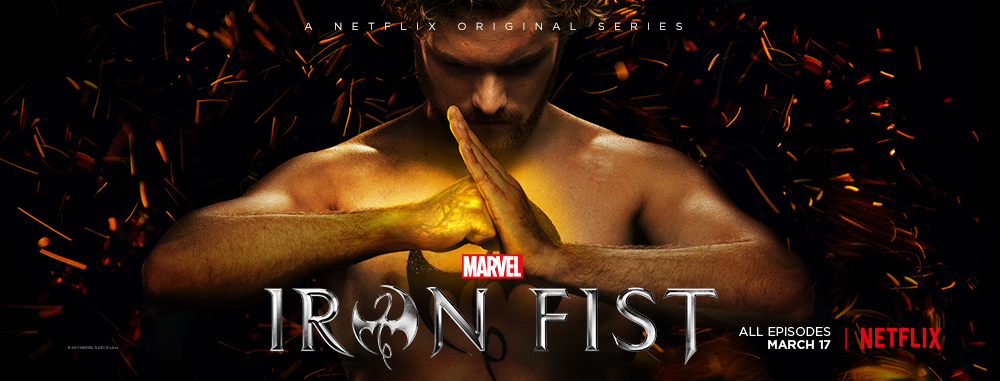
Much like Luke Cage, my experience with Iron Fist has usually been when he's part of teams or larger events. Most of the time he's usually tagging along with Cage, which makes sense since they're long time partners called the Heroes for Hire. When it comes to the Marvel Netflix series, Iron Fist was my second most anticipated after Daredevil. Now that all of the solo series have been released, it does kind of hurt to say that it's actually a dip down in quality from what came before.

When the reviews started coming out, they were surprisingly negative, a first for the Marvel Cinematic Universe. However, it turns out those reviews were based on just the first six episodes. Now, I understand with TV shows, they're usually reviewed on an episodic basis since they're not all out at once like Netflix does. But since these Marvel series are basically 13 hour movies, it's not exactly fair to review something halfway. That said, after the first six episodes, I can see some of their criticisms. In my own opinion, there was slow build up, and I was mostly frustrated by how long it took for Danny to prove he was who he said he was. I mean, I don't know how often someone missing and believed dead for years eventually resurfaces in real life, but I assume it does happen. Even in the context of the MCU, Captain America came back after 70 years of being "dead". But besides that, it just didn't suck me in at the first episode compared to the other series, which did a good job introducing the tone and atmosphere of their respective stories. Once Iron Fist did actually reach episode six though, I found the series to finally be at the quality I expect from Marvel and Netflix.

Danny Rand, the Iron Fist, played by Finn Jones, has a lot of development through the series. When he's introduced, he kind of comes off as a homeless hipster, at least to the people around him. He also overshares at first, which leads to people think he's crazy. It takes some time to figure out how things work in the business world, although he still wants to do the things the right way instead of the "business way", which doesn't make him many fans among his colleagues at his family's company. This really adds to Danny's conflict of identity. Is he Danny Rand, billionaire heir to a business, or the Iron Fist, kung-fu master and enemy of the Hand? He's doing his best to find common ground on both, which makes sense considering he's the youngest and in some capacity the least knowledgeable compared to the other Netflix heroes.
His fighting style, much like the series, takes some time to improve. I can kind of chalk this up to the type of opponents he faces. He starts out fighting regular goons, which isn't as fun given his training, but eventually gets into fights with individuals on his level, and he does have some interesting opponents, making it more entertaining.
There are some elements to Danny's story, while mostly adhering to the source material, have still been seen before in other superhero movies and TV shows. I think the obvious comparison people will make is to "Arrow", with both series having very similar to plotlines when it comes to their first seasons. There's also a bit of a "fish out of water" story in the beginning of the season, much like Thor. Danny also has a friend and rival in Davos, where the relationship turns bitter, much like Thor and Loki, and more recently, Dr. Strange and Mordo.
Now, I'll address some common criticisms aimed at Danny:
  • They didn't cast an Asian: Apparently this needs to be made more clear: Iron Fist is white. I won't deny that there needs to be more diversity in the superhero genre, but it's not controversial or whitewashing when the character is depicted as the race he is in the source material. The fact that some critics brought this up in their reviews is ridiculous. Diversity just for the sake of it almost never works. Also, why does the kung-fu superhero have to be Asian? The people who wanted to be racially inclusive are actually perpetuating a cultural stereotype.
  • Hardly any "Iron Fist": By this I mean his actual power. I actually don't mind this, as there was enough action to keep me entertained. Storywise, it's said that Danny just got the power and doesn't have much control of it yet. When he does use it though, it's pretty cool, especially during one moment in the final episode.
  • Lack of costume: Yeah, this one did kind of bother me at first. Jessica Jones and Luke Cage get passes since they don't need costumes, and Daredevil had some progressions in his costume. But out of the four, Iron Fist has what could be seen as an iconic suit. I did think of opportunities to create something of a costume, like he could just leave his shirt off showing his chest tattoo, or he could wear the gi he wore in K'un L'un, which has the green/yellow scheme. But then I realized that would be silly. Danny isn't a vigilante yet and he's facing an enemy who already knows who he is. He doesn't need a costume or the need to hide...yet. 
One character that really stands out is Colleen Wing, played by Jessica Henwick. The development of both her character and relationship with Danny as the series progresses was really enjoyable. At some points, even her fights were more entertaining than Danny's. I've heard that she might get her own spin-off series, "Daughter of the Dragon", and I'd be up for it.

Let's talk about the Meachum family, and boy are they a messed up family.
Harold Meachum is the father of Ward and Joy and business partner with Danny's late father Wendell. He's played by David Wenham, who I'm only familiar with from his roles in "Van Helsing" and "300", but I've never seen him in a role like this. I don't want to go too much into his story or actions to avoid spoilers, but I'll just say he would have been a good Norman Osborn.
Ward Meachum, played by Tom Pelphrey, is a character that grows on you. Right off the bat, you can tell this guy's bad, and they don't even hide the fact. As the series goes on though, he starts to have a mental break, which is pretty entertaining, and eventually leads to a surprise redemption.
Joy Meachum, played by Jessica Stroup, is a mixed bag for me. I want to like her and think she has heart, but then she says and does things that are just bad. I can tell she wants to be a good person, but her job keeps her from completely being one. Besides that, she's either too gullible or too trusting with both her father and brother, which leads to my issues with her. It'll be interesting to see where her character goes in the future though.

Some other good performances are turned in from stars returning from past Marvel Netflix series.
Rosario Dawson returns once again as Claire Temple, who has been to some degree part of all the previous series. At this point, she's getting some training with Colleen when she becomes part of Danny's quest. It's funny how she seems to be a magnet for all these super people. I also liked that's she's taken to using Luke's "Sweet Christmas!" catchphrase.
Carrie Ann Moss of Matrix fame returns once again as Jeri Hogarth, who appeared in "Jessica Jones", and she acts a little more human this time around, after making some questionable decisions in her prior appearance.
Madame Gao, who had a minor role in "Daredevil", returns to the forefront in a major way as part of the Hand. She kind of reminds me of Kilgrave from "Jessica Jones" in while she's not physically imposing, she can be quite manipulative.

Overall, "Iron Fist" is as good as you can expect from Marvel and Netflix, but a slow build up in the beginning does hurt it. If I had to rank the seasons so far, it would be Jessica Jones, Daredevil, Luke Cage, Daredevil Season 2, and Iron Fist. It may be in last place in this group, but I still found it better than some of the less stellar MCU films like Iron Man 2 and Thor: The Dark World. Iron Fist hasn't been renewed for a second season yet, but I think it would be better if they actually put him and Luke Cage together for a "Heroes for Hire" series, but let's not get too ahead of ourselves.

RATING: 7.5/10

When Marvel returns to Netflix this summer, we'll finally reach the Defenders miniseries, finally bringing the four heroes together. "Iron Fist" included a lot of references to the other heroes and it made me realize this really has been building up since the first season of "Daredevil". When these Netflix series were first announced, I thought it was a pipedream, but it's finally almost here, and hopefully the culmination of a new superteam will be just as good when it happened with the Avengers...now if only we could see both teams together.


Saturday, March 18, 2017

Sony Moving Forward with Venom: What Can They Do?


When Sony was still hoping to build a cinematic universe with the Amazing Spider-Man franchise, among the spin-offs planned was for Venom. But of course, the plans fell apart which led to the deal that would bring Spider-Man to the Marvel Cinematic Universe. However, despite having the backing of Marvel, Sony apparently still wanted to do their own thing since they do own the rights. Among those plans includes an animated film featuring Miles Morales set for December 2018. Now that would be fine as it would give everyone what they want. Marvel would work on live action films with Peter Parker, while Sony would still have their own projects with animated films and Miles Morales, who some fans wanted in the MCU instead of Peter. But that's not enough apparently, as Sony still wants to do a Venom movie. And as of Thursday, a Venom movie has been slated for October 2018.

Here's the thing about Venom. You can't rush him. "Spider-Man 3" was proof of that, and it was already stuffed with multiple plots. But to start Venom off with his own movie right off the bat is insane. They call it a spin-off, but spin-offs usually work better when something is established and then given its own focus. That's not what's happening here. The right path to do bring in Venom is one Spider-Man film featuring the black suit, one movie with Venom as the villain, and finally give the character his own film.
Frankly, ever since the Spider-Man deal was made, I immediately thought of a way to bring Venom into the MCU. Spider-Man gets the symbiote in Infinity War, gets rid of it in his solo sequel, and fights Venom in the third. And with Marvel backing them at this point and knowing their failings in the past, why can't Sony just focus on animated films and leave Venom alone? And the obvious answer, money, isn't a good one.

Unlike previous reports, the release date announcement doesn't make it clear if the Venom movie will be its own entity or be part of the MCU. This will be the determining factor of whether this film will be worth it though. If it exists on its own, then what's the point in making it when the real Spider-Man films are being done with Marvel? It would be like the situation with Fox and the Fantastic Four. There would be no faith in a project that would be much better in Marvel's hands, and the audience can tell the difference between 'Marvel' films and 'Marvel Studios' films now.
But let's look at the flipside and the potential that Venom could be in the MCU. I laid out my plan above, and that would be the correct course. Hell, there's already rumors of the symbiote indeed making an appearance in Infinity War. Of course, this would mean that a Venom movie would have to come later.  It's not like Sony needs to make the film to keep the Spider-Man rights when they already have the Homecoming sequel set for 2019. But if a Venom comes before the sequel, what could it mean? Well, I've come up with a theory.

The film could take inspiration from the Ultimate comics and be a prequel of sorts. In the Ultimate universe, the Venom suit was not an alien symbiote, but as a cure for answer to help heal the patient, developed by Richard Parker and Eddie Brock Sr. But problems arise when the company they were working has plans to weaponize the suit. And if the Ultimate Spider-Man video game is to be believed, Brock Sr. bonded with the suit, losing control and causing the plane crash that killed Peter's parents.
Maybe the film could take inspiration from this, making it somewhat unique to the MCU and giving it a bit of a horror field. In fact, aside from the time Peter was wearing it, the wearer of the Venom suit does not bear the white spider as the mainstream version does.

This could lead to Peter actually getting the suit in the Homecoming sequel, leading to Eddie Jr. becoming the new Venom for the third film.
Although, there are two reasons why I feel this approach couldn't work:
1. The Amazing Spider-Man films already placed an importance on Richard Parker's work and that a life saving treatment and could be weaponized. Some people didn't like this idea and I doubt they'd like that aspect to continue over to the MCU.
2. I could see the film being an Alien film but with some Hulk-like tendencies. Honestly, it's not hard to see some similarities between the symbiote and a Xenomorph. Hell, in "Spider-Man 3", you could pretty much swap out Venom for one and no one would notice; they even had similar shrieks. The point is, I wouldn't want it appear like an Alien rip-off.

Who knows though? Setting a release date doesn't automatically mean it'll come out by then. Marvel's rearranged their release schedule before to make room for Spider-Man and an Ant-Man sequel. A Venom movie could work if it's done by Marvel and comes out at the right time. If it's done by Sony and has no connection to Tom Holland's Spider-Man or the MCU, then it's really not worth seeing and could flop as bad as "Fant4stic".

Saturday, March 4, 2017

Movie Review: Logan - A Brutal Farewell


In my first year of writing this blog, I reviewed the 2013 film "The Wolverine" and referred to it as a film worthy of the character. While that's still a good film, it really can't be compared to the final film of the trilogy, "Logan". Now, I know it's not a true trilogy in terms of an arc, but any case, Wolverine movies until now have kind of been overlooked in the X-Men franchise. "Origins" is the worst of all of them, and "The Wolverine" is criminally overlooked. But when it came to "Logan", which is set to be Hugh Jackman's final time portraying the character, it's clear they wanted to give audiences something great and memorable. They have succeeded.

Right from the first scene, it's made clear that this is different from any other Wolverine, X-Men, Marvel, or any superhero movie from before. It's rated R, which makes sense when your main character has sharp claws that come out of his hands, and he makes good use of them throughout the film in very bloody fashion. The actions of Logan, as well as other characters in the movie, are ones we've never seen before in previous films, at times taking me by surprise. I only wish in some instances that the action wasn't as fast paced as it was to appreciate the brutality. I know that sounds morbid, but this is film is supposed to be Wolverine at his finest and I kind of wanted to take it in as long as I could. If I could compare this film to Deadpool, the X-Men franchise's only other R-rated film thus far, there's definitely a lot more gore and they're taking it very seriously. The best way to look at it as that Deadpool is the over-the-top, juvenile R, while Logan is the gritty and grounded R.

Hugh Jackman and Patrick Stewart, two of the stars who helped start the X-Men series way back in 2000, are back as Logan and Charles Xavier, and they are both in a very different spot than they were then. They are broken, having been through so much after all these years. Logan has lost almost everyone he's cared about, and considering he still remembers the old timeline that was erased in "Days of Future Past", that means he's experienced it twice. Besides that, his healing factor is waning, and much like in "The Wolverine", he's dealing with his own mortality, but there's no easy fix this time.
Then you have Charles Xavier, the wise mentor to the X-Men. It isn't outright stated if he's been afflicted with Alzheimer's or if its his own powers taking their tole as he's gotten older, but Charles mind isn't what it's used to be. We've always seen Charles as a shining light of hope to his students, always seeming to have the answers. Here, we realize he's still just a man and can suffer like anyone else. Knowing all that, it's kind of sad to watch him sometimes. But even then, there's still signs of the old Charles there.

Of course, there's another main character making her film debut, Laura/X-23, played by Dafne Keen. There are a few differences from her portrayal in the comics, but it works here. Laura remains quiet for a good two-thirds of the film, but it's in her quiet moments where she truly shines. Keen has to rely on body language to convey her emotions, which is very different when it comes to child actors. While still young, her character has already been through so much that her demeanor is understandable. Of course, they show she's just as dangerous as her father, and it's entertaining to watch her fight both on her own and side by side with Logan.
Between Laura, Logan, and Charles, all three make up the emotional core of the film. Regardless of the differences in all their ages, each of them are damaged to some degree, and while none of them would admit it, they all need each other. In any sense, they're what the X-Men should be: a family.

As for the villains, there's not really too much to talk about with them. They're the usual bad guys hunting mutants and wanting to use their powers for their own means. That said, they do seem a little more brutal in their methods than other groups in the past, but that can probably be attributed to the R rating. While they don't really stand out, that's okay because this film isn't really about them. (MINOR SPOILER): Not even Logan gives a shit about their "master plan" when he kills the leader of the group in the middle of his monologue, focused only on protecting Laura.

There's one review I've seen calling "Logan" the X-Men franchise's version of "The Dark Knight." In terms of story though, I see it more as "The Dark Knight Rises". It's the end of a trilogy where the main character is reaching the end of their journey, and going in, you don't know how things will end up, but in any case, they will leave a legacy behind. However, this is a film that I feel is deserving of an Oscar, which is something I haven't said about a comic book movie since "The Dark Knight."

All in all, this truly does feel like the end of an era. Jackman helped start the franchise and has been Wolverine ever since. While you don't need Wolverine to make a good X-Men movie, to think of him no longer being a part of things, or at least Jackman, is kind of sad. It wouldn't seem right to recast him either unless they decided to go with a full-on reboot. Hell, they could stop making X-Men films right now and I would feel we have a complete franchise. But of course, that's not happening. Fox is moving forward with sequels to both "X-Men: Apocalypse" and "Deadpool";  I can only hope Hugh can make the occasional cameo.

If Hugh Jackman's Wolverine has been part of your life in any way, or you enjoy films with graphic violence and an emotional backdrop, go see "Logan" to watch the character go out in a blaze of glory...just don't bring the kids.

RATING: 9.5/10

My Personal X-Men Film Rankings:
1. X-Men: Days of Future Past
2. Logan
3. X-Men: Apocalypse
4. Deadpool
5. X-Men: First Class
6. X2
7. The Wolverine
8. X-Men
9. X-Men: The Last Stand
10. X-Men Origins: Wolverine

Thursday, February 23, 2017

Rebirth Review Month Week Four: Deathstroke, Supergirl, Blue Beetle, Teen Titans

Welcome to the final week of Rebirth Review Month. 17 down, 4 to go, so let's get right down to the last leg of this series I started last Summer.


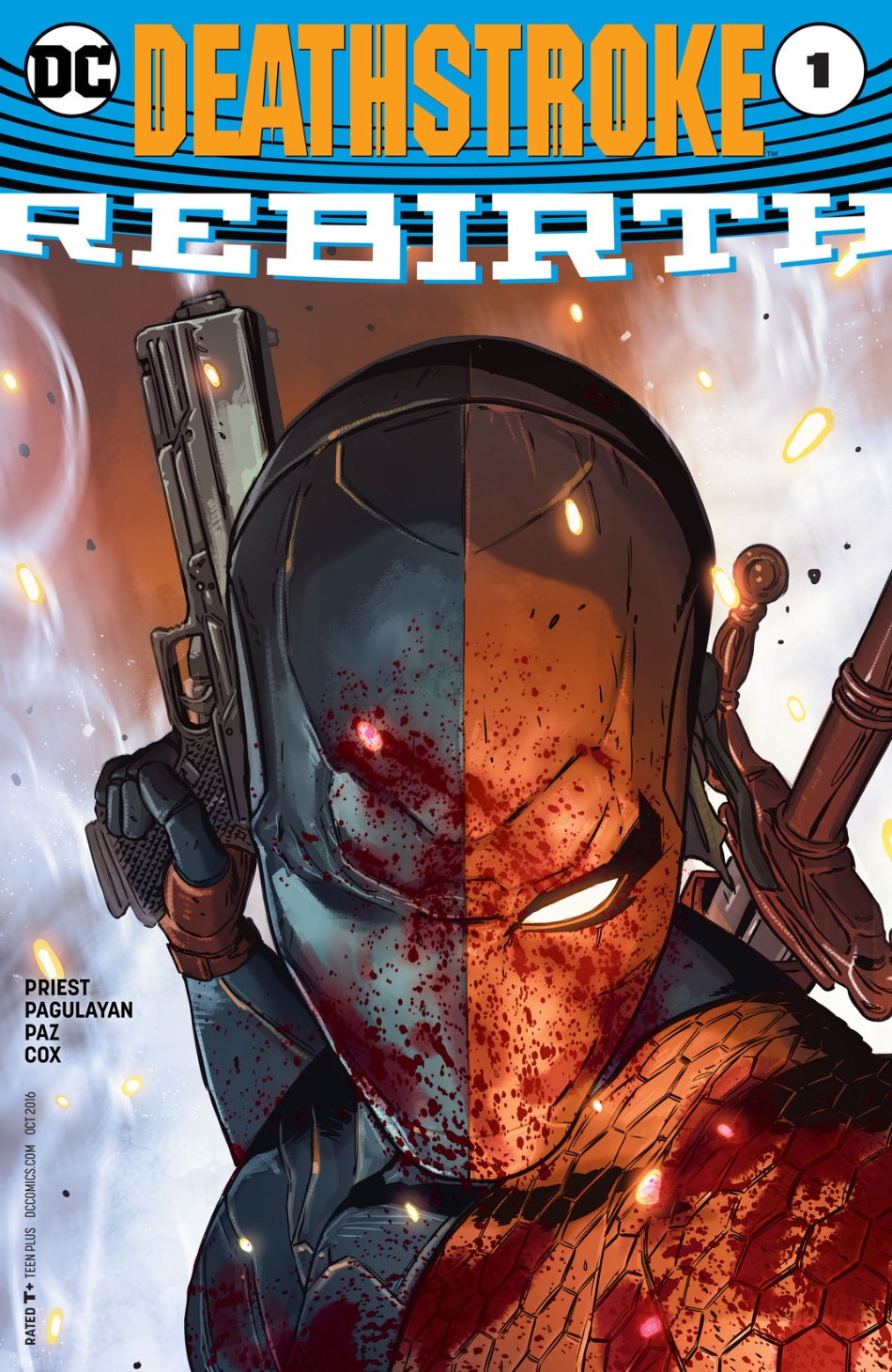
Written by Christopher Priest
Art by Carlo Pagulayan

Deathstroke had his own solo series when the New 52 began, only to be cancelled at 20 issues. He would get his own title again a year later, probably due to the character's renewed popularity from his appearances in the "Batman: Arkham Origins" video game and the "Arrow" TV series. This title would continue on before being relaunched for Rebirth. I've never read Deathstroke's solo titles, and I've only been familiar with him in an antagonistic role (my first introduction to the character being in the Teen Titans cartoon where he was voiced by Ron Perlman). As my first Deathstroke book, I have to say it didn't really have an impact on me.
The issue involves Deathstroke being hired to kill the Clock King, who's under protection of a warlord known as Jazaki. As it turns out though, Jazaki is an associate of Deathstroke, so he allows him to do his business with the Clock King. As Deathstroke arrives to make the kill, Clock King reveals someone close to Slade is being held captive nearby, and will only give Slade more information if he allows him to live. Slade agrees and infiltrates a compound and finds his old mentor, Billy Wintergreen. It ends there because this is once again more of a prologue issue than a one-shot. Besides that, there's also flashback scenes to when Slade was younger and on a hunting trip with his sons, and let's just say he is NOT a good father.
Much like my feelings about Suicide Squad, it's just hard for me to be interested when the villains are the protagonist of a story. The flashback scenes are probably my favorite part of the issue because of how it presents Slade as a complete bastard. But the present scenes were actually kind of hard to follow for me. I actually had to find a synopsis online to figure out what was going on. I think it's because I'm not clear on the basics of how the life of an assassin is when it comes to contracts or politics.
At the moment, I just don't have an opinion either way on this book. I've heard good things about this series, so maybe when I actually read the first full storyline, I'll be a bit more clear on whatever's going on.


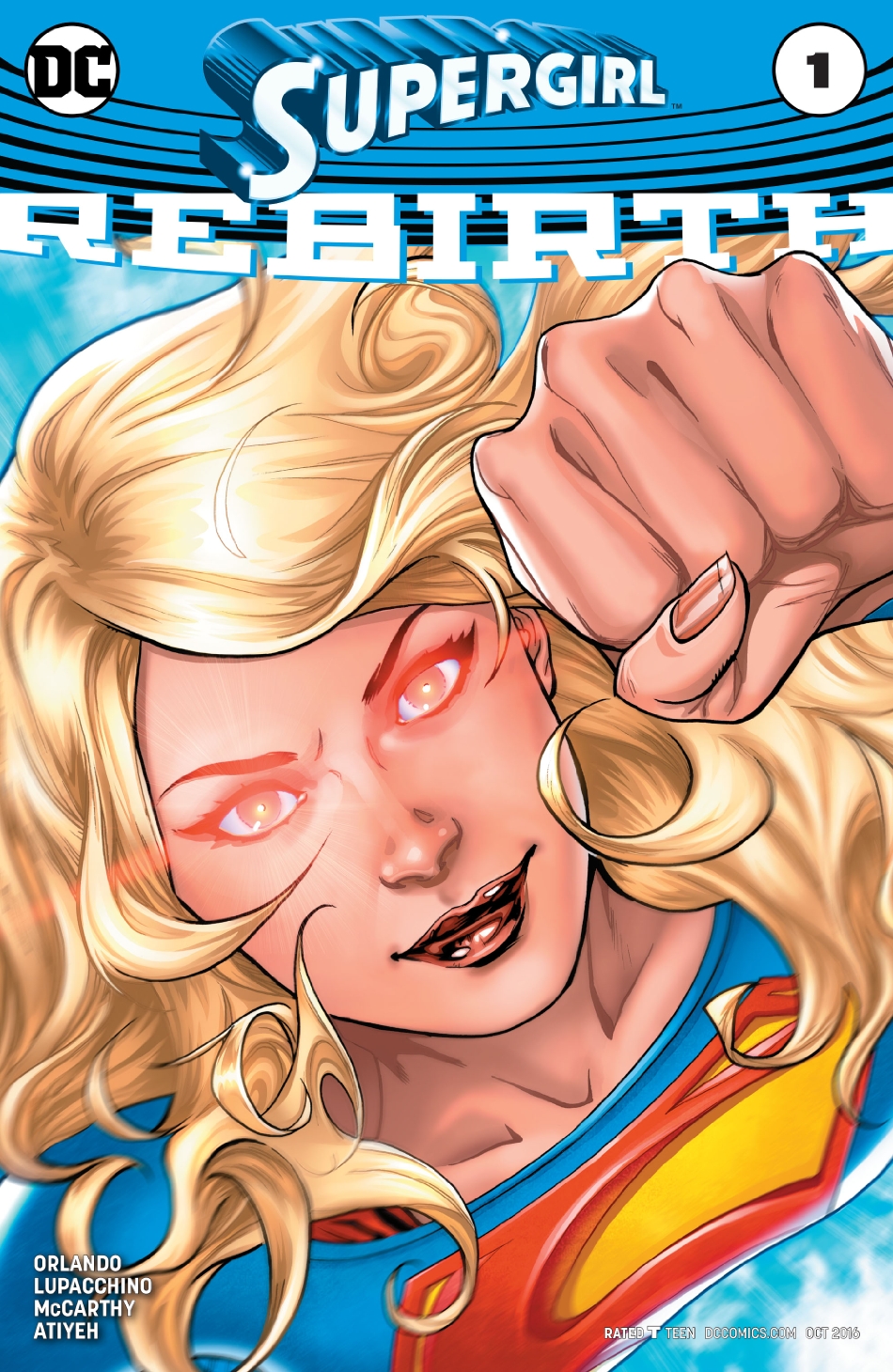
Written by Steve Orlando
Art by Emanuela Luppachino

Much like the Suicide Squad, the latest relaunch of Supergirl was going to take cues from an outside source, in this case being her hit TV show. Comic wise, I haven't really had much experience with Supergirl aside from her guest appearances in the Superman books and being part of the Justice League United book. But Supergirl was a book I was planning to try out for Rebirth anyway, for the art if anything, even though the artist for this Rebirth one-shot is different. All that said, let's dive in.
Working with the Department of Extra-Normal Operations to regain her powers, Supergirl is in an experimental craft powered with a Phantom Drive to get her close enough to the sun to recharge her Kryptonian cells. After she launches, a side effect from the Phantom Drive results in a Kryptonian, Lar-On, coming out of the Phantom Zone; as it would turn out, he was exposed to red Kryptonite and quarantined in the Phantom Zone by Zor-El, Supergirl's father. Because of this exposure he turns into a large red werewolf like creature. As he can only speak Kryptonian, he can't communicate with the DEO troops he encounters. In space, Supergirl is able to hear the trouble through the comms before they go out as she gets closer to the sun. Thankfully, her powers return and she flies quickly back to Earth, sporting a brand new suit similar to her original costume and much better than her New 52 one, to face Lar-On. Since she can also speak Kryptonian, they're able to communicate. She tells him of Krypton's destruction and he blames Zor-El for him having lost everything, wanting to kill her for revenge. Supergirl is able to talk him down, telling him that she knows how he feels and that his family wouldn't want him to honor them with more death. He's placed in a stasis pod where the DEO will work to cure him of his red Kryptonite sickness. The issue wraps with Kara officially joining with the DEO, being placed with Agents Jeremiah and Eliza Danvers as their foster daughter, and going to high school, not to mention a tease for Cyborg Superman for the upcoming first arc.
As a fan of the TV show, adding some of those elements helps had some familiarity for me, like her foster parents being part of the cast. While they are taking cues from the show, there are some differences. For one, Kara's still a teenager. Then there's the director of the DEO, Cameron Chase, who isn't on the show. From what I can tell, she's filling the role of both J'onn J'onzz (Martian Manhunter) and Alex Danvers, since J'onn's doing his own thing in the comics and having Alex be the director would be weird if her parents work as agents under her. But my main takeaway of how this issue reminds me of the show is how Kara handles Lar-On, as she's able to end the conflict without pummeling him; this is something she's attempted and able to do before.
While the art isn't the same as it will be when the main book starts, it's still good. Nothing that really stands out, but still good.
Overall, I was quite entertained by this issue and look forward to how the first arc goes.


Written by Keith Giffen
Art by Scott Kolins

My first real introduction to Blue Beetle was the "Batman: The Brave and the Bold" animated series, and that goes for both Ted Kord and the current version, Jaime Reyes. Reyes' version reminded me of Spider-Man and Venom, being a teenage bug-based hero and having to work with an alien "partner" bonded to him. I didn't read the first Blue Beetle book when the New 52 began, but through a Linkara retrospective video, I learned that the book suffered from rehashing the origins from the old continuity as well as constant shifts in where the book was going, eventually being cancelled after 16 issues. Ted Kord, who had been killed and remained dead until the end of the pre-Flashpoint continuity, was introduced into the New 52 at the end of the "Forever Evil" event. As far as I can tell, Rebirth is Ted's first appearance since then. Since Ted and Jaime never met before, I thought it was a good idea of putting the two together on a book, giving fans of both characters an outlet.
The issue begins with a splashpage of Blue Beetle battling our villains of the issue, Rack and Ruin, with Ted in the background propelling down from a rope coming out of the Bug, his hightech airship. The thing is though, the story doesn't actually start until the next page. This first page was kind of like a second cover, giving us some info about what the issue entails. From what I remember, the very early Spider-Man comics in the 60's used to do this. It may be because of that that I enjoy that they did it here, giving a bit of an old-school feel, while also (again) reminds me of Spider-Man. Unlike this page though, Ted doesn't actually come to help in the actual story. So it is like a second cover, and one that misleads at that.
The story actually begins with Jaime heading off to school and meeting up with his friends, Paco and Brenda, walking in on a bit of a ridiculous argument. The way it's written though also makes me think this is something Brian Michael Bendis would write in Ultimate Spider-Man (both Peter and Miles eras). It's worth noting that they both know he's Blue Beetle too, which reminds me of another teen hero, Danny Phantom, whose friends Sam and Tucker would help him out. Anyway, Jaime gets a call from Ted who tells him of a hostage situation with the takers calling out Blue Beetle. Jaime has to bail on school, meets Ted on the Bug, and they head to the scene.
The best word to describe Beetle's battle with Rack and Ruin is "awkward". Ted's talking to Jaime through a comm, but it doesn't seem like they have a good flow going yet. Ted isn't quick to give Jaime advice, not to mention it seems that he's having more fun than Jaime is, which leads to a lot of bickering. There's also the fact that the scarab does have a mind of its own and Jaime has to use some his own strength to keep it in check. The two villains get the best of Jaime, so Ted fires a gas bomb in and the two retreat. It's worth noting that the two seem to have been hired to take on Beetle and analyze his skills, also taking note that he has someone helping him.
Afterwards, we get a retread of Jaime and Ted's segment from the main Rebirth one-shot, as well as Dr. Fate appearing to tell Ted that Jaime's scarab is magic instead of alien technology. Time for a history lesson: in the golden age, there was another Blue Beetle who used the scarab, which at the time was believed to be an ancient artifact. Like other characters in the silver age, Blue Beetle got a makeover as a more tech-based hero. When Jaime was introduced, they brought back the scarab and revealed it was alien technology sent to Earth by a conquering race known as the Reach, sending scarabs to bond with a planet's inhabitant to help them in taking over said planet. The scarab that came to Earth though was corrupted, forming a partnership with its host rather than taking it over. I don't know how I feel about this change Dr. Fate is talking about. This appears to be another case of retconning the retcon. It might be too early to judge, but at the moment, it seems unnecessary.
The issue ends with Brenda's aunt Amparo apparently being the one who hired Rack and Ruin, not liking the idea of Beetle having someone helping him. Hmm, a friend of the hero has a villainous relative? There's another Spider-Man similarity!
So overall, I quite enjoyed this issue. I know I kept referencing how much I was reminded of Spider-Man, but not only is Spider-Man my favorite superhero, but he is pretty much the archetype of the teenage superhero, so comparisons aren't hard to make. Ted and Jaime's relationship at this point is interesting. Ted wants their partnership to be like Batman and Robin, but it's hardly that. It's not even like Bruce and Terry in Batman Beyond. This version of Ted is hardly the veteran hero of before, and like I said, he doesn't seem to take it as seriously as Jaime. If anything it'd be like if Dick was monitoring Damian. Or a more apt comparison would be if Peter Parker mentored Miles Morales if he was bonded to the Venom symbiote. All that said though, it does give us something fresh, even if the bickering can be annoying.
Like the other Rebirth books, I was already planning to pick up the first Blue Beetle volume, but after reading this, I may considering continuing reading Blue Beetle even past that.


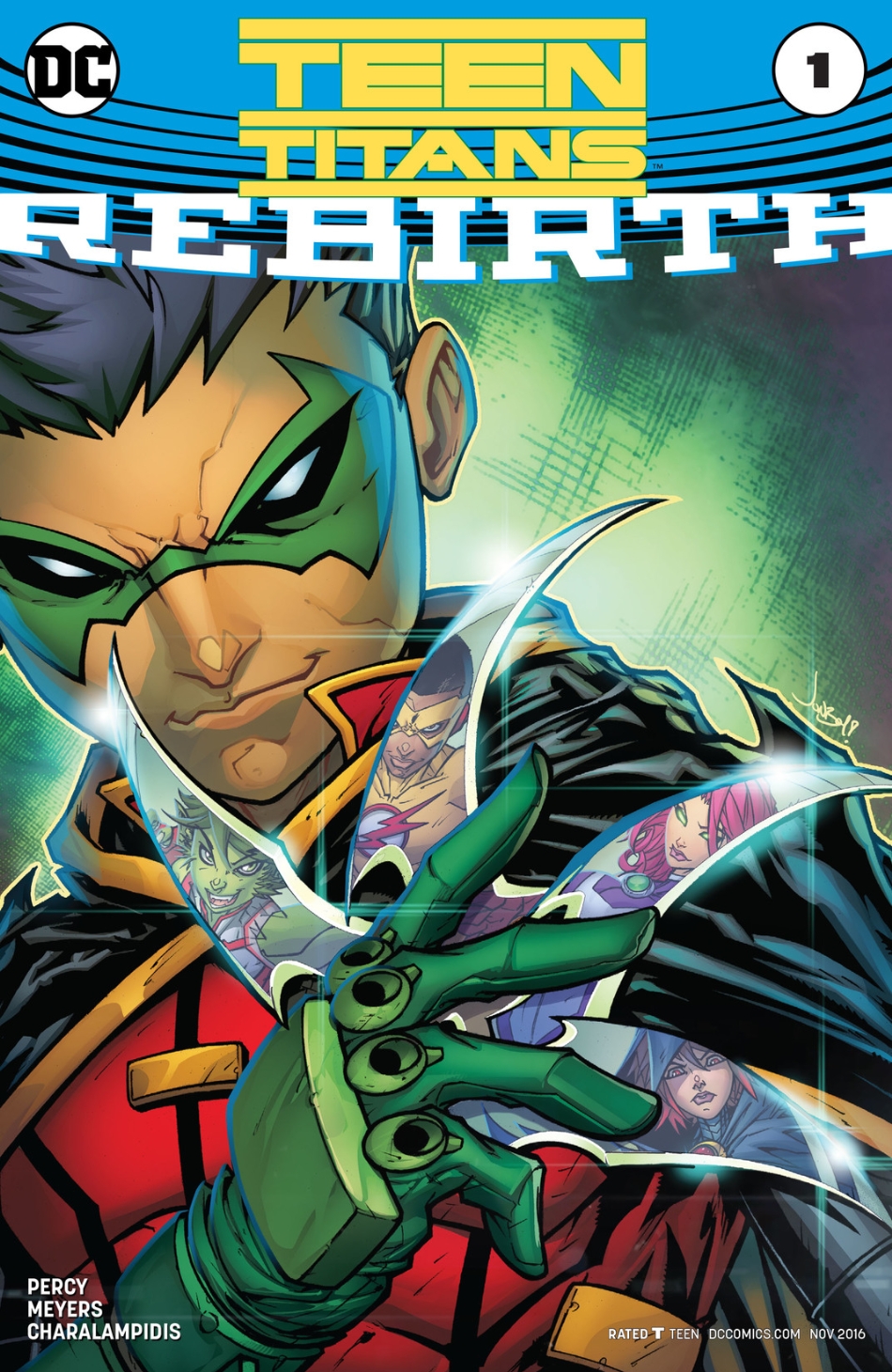
Written by Ben Percy
Art by Jonboy Meyers

As I've mentioned in past posts, the Teen Titans have had it rough the last few years. Besides the "Go!" cartoon, their New 52 incarnation has not been the best run to say the least. Considering we're on the final Rebirth one-shot, I guess this would be the last instance for me to say that this is yet another mess for the initiative to clean up.
Damian Wayne, the current Robin, had briefly been a part of the Teen Titans before "Flashpoint" but clearly had trouble working with others. But now that the character has had years to grow, surely the time was right to place him on DC's flagship adolescent team. As we'll see in a moment though, he might not have grown too much. The other members announced for this relaunch were Beast Boy, Starfire, and Raven (three characters most people will associate with the Titans), as well as the New 52 version of Wally West, now the new Kid Flash (not to be confused with the pre-Flashpoint Wally West/Flash in "Titans"). From some standpoint, this new version of the team could probably be seen as similar to the line-up of the cartoon, though that's something that isn't displayed in this issue, leaving to the core team building for when the proper series begins.
The issue is pretty much showing what our characters have been up to. Beast Boy is renting a house in the Hollywood Hills and throwing a party. Starfire is investigating human trafficking in the Caribbean. Raven is sneaking into an art museum after hours to be by herself. Wally is running across Central City as Kid Flash to blow off some steam. The four are all knocked out in some way and restrained with power inhibitors in a machine that looks like the one from "The Incredibles". As they all awake, they're greeted by Damian, with his pet giant dragon bat Golitah, who says they're probably wondering why he's brought them all together.
So yeah, Damian kidnapping his future teammates isn't really good for a first impression, for both them and new readers. But as someone who's been following Damian since his creation in 2006, this is right up his alley. As much as the character has grown since then, he can still be a little bastard. There was a brief scene in the main Rebirth one-shot with Damian blowing out candles on a birthday cake indicating he's now 13 years old. So now he's officially a teenager, and apparently his first idea is to build his own Teen Titans. Kids these days, right?
Anyway, as I've grown to appreciate the Teen Titans as a whole lately (which can probably be chalked up to nostalgia for the better days), I can say that the characters are written well and accurately. The art is pretty good too. I'd say it's anime inspired, which is a good fit for the Teen Titans for a number of reasons. From what I heard though, the artist left a book shortly after it started, which kind of sucks. I'd say this issue is almost perfect, and while I'd bring up my problems with it, it's honestly just nitpicking and really not worth mentioning.
I'm not sure which will be better between this and the other Titans book, but I think they'll both have their own aspects that make them good.

That's all folks. My Rebirth Review series is done. I hope you've enjoyed my analyses of each one-shot and that they've given you some ideas of which books to pick up for yourself. For the most part, while some books will definitely be better than others, I'd say Rebirth is a promising new era for DC Comics.

Thursday, February 16, 2017

Rebirth Review Month Week Three: Batgirl and the Birds of Prey, The Hellblazer, Red Hood and the Outlaws, Suicide Squad

We're half-way through Rebirth Review Month, so let's not waste time with another long introduction (besides this one).


Written by Julie and Shawna Benson
Art by Claire Roe

Since being paralyzed by the Joker, former Batgirl Barbara Gordon had spent the remainder of the pre-Flashpoint timeline confined to a wheelchair, but still operated as Oracle, a tech genius who could relay intel to Batman or any other hero who needed her help. But when the New 52 began, it was decided for Barbara to get back on her feet and become Batgirl again. Oh, but she was still crippled and operated as Oracle for a time...she just got better. If this was in the Marvel universe, I'd say it was probably a trip to Europe. That usually works for the Osborns. Anyway, I always felt making Barbara Batgirl again was a step backwards for her character. It takes away a physically disabled character that could be looked up to, as well as the previous Batgirl, Stephanie Brown. Steph wouldn't make her debut in the New 52 until 2014, where she once again became Spoiler. Storywise, I've heard her solo book had its ups and downs due to editorial interventions. As for the Birds of Prey, it's a book that just didn't pique my interest because of how different it was from the previous continuity, not to mention it got really bad leading up to its cancellation.
Once again, time for Rebirth to clean things up. It was decided to put back together the trio of Barbara Gordon (now as Batgirl instead of Oracle), Dinah Lance/Black Canary, and Helena Bertinelli/Huntress; the original Birds of Prey.
The issue begins with Batgirl busting up a robbery, and when she looks at one of their phones, she discovers they were sent intel by someone named Oracle. We then get a recap of Barbara's history in the New 52, from being Batgirl to Oracle and Batgirl again. She also mentions that as Oracle, apparently she only worked with Black Canary, giving her intel to bust crimes (I guess they're just ignoring the old team, but I can't blame them for that). Barbara goes to Dinah to get her help on the situation, taking her to her new headquarters inside an old clocktower (a nod to her old HQ as Oracle back in the old continuity) and they find the lead. Elsewhere, Helena is in a church confessional and recaps her New 52 backstory before she kills the father because of his links to the Gotham mafias, who she plans to take out one person at a time. And because we need to get these these three together, by sheer coincidence, Helena's next target just happens to be the guy Babs and Dinah want information from. They end up fighting and the guy gets away, and it turns out they're being watched by this bad Oracle.
This issue is pretty bad. Honestly, what kills this for me is the art, once again, focusing on the faces. I don't know what was going in the process or who thought this was good, but throughout this issue, we have for the most part Barbara, making faces that are just not humanly possible. Either she's showing too much gum (sometimes it looks like she's biting her lip during a weird smile), her tongue's sticking out, or there's a gap between her two front teeth. Besides that, there are times where Barbara and Dinah have really pointy noses. Honestly, the one part of this story that actually looked good was Helena's confessional. But the worst art example of this book was during the flashback to "The Killing Joke" when Barbara opens the door to find Joker about to shoot her. If you remember that scene, Joker has a big smile showing his teeth. Here, his mouth his closed with a smile that looks half-hearted, like he's thinking "Yeah, I'm here. Gonna shoot you now, I guess".
Story wise, I guess it's okay and introduces an interesting idea, but I just can't get past the art. However, this is another issue that ends on a cliffhanger instead of being self-contained. Although had it ended at Helena's scene at the church, that would have been better, because it would have introduced our main characters and the threat before getting to the meat of the story when they all meet. Otherwise, this would have been better as an #1.
One thing I don't get though is why they named it "Batgirl and the Birds of Prey" instead of just "Birds of Prey." The only reason I can think of is from a marketing standpoint.
When I get the first book of this series, maybe the art will grow on me, but at this point, I'm not too invested.


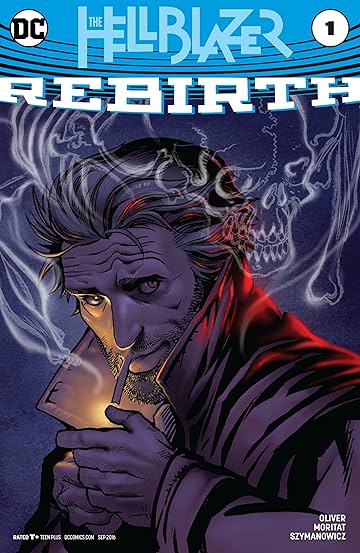
Written by Simon Oliver
Art by Moritat

If you're a fan of Supernatural, you can owe its existence to John Constantine (seriously, they even based Castiel's appearance on him). Debuting in the late 80's and making some appearance across the DCU, Constantine would eventually be relegated to his own title outside the universe, "Hellblazer", which lasted for 300 issues. Shortly before the New 52 began, Constantine had been reintroduced in the proper DCU. He would be part of the Justice League Dark and eventually get his own series.
Outside of his appearances in other books, it wasn't until his short lived TV series that I really started to appreciate and understand the character. I never read his past series, but as I've been trying out new things through Rebirth, why not now?
The issue begins with Constantine about to be sent to Hell by a demon, until John points out how many souls would be waiting for him down there, which would lead to complete chaos (it does make sense for Hell to have some kind of order). The demon lets Constantine live but places a curse on him to force him to leave London, or his body would be eaten up from the inside. After years of planning, Constantine returns to London and is able to remove the curse from himself. The demon reappears and lets John know he's only spread it out to everybody in London, essentially creating a supernatural contagion. Because an influx of souls into Hell would be troublesome, the demon tries to bargain with Constantine, even offering to bring back Astrid, a young girl John condemned to Hell in his early years. It turns out John was biding time though for his psychic friend Mercury to show up and help. She reveals the demon's name, Nybbas, which removes all his power, including removing the curse and saving all of London, and sending him back to Hell. John then ends the issue talking to the reader: "If Mercury hadn't shown up...would I really have stood by while eight million souls were condemned to Hell? Well, that's something you're gonna stick around and find out for yourselves. Or not. Because, quite frankly, at the end of the day--do I strike you as the kind of guy who gives a ****?" I just love that part. It perfectly captures Constantine's contradictory nature as a guy who would stop demons from causing trouble while acting like a selfish bastard the whole time.
As my first ever issue of Constantine, it was pretty good. It helps that it includes elements shown in the TV show, with an appearance by Chas and a reference to Astrid. Before she arrived to help John, I thought Mercury was going to be Zed. In fact, why wasn't it Zed? For fans introduced to Constantine through the show, including Zed would have been a nice touch.
There's also a cameo scene featuring Shazam, Wonder Woman, and Swamp Thing. Shazam and Wonder Woman sense the magical danger and want to intervene, but Swamp Thing stops them, hoping that Constantine will sort this out. It's a scene that doesn't add anything to the plot, but more about making it clear that this title does take place in the DC universe. Besides that, Shazam kind of sounds off for a 15 year old (at least I still think Billy's 15).
Art wise, it's pretty unique compared to the other Rebirth issues so far. I'd like to think that they want to give this book its own style, much like how his own series was kept separate from the rest of the DC line for so long, not to mention this is the only supernatural/horror based book DC has at the moment.
Overall, this was another enjoyable read that has me more interested in picking up the first volume when it comes out.


Written by Scott Lobdell
Art by Dexter Soy

Of all the Rebirth books, this is the one I was most worried about. Aside from a brief interlude, Scott Lobdell has been writing a Red Hood book (both "Red Hood and the Outlaws" and "Red Hood/Arsenal") for most of the New 52, and let's just say there hasn't been much praise. With that in mind, you would think they would get someone new to shake things up with Rebirth. For whatever reason though, Lobdell remained on the character. That said, I went in with low expectation but came out pleasantly surprised.
After a flashback to Jason Todd's first meeting with Batman and induction as Robin, we cut to the present where the Red Hood is attacking the mayor. Batman intervenes, but Jason fights him off long enough to shoot the mayor point blank. At an apparent villain bar, the news is reporting the incident but with no confirmation on the mayor's condition. Nonetheless, Red Hood earns praise from everyone there. He is then approached by one of Black Mask's False Facers, offering Jason a position as the Mask's operation is expanding. Jason then heads back to his own headquarters, where Batman is already there waiting. It turns out Jason had shot an antidote into the mayor, eliminating a technovirus he had been implanted with. Bruce asks why Jason didn't tell him about his plan, but Jason reveals he wanted to use this as a chance to infiltrate Gotham's underground. While Batman doesn't fully support Jason's plan given his history, he decides to give Jason a chance, but warns him he only gets "one strike" and he'll come for him.
Obviously, this issue only focuses on Jason, and the upcoming Outlaws, Artemis (the amazon, not the archer from Young Justice) and Bizarro, will be joining in the first arc. If it wasn't for that, you'd think this would be set-up for a Red Hood solo book, which has never happened. My question is, why not? Does DC not have enough faith in a title with the Red Hood without any other characters? Do they worry about Red Hood being compared to the Punisher? Well, first off, it's not like DC has any gun-toting anti-hero vigilantes with their own book at the moment. Then again, this issue makes it clear that Jason wants to avoid going too far. In any case, DC should consider a Red Hood solo book, like trying it out as a miniseries before giving it an ongoing.
I do have to nitpick though that this issue shows Jason's previous origin in meeting Batman, where he was stealing a wheel off the Batmobile. When Jason's origin was first told in the New 52, he had been receiving medical care from Leslie Thompkins, and when he tried to run off and steal medicine in the process, that's when he met Batman. While Rebirth is all about reintegrating elements of the pre-Flashpoint continuity in the New 52, this is for all intents and purposes, the New 52 continuity. And though I wasn't a fan of how the New 52 changed some things for the sake of changing, Jason's first meeting Batman for example, I feel they really should have stuck to their guns and keep things the way they were. However, if it wasn't for this change, we wouldn't have Jason actually having the Batmobile wheel on display at his headquarters, and I found that to be a really nice touch.
This issue is pretty much a fresh start, introducing the basics of Jason Todd's character and history, while making no reference to his other series (which is another case of being a good thing). What really makes this issue though is the relationship between Bruce and Jason. Despite their differences, there's still a bond between them. Jason still has respect for Bruce and wants to earn his trust, while Bruce still cares for Jason but worries for his soul. If there's one thing I'm not sure about, it's that we have another former Robin acting as a double agent (Jason even makes note that Dick's done the same). I guess it's all about how its done, and it could be different since Jason seems more comfortable playing on the bad side than Dick is.
While this is a promising start, I have to wonder with Lobdell involved how long until the shoe drops, as well as how this book will go when Artemis and Bizarro show up. Seriously DC, consider giving Jason a solo.


Written by Rob Williams
Art by Philip Tan

Things lined up perfectly for the Suicide Squad, as the movie was coming out and Rebirth was in full swing. Which of course meant one thing: make the team in the comics match up with the movie. Suicide Squad was another thing in DC I never really had much interest in, but again, Rebirth would be a good test run, and I am curious as to how they make the book similar to the movie. Whether it means a good story or not is another thing.
The issue opens with Amanda Waller being chewed out by President Obama (DC seems to prefer to show the current President instead of placing them in shadows like Marvel does), telling her that the Suicide Squad is over and that the implications of their actions and potential discovery of them being sanctioned by the United States could be dire. In true Waller fashion, she's able to convince him to keep it going, both by saying bad things have to be done to ensure America's security and that she'll be placing someone with morals to lead the bad guys. Enter Colonel Rick Flag, making his first appearance in the new continuity as far as I know. Apparently, Flag has been secretly place in Guantanamo Bay after refusing to follow an order that got his fellow soldiers killed, so his superior had Flag locked up to keep him quiet, and not even the President or Pentagon know he's there. She makes her pitch, but Flag doesn't want to be part of it at first. Waller says he's damned either way, so why not do some good in the process?
Flag then joins Deadshot, Harley Quinn, and Captain Boomerang (holdovers from the previous series), on a mission to retrieve a kidnapped metagene researcher in China, who has been forced to make a metabomb giving a couple hundred war criminals super powers. They try to retrieve both the researcher and the bomb, but as he's being dragged away, Boomerang cuts off his hands, which was holding the bomb, and Deadshot shoots him in the head, making sure no one can use him again. But thankfully, the metabomb can also work in reverse. Harley presses the button and removes the powers of everyone there, with the issue ending with the Squad cutting everyone down.
If there's one thing I really liked about this issue, it's that it shows that the actual bad guys in the Squad are bad people, best shown by Boomerang and Deadshot's actions toward the researcher. Honestly, this does a better job at portraying the characters than the movie did. In the movie, they were bad guys somewhat looking for redemption fighting an army of innocent people turned into monsters. Here, they're still bad guys fighting actual other bad guys in control of their own actions. Now that I think about it, criminals wanting to get their own superpowers would have been a better plot for the movie than whatever Enchantress' plan was.
The art in this issue is okay, but it seems a bit rushed, almost like a poor man's Jim Lee (who does actually work on the main book after this issue).
It's not a bad introduction to the Squad, even though we don't have the full team yet, thought I'm not exactly impressed either. It might be because that I don't really read books starring villains, but maybe this book's first volume will make me think differently.

As we wrap up Rebirth Review Month next week, we take a look at a master assassin, the girl of steel, a boy and his scarab, and some super adolescents.

Thursday, February 9, 2017

Movie Review: Justice League Dark - The Horror! The Horror!


For a long while, a live action film had been talked about based on the Justice League Dark, a team made up of magic users and supernatural based characters in the DC universe. Nothing had really come of it, aside from a shortlist of a possible cast that included Colin Farrell as Constantine, which is an actually good choice in my opinion. While it could still happen eventually, for now, fans would have to settle for a film set in DC's animated movie universe. The last few Justice League films in said universe have usually been used to focus on other characters besides the League. "Throne of Atlantis" had a good focus on Aquaman, but still felt like a League movie. "Justice League vs. Teen Titans" mostly served as a launchpad for the Titans, but still gave almost even ground to both teams. When it comes to "Justice League Dark", this approach works for and against it.

Let's start with the characters and voice cast. Matt Ryan returns to voice John Constantine after portraying the character in the short lived TV series and his guest spot on "Arrow". At this point, its needless to say that his portrayal has left a mark on the character and fans. Hell, I even hear his voice when I read Constantine in the comics. It only made sense to bring him back for this film, and he's as good as ever. The way I see the character, he's an asshole who still tries to do good, and that shines through in this film. A running gag I love is how all the characters know who he is and show some animosity towards him, something Constantine just shrugs off like "yeah, I'm used to it."
A bit of a subplot is Constantine's relationship with Zatanna, voiced by Camilla Luddington. There's hints at a previous romance between the two, something they're apparently not over, and the chemistry between the two really shines through. Aside from that though, Zatanna's as entertaining as you can expect from the character, but I still prefer Lacey Chabert's voice and the traditional costume over the New 52 version she has in the movie.
While not a major character compared to the others, Ritchie Simpson, an associate of Constantine's, is part of the film and they even got the actor who betrayed him on the Constantine show, Jeremy Davies, to return to voice him. I found that surprising.
The main villain of the movie is Destiny, and while there's nothing really past him besides being all powerful and wanting to take over the world (which we've gotten before with Darkseid and Trigon), he gets extra points for being voiced by Alfred Molina, who just has a perfect villain voice. But he also gains strength through making people cause pain and death toward each other, which I think is a pretty decent power, particularly for a supernatural villain.
Deadman acts as one would expect from the character, but the voice they chose for him, Nicholas Turturro just really irks me. He's usually the comic relief of the film, but he didn't need such a funny voice. Honestly, the best voice I've heard used for the character was Michael Rosenbaum on "Batman: The Brave and the Bold."
Much like Deadman, I have problems with the voice for Felix Faust as well. He's supposed to be a powerful wizard, but his voice makes him sound like a novice. Besides that, he's used mostly as a red herring and doesn't really bring anything to the plot.
I don't really have an opinion on the voice of Jason Blood and Etrigan. They act as you'd expect, but a nice touch is that Etrigan has the sword he uses in the New 52, something I don't recall him having before in animation. The two also have a character arc that I won't spoil, but adds a nice touch of brotherhood between the two despite their differences.

And like the other movies in this universe, Batman's in it too. Real world reasoning: marketing. Story reasoning: he brings a touch of skepticism to the film. At the beginning of the story, he doesn't really buy into a paranormal theory of why people are inexplicably killing each other, based on his own experiences with the criminally insane. Ironically, he's the driving force that bring the JLD together (with some coercion from Deadman). A running gag the film has is that whenever something really out of this world happens, Batman lets out a "Hmm." It's like, he's impressed or surprised by what's going on, but he can't let it show because he's Batman.

But let me get to the main problem of this film: too many characters. As I've said, the last few Justice League movies have been used to focus on other characters, but the League still had some purpose or capacity. In this film though, they really don't serve much of a purpose other than beginning the main investigation of the movie. Superman, Wonder Woman, and Cyborg are back with a few lines (the first two more so). Flash and Aquaman make non-speaking cameos. Shazam is mentioned but not present. And apparently, the League got some new members since the last movie: Hawkman, Martian Manhunter, and John Stewart/Green Lantern. Out of the new members, only Stewart speaks, but just a total of three lines. While I know these movies are mostly made for fans, I'd still like to know the context of how they join. These movies don't stand alone anymore; it's a shared universe. Don't just throw in new characters and act like they've been there before. Not only that, but Wonder Woman mentions other magic users the League have faced before, like Trigon in "Justice League vs. Teen Titans", but also Circe and Faust. I feel like the point could have been made by just mentioning Trigon. Circe has not appeared in these films, and they could have just introduced Faust here. Honestly, the main League didn't need to be in this movie. They could have just had Batman investigating strange deaths in Gotham, finding out from Wonder Woman about similar instances around the world, dismiss her paranormal theory, and the film could have played out the same from there. I don't know what next year's movies will entail, but I'm kind of hoping we get another movie focusing on the main League.

Aside from the previous characters though, there are a few more introduced in the film I didn't mention yet. The first is Black Orchid, who is actually the spirit of the House of Mystery taking on a bodily form and follows Constantine's orders. There's not much to her, honestly. Although she and Deadman share like three sentences together, which is apparently enough for them to hook up by the end of the film.
And of course, there's Swamp Thing. When he first appears in this film, you automatically feel his presence as he rises out of the swamp to meet with the JLD, and has a very powerful voice. He even has a great fight scene with Destiny that shows off the extent of his powers. Unfortunately though, Destiny gets the upper hand and rips out Alec Holland's corpse from the Swamp Thing body (it'd be easy for you to Google his origin than for me to explain it), which causes Swamp Thing to return to the Earth...and that's the last we see or hear of the character. I mean, Holland's body probably just landed in the middle of the streets of Metropolis. Is he even still connected to the Green? Is that the last we've seen of Swamp Thing in these movies? They had something awesome going and they just cast it aside. Honestly, it feels like they just introduced Swamp Thing and the Green just so they could have some precursor to Brother Blood and the Red in the upcoming Teen Titans film.

A few last notes:
* Going in, I kind of expected this to be the superhero horror movie we didn't know we wanted. We do kind of get that in the first few scenes, a hospital fight scene with a literal shit monster (yes, you read that right), the Shrouds, and Swamp Thing's introduction. But for the most part, there's just a lot of magic being used like you've seen in Harry Potter or more recently Doctor Strange.
* For what's supposed to be a team movie, they don't actually form an official Justice League Dark. At least half of the members go their separate ways by the end, which makes a group shot before the credits a little strange.
* The music's a little good and bad, with the main score being similar to the opening titles to the Constantine TV series, but then you have some weird dubstep during the fight between Swamp Thing and Destiny.

"Justice League Dark" is the weakest film of the DC animated universe since "Son of Batman", but mostly better voice acting, character interaction, and the clever way the villain is defeated keep it from being the worst. It introduces new elements not seen before in these films, but doesn't give it enough focus as it should have. But still, if you're looking for a bit more horror with your superheroes, I'd give it a view.

Rebirth Review Month Week Two: Green Arrow, Cyborg, Green Lanterns, Titans

Welcome to week two of Rebirth Review Month. You probably know the basics of this by now, so let's just jump right in.


Written by Benjamin Percy
Art by Otto Schmidt

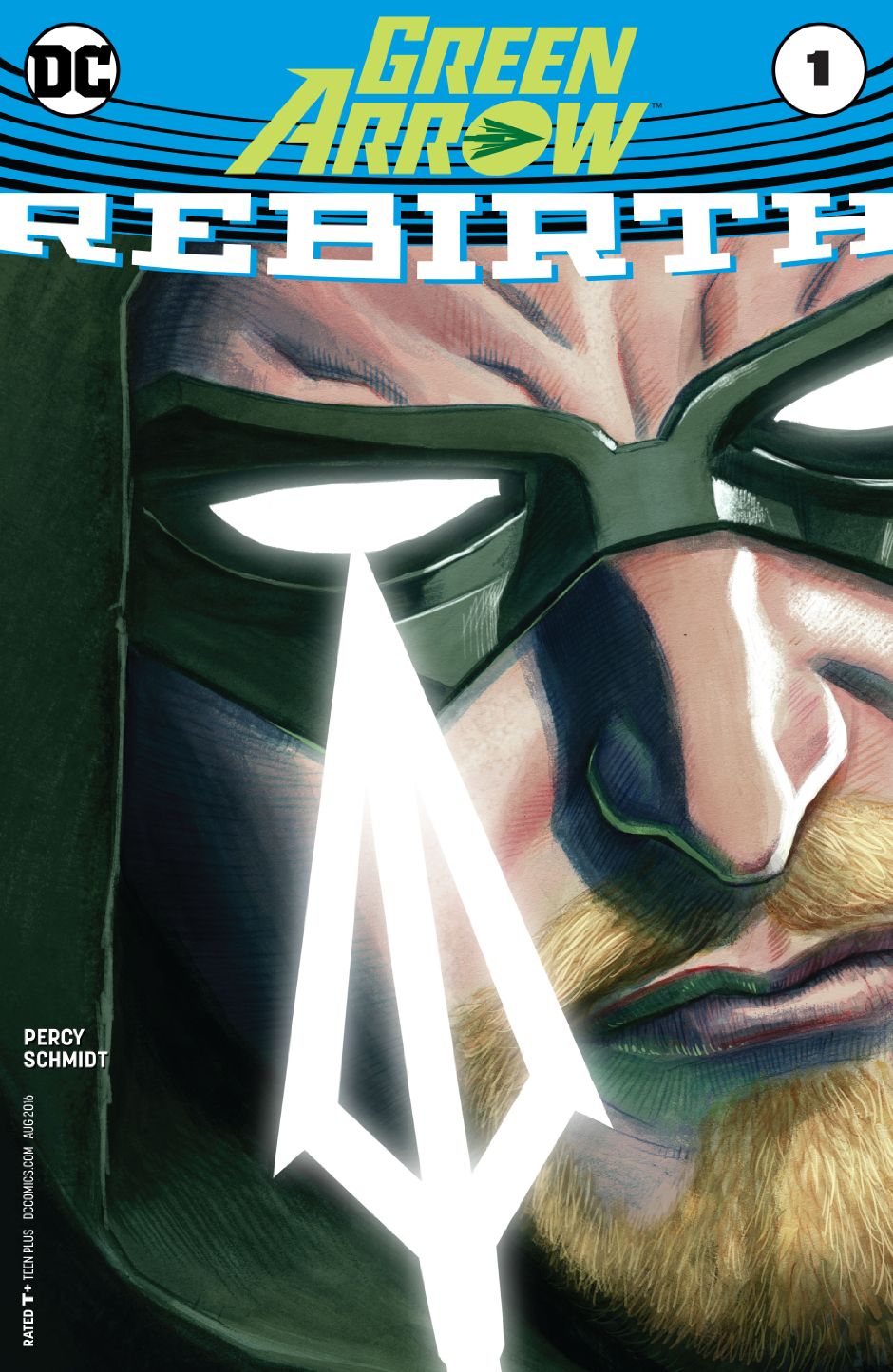
Green Arrow has had a bit of an odd journey since the New 52 began, which can be understandable when a majority of your history has been erased. For the most part, his character design was revamped to match what he looked like on the "Smallville" TV series. Eventually, the character got a boost in popularity thanks to the "Arrow" TV series, and like comics do, they try and make things match up. Among all the writers (and there were a lot) through out Green Arrow's New 52 run, the only one who seemed to receive a favorable reception was Jeff Lemire. Even when Andrew Kreisberg and Ben Sokolowski, writers from "Arrow", took over the comic, it received criticism for trying too much to make it like the show. After they left, Benjamin Percy took over the book, and from what I heard, it wasn't that good. I think there was a bit about him becoming a werewolf, so take that as you will. But once again, we have Rebirth to thank for cleaning up previous messes, but with Percy being one of the only writers to remain on their current book, there was cause to be wary.
While I didn't read the main Green Arrow book, he was part of some of the Justice League books and events. Much like my view on Superman in the New 52, I didn't really have a problem with how this version of Green Arrow was written, but it seemed a bit off compared to what I'm used to from the character. As we enter Rebirth, it's evident that the classic feel of the character was back, right down to the goatee. At this point in the new continuity, Oliver barely had facial hair, which made him seem younger. Giving the goatee back makes him seem a little older, but when it comes to Rebirth trying to recapture the classic feel for some characters, that makes it okay. In a way, this issue kind of seems like a complete restart, so that we don't really need to read the previous New 52 series, and from what I've heard, there's not much to look at outside of Lemire's run. He also has a new costume which resembles the one from season four of "Arrow". It looks good for the most part and it's nice to get a revamp after keeping the "Smallville" suit for so long, plus the goatee brings it all together.
But aside from looks, Oliver's character seems in line with that I'm familiar with, particularly from Justice League Unlimited, Young Justice, and Injustice, with a bit of Stephen Amell's version sprinkled in. For the most part, he's a man at the top who still cares for the little guy, no matter who they are. This is best illustrated in this story with how he helps a homeless boy rescue his mother from a human auction run by "The Underground Men", who sell people they believe won't be missed to mysterious bidders in masks.
Another aspect that makes its return to the Green Arrow book is his relationship with Dinah Lance, the Black Canary. This relationship was erased after Flashpoint and this issue is only their second ever interaction with each other in the current continuity. The issue does a great job (re)developing their relationship from the two getting past their preconceived conceptions about the other and eventually making quite a connection.
If there's a theme to this issue, it's second chances. Green Arrow's whole crusade is a second chance to make up for his past life style (which in a way makes him kind of like Iron Man), Black Canary has come to Seattle to get a fresh start, and Oliver even talks about how the city got a second chance itself after the Great Seattle Fire. I get the feeling that this new volume of Green Arrow, as well as Rebirth as a whole, is a second chance, learning from the mistakes of the past and building a better future for the character.
Overall, this was a great issue and I look forward to picking up the first collection.


Written by John Semper Jr.
Art by Paul Pelletier

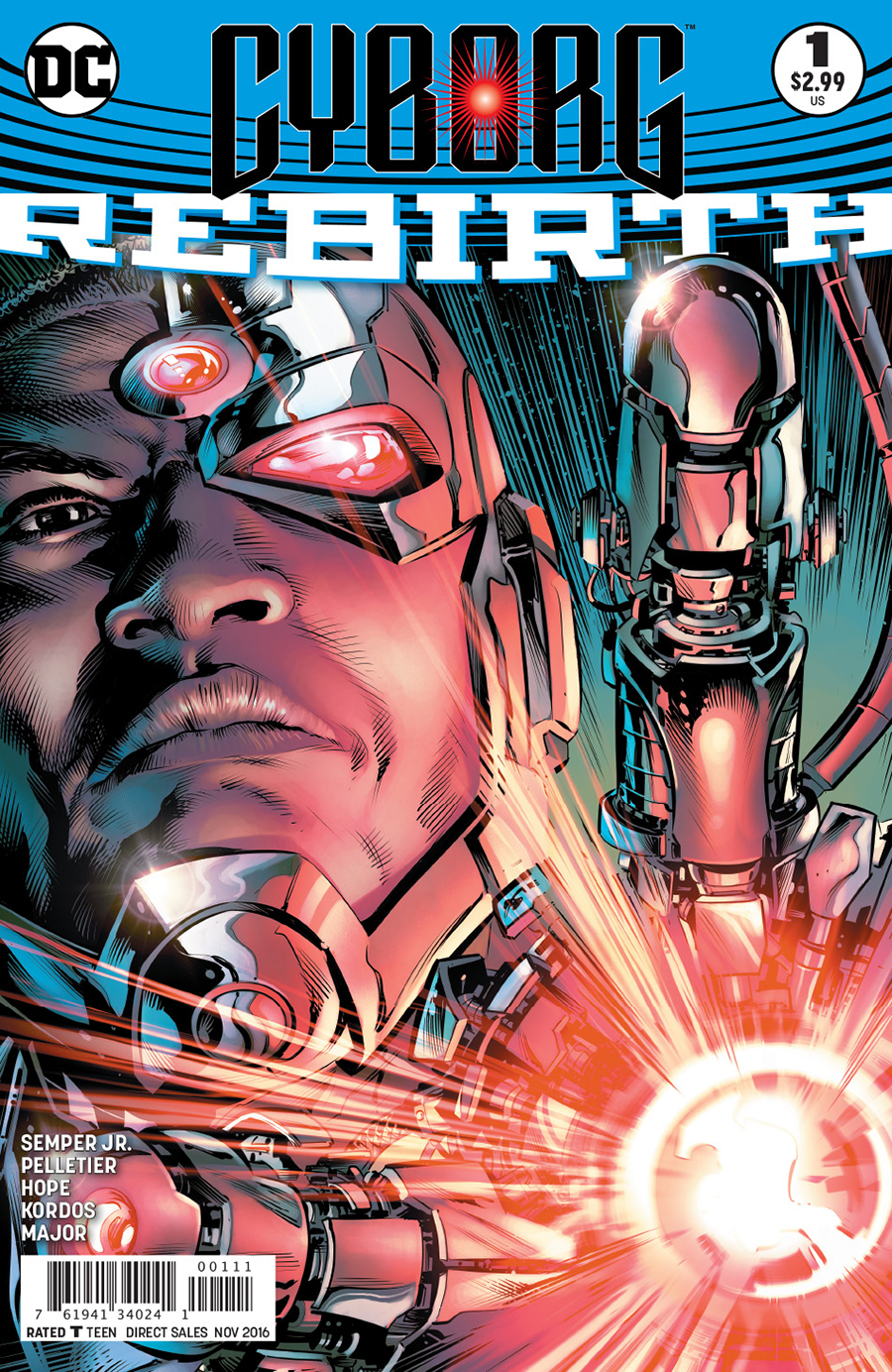
Most people are probably more familiar with Cyborg as part of the Teen Titans. When the New 52 began, Cyborg was given a major push by being retroactively made a founding member of the Justice League (replacing Martian Manhunter), and that push has continued outside the comics as well, with the character also founding the League in the DC animated movie universe and in the upcoming live action movie. Despite his upgraded status, strangely enough, Cyborg wouldn't get his own solo ongoing series until four years later. I heard something before that it'd be hard to market a non-unique name like Cyborg, but it hasn't stopped them now has it? Cyborg's previous volume lasted over a year before Rebirth began, which is where we're at now. I've gotten to know this version Cyborg well since he's a main character in the Justice League, so I hope I'm not missing much when it comes to his previous series.
The main plot of this issue is Cyborg fighting off a cybernetic organism known as Malware, who is trying to break into a secret area of STAR Labs that even Victor doesn't know about. Also during this fight, we're told by an unknown narrator about Victor's backstory, going back all the way back to when his parents met. We see them date, marry, and have Victor, but then his mother is stricken with cancer. His father works tirelessly to prolong her life, but neglecting Victor in the process. His mother is still there for him though until the day she finally passes. I was aware of Victor's issues with his father and that his mother had passed, but didn't know the full backstory until now. It's pretty sad, and I feel a little more sympathy for both Cyborg and his father, who I've really only seen in the present helping his son.
Cyborg and Malware's battle eventually gets to the secret area, where Cyborg is able to hack into Malware and shut him down. However, the secret area is still breached and we see what's inside: hidden recorded notes by Cyborg's father, questioning whether his attempt in saving his son's life and transforming him into Cyborg actually means he's alive or just a replication in a metal shell, as well as what it will mean for the future of mankind. Cyborg, while upset by this, doesn't let his father know he heard his notes. Elsewhere, our unnamed narrator is speaking with other machine based DC characters (including the Metal Men, Cyborg Superman, the Brain, Amazo and OMAC), and he's revealed to be another cyborg like character who believes Victor is the key to a machine uprising. I don't think this character's name is given, and while I could easily look it up, I'm not going to. He's so freaky and intimidating looking, that I can hold on until I pick up the first trade of this series to find out more.
So this comic was pretty damn good. I've always been used to Cyborg as more of a 'team' character that I didn't know what to expect out of a solo story. But color me impressed. Plus as an introductory issue, it does a good job at showing who the character is and  The art is great as well, reminding me of Ron Garney's work on Spider-Man within the past decade. I'm not sure how I feel though about apparently more father-son drama being a plotpoint in this book, especially since as far as I know, Vic and his father finally reconciled back in "Forever Evil".
I do have a few nitpicks though. Apparently, Vic has been Cyborg for "5 years, 31 days". On that, I call bullcrap. The Justice League's New 52 origin takes place five years before the present timeline began, and given EVERYTHING that's happened, not just to Cyborg, but EVERY other character in the DCU, I find it very hard to believe that it all happened within 31 days. Besides that, there's a flashback to the first Justice League story, but they show him in his current armor, which he didn't get until "Forever Evil." At this point though, art inconsistency across continuity has become a norm unfortunately.
Overall, this is another great issue that gets me excited for the first story arc.


Written by Geoff Johns and Sam Humpries
Art by Ethan Van Sciver and Ed Benes

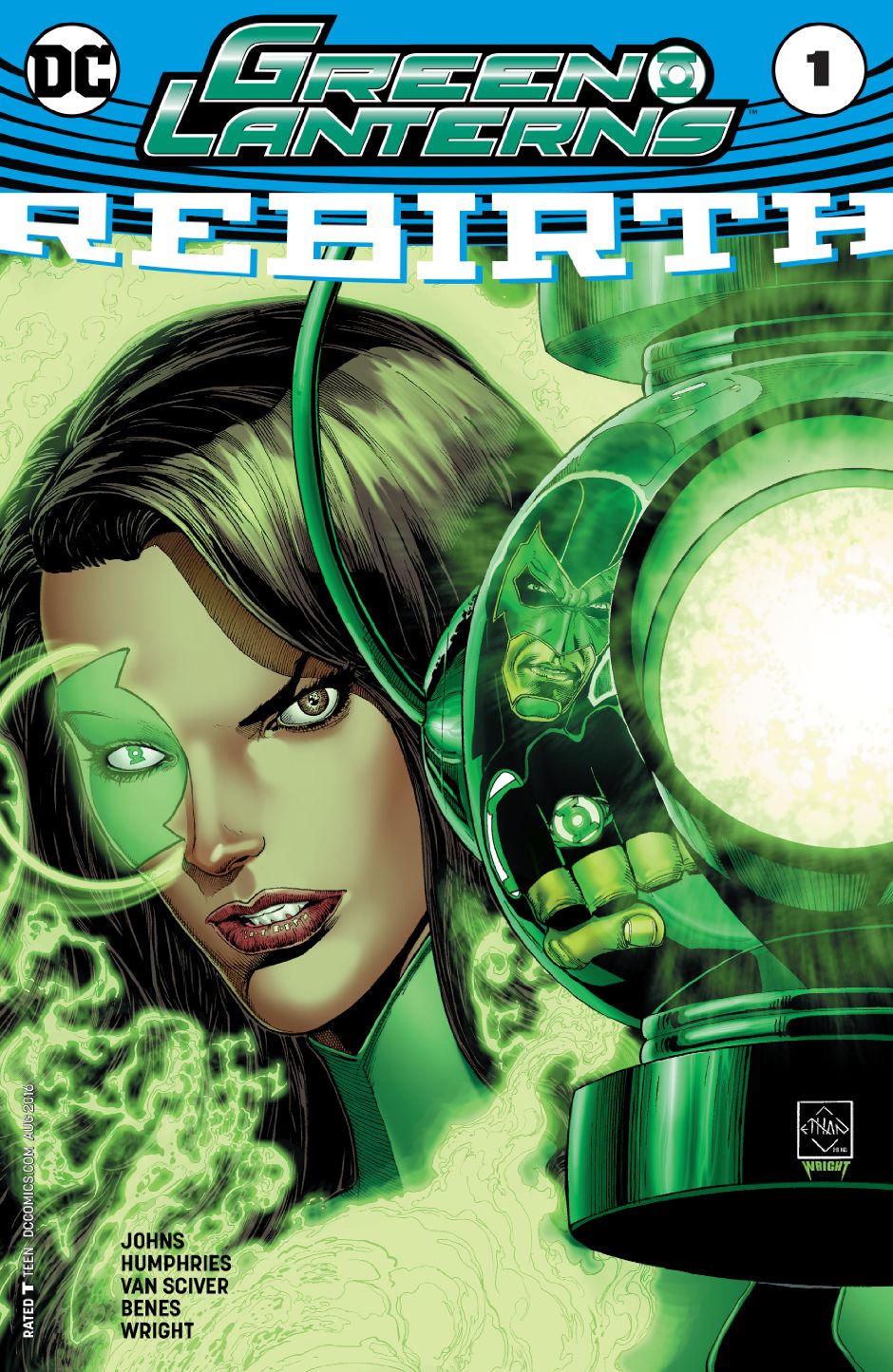
For whatever reason, Earth seems to get more Green Lanterns more than any other planet. We've had Hal Jordan, John Stewart, Guy Gardner, and Kyle Rayner. In recent years, there have been two more: Simon Baz and Jessica Cruz. Simon debuted a year into the New 52 and while his debut had gotten attention, he eventually and unfortunately fell into obscurity. Jessica debuted in the Justice League series, being possessed by the ring of Earth 3's Power Ring and taken under the League's wing to use that power for good. Eventually, she was able to destroy that ring and had been chosen to become a Green Lantern herself. As Rebirth approached, not only would Jessica be getting more of a push, but Simon was finally coming back to the forefront along with her. While the veteran Lanterns would be off in their own book in space, the two rookies would be co-starring in their own series as Earth's official Green Lanterns.
This issue is set sometime after the Rebirth issue of Hal Jordan and the Green Lantern Corps, as Hal in full Lantern mode is shown putting the rookies to the test with a Manhunter drone. As expected, the two don't work well together, so to make sure they do better, Hal fuses their Lantern Batteries, pretty much forcing the two to be partners to protect Earth while Hal is off looking for the rest of the Corps and stopping Sinestro. Hal also makes a comment about how the rings seem to keep choosing more Lanterns on Earth because they know something is coming.
The issue is a bit introductory for the two Lanterns, giving you a feel for who they are if you hadn't read about them before. Simon is a formerly accused terrorist, but the stigma still remains because he's a Muslim (and considering the current political atmosphere, we could use a role model like this). Before she became Power Ring and eventually a Lantern, Jessica was a shut-in with a fear of going outside. This issue shows her coming to the soccer game of her little sister (who is surprised to see Jessica outside), and even her inner thoughts show she's still uneasy and thinks the ring may have made a mistake in choosing her. We also have a bit of set-up for Atrocitus and the Red Lantern Corps being our first villains, but they don't have too much bearing on the plot.
The art is split up again between two artists. It starts out being done by Ed Benes and is taken over by Ethan Van Sciver. The change-up doesn't really bother me as much as the other issues that have done it, since both artists do very well. Plus Van Sciver's involvement begins once Hal Jordan arrives in the book, which adds some significance because his involvement in the past of the franchise.
Overall, I think this issue is okay. It's good, but it doesn't wow me, especially since it's mostly set-up and (re)introductions. And while I don't have anything against these new characters, I kind of have more interest in the veteran Lanterns' book given my familiarity with them. Maybe after reading Simon and Jessica's first story arc, I'll warm up to them a little more.


Written by Dan Abnett
Art by Brett Booth

Much like Superman, the book to keep an eye on going into Rebirth was Titans. The reason for that would be that it would feature the newly returned pre-Flashpoint Wally West. For those who read the proper Rebirth one-shot that started it all, Wally had been trapped in the Speed Force for years, and due to the events of Darkseid War, he was able to break free and interact with the New 52 Prime Earth. Unfortunately, due to the manipulations of time, no one knew him, and each time Wally tried to talk to someone without success, he disappeared further. In his last shot, he spoke with Barry Allen, and even if Barry didn't know him, Wally still wanted to thank him for the life he's led. Thankfully, Barry's memories of Wally came back and he was able to pull Wally from the Speed Force back into the real world, making it an emotional moment that was a sign of good things to come from Rebirth. Wally knows someone manipulated the timeline and erased him from everyone's memories, and he's going to find out who. In the Flash's Rebirth issue, Barry and Wally have an extended conversation, where Wally decides to go find the Titans and creates a new costume, and uses the Flash codename (as he once did in the old continuity) with Barry's blessing.
This brings us to the Titans Rebirth issue. Prior to this, Dick Grayson, Donna Troy, Roy Harper/Arsenal, Garth/Tempest, and Lilith Clay/Omen reunited as a team years after they were once the original Teen Titans, but through a little convoluted series of events, their memories of the team and each other were erased. While they were back together, they still felt something was missing...or someone.
The issue begins with a flashback of our characters taking a team picture together. We shift to the present where Wally in costume arrives at the Titans' loft (I'm guessing they live in a loft), where he finds the picture they took, but he's missing. Dick (now back to using the Nightwing identity) arrives, and of course, he doesn't know Wally. Dick tries to fight Wally, but Wally accidentally gives Dick a shock, which reignites Dick's memories of Wally. The rest of the Titans show up and fight Wally, thinking he's done something to Dick. While Wally tries to avoid the fight at first, he figures out that physical contact and a shock from the Speed Force reignites the team's memories of Wally. Eventually, the fighting stops and everyone's happy to see Wally again. Much like his conversation before with Barry, Wally explains what's going on, and that "the Titans are going to figure this out...together" while holding up the team picture once again featuring Wally.
Bringing back the classic Wally West was a sign of the old continuity resurfacing in the new, and him being a part of the reformed Titans is more proof of that. When he reignites the others' old memories, it's almost as if they're transformed back into their old selves. Well that technically applies to Donna and Garth, who haven't really been part of the new continuity too long. Dick's been more or less the same, and while Roy's been around just as long, I haven't been a fan of his New 52 depiction. As for Lilith, I've never actually heard of her until this book. The flashback segments were probably my favorite parts of this issue, as it helps establish the forgotten past, and in a way, makes me think of the versions we've seen in the Young Justice animated series (particularly the interactions between Dick, Roy, and Wally). The rest of the series going forward will probably them picking up the pieces and making up for lost time.
Art-wise, Brett Booth is in his usual form. I know some people don't like it, but I think it's okay. It's stylized, but can be off sometimes.
If there's one thing I have to take off points for, it's that Roy is still wearing the trucker hat he's had since the New 52 began. I mean, here's Rebirth, where you're giving characters a new start and new designs (sometimes reflecting the classic continuity), and they keep one of the most ridiculous aspects of the present. I mean, what function does a trucker hat serve for an archer?

Nonetheless, with Wally back and the Titans fully reassembled, it seems like this is going to be one of THE books that best emphasize Rebirth's goal of returning a classic feel to the DCU.

Next week, we deal with some ladies of Gotham, a petty dabbler in the dark arts, a gun-toting vigilante, and a bunch of misfits trying to do some good.