Tuesday, July 16, 2019

Comics Review: Heroes in Crisis - Somebody Save Me


Superheroes are an ideal to look up to, but not everyone thinks about the physical or psychological risks they can endure. Torture, long-term injuries, being maimed, killed, as well as resurrected, and any of those could happen to heroes' loved ones as well. How do heroes cope with these traumas? This was the idea behind Sanctuary, a rehab facility developed by Superman, Batman, and Wonder Woman, where heroes could come and go as they pleased when the pressures of the job can become overwhelming. Sanctuary itself was the focus of the murder mystery miniseries "Heroes in Crisis", where multiple residents are killed in a massacre. While there was a lot of potential to be had in this, what resulted was one of the most frustrating and pretentious comics I've ever read.

Before we delve into the story itself, I need to take time to explain how Sanctuary worked. "Heroes in Crisis" is the first time we actually see Sanctuary, and it isn't until issue three until they give us the rundown. Sanctuary is designed as a farm house in Nebraska run by an artificial intelligence. Some of its features include robots meant to resemble Jonathan and Martha Kent as well as Lana Lang, a reality show style confessional room where heroes can privately express themselves for the house AI to help, as well as a holodeck that helps heroes work out their issues in a more tangible way, which they call "chamber sessions". Heroes can also preserve their privacy by walking around the facility in white robes and golden masks.

Issue one is a bit disjointed, much like a good chunk of the series itself, so I'm going be summarizing for the most part. Superman, Batman, and Wonder Woman are responding to an emergency alert at Sanctuary. Superman arrives first to find all those present have been killed, with bodies laid out both inside the house, but mostly in the field outside.
All the casualties aren't revealed in the first issue, but rather over the course of the series. To save time, those killed include Blue Jay, Commander Steel, Hot Spot, Lagoon Boy, Gunfire, Red Devil, Gnarrk, Protector, Tattooed Man, Solstice, and Poison Ivy. For the most part, it's a bunch of c-list heroes. The problem with some of these deaths though is that a good chunk of these characters hadn't been seen in years including before the New 52 reboot, and even after the reboot, some of these characters had either only made minor appearances or "Heroes in Crisis" marks their first appearance in the new continuity. Like Lagoon Boy. "Hey remember that character you liked on 'Young Justice'? He's dead now." I'm not even kidding when I say DC even tried to promote the character's return to comics with his own death. I'm just saying, it's hard to care when some of these characters hadn't made any recent significant impact. Also, I didn't notice before with the character of Blue Jay, a character who has shrinking powers. Apparently, his shrunken body was being ripped apart and eaten by birds. And here I thought I couldn't hate this story more without looking back and finding such morbid imagery.
However, there are two major characters killed whose deaths really pissed me and a lot of fans off: Roy Harper/Arsenal and Wally West/The Flash. Killing off these two shows that DC was still willing to screw with the Titans. Hell, throw in Dick Grayson getting shot in the head over in the Batman book, suffering from amnesia and now going by Rick (ugh), and Tom King has singlehandedly dismantled over half the original Teen Titans roster. Wally's death hurt the most though. His return at the beginning of the Rebirth initiative was a sign of good things to come from DC. Those who remember my Rebirth Review series know that it allowed me to expand my view of the DC universe further than ever before. The idea that this was how Wally's story would end is a giant middle finger to fans who were happy to see him back and what Rebirth represented.
Once Batman and Wonder Woman arrive to the survey the damage, they find the house ransacked, the robots of the Kents dismantled, and a message written on the wall saying "THE PUDDLERS ARE ALL DEAD!" Wonder Woman explains that puddlers were a term for those who made swords, skimming the molten metal ane removing the impurities so the iron can be strong. Batman surmises that someone who was being treated at Sanctuary was responsible for the massacre. All three lament how their attempt to help their superhero community has failed and just became another wrong to right.
The only ones unaccounted for at Sanctuary are Booster Gold and Harley Quinn. The two apparently believe they saw the other kill all the other heroes, and after initially getting away from each other, Harley finds Booster at a diner and it leads to a fight between the two.
It's also in this issue where we are introduced to a recurring plot element throughout the series, that of the confession cam videos, featuring heroes who have come and gone. The layout of these pages are nine panels with the heroes in front of the camera just saying what comes to mind.

Now in theory, this is a pretty good idea, especially in the first issue, as it allows us to get some insight to those residing at Sanctuary. Unfortunately, this idea becomes overused quickly, turn out to add nothing of value to the story, and just feels like a way to fill out the page count. I did do a tally and these scenes make up 31 of the 202 page count. I know that doesn't seem like much, but when they're sprinkled throughout the story in random spaces, it can get annoying and hurts any momentum the main story may be building.
One of the biggest examples of these pages being a waste include one for Black Canary in issue four, where she's sittting down in the first panel, says "Ah, $%@# this" in the second, gets up and walks out in the third panel, and the remaining six panels are just the background of the room. Like, why?! Then you have the pages featuring multiple characters at once, many of whom play no major part in the story and some whose dialogue doesn't really give us any clue about what they're actually at Sanctuary for. For example, Catwoman has a panel where she just says "Meeoww." Or better yet, there's one with Blue Beetle Jaime Reyes where he says "You ever see that old movie? The one where the guy has to do the thing? I think that's me. I'm the guy who has to do the thing." I have literally no idea what King is trying to have Jaime say here. And that's the problem. DC let King have full reign of the toy chest, and he's acting like he has this deep insight to all the characters. Sometimes it works, other times it seems like he's trying too hard to the point where you're not sure what the character is trying to say, and the rest of the time it seems like he just gives up.
Also, the nine panel page is one of the ways King tries to emulate Alan Moore, who famously used this layout often in his work, including "Watchmen" and "Batman: The Killing Joke." There's more I think King is trying to emulate from Moore and particularly "Watchmen" with this story, but we'll get there.
I will say though that despite my rage towards Wally and Roy's deaths, I did objectively find the beginning of the story an intriguing start with a genuine mystery to be solved. Much like "Civil War II" though, how a story begins doesn't entail how the rest of it goes.

Issue two sees Batman performing an autopsy on Commander Steel as Superman and Wonder Woman believe Batman already knows who committed the massacre. Batman denies this, but the other two tell him that he's been known to try and exploit heroes' weaknesses (see the "Tower of Babel" storyline for example) and that he would put backdoors into Sanctuary to do so. Batman insists he intended to keep Sanctuary anonymous, so that heroes could talk about their problems without judgment and that any information collected is deleted immediately afterward. Batman's final argument is that he himself has gone to Sanctuary for sessions. Back to the autopsy though, Batman finds a pair of wind-up teeth down Commander Steel's throat, and that someone forced it down. This leads them to Harley as a suspect.
The earlier fight between Harley and Booster ended with her stabbing him and leaving him for dead. Afterwards, Harley went to Penguin for help and was given one of his safehouses to hide out in. We also see that's she back to wearing her original jester outfit; I'd say that would be at least one win for this series, but she's clearly going back to her Rebirth look by this September. Of course, the Trinity find Harley. Upset, she runs to Wonder Woman for a hug claiming that Booster killed everyone at Sanctuary. This is an act though as Harley uses the opportunity to steal the lasso of truth. After kicking back Wonder Woman, Harley gets the jump on Batman, wrapping the lasso around his neck. Superman and Wonder Woman don't want to make any sudden moves with Batman's life in danger. Harley then makes Batman tell her what he has in his utility belt to fight Superman, forcing him to reveal where he's concealing his Kryptonite ring. Harley uses the ring to weaken Superman, and as Wonder Woman's helping him, Harley lets go of Batman and makes her escape, still carrying the Kryptonite ring. A lot of people complained about this scene with Harley being able to beat out the Trinity. Honestly though, these moments in comics where a character beats someone they're outclassed by happens so much that it doesn't bother me. I mean, they all underestimated Harley and she took advantage of that. I will say though that I think Wonder Woman still could have given chase; Harley was leaving, taking the Kryptonite with her which meant Superman would have been fine in a little while, and Wonder Woman was in much better shape compare to the other two.
Elsewhere, Booster is awakened by his robot companion Skeets, who has healed Booster of his wounds. It's here we see that King is still writing Booster as stupid as he did in "The Gift". Booster explains to Skeets what happened, that either he or Harley killed everyone at Sanctuary, and is wondering what he should do next. Despite Skeets' insistence that he should turn himself in, Booster doesn't listen and convinces himself to solve the mystery because that's what Batman would do. Booster then heads to Central City to find the other Flash, Barry Allen. Barry is fighting a group of samurai robots (because comic books) as Booster arrives talking about what happened believing Barry already knows everything. Unfortunately, Booster is too dumb to realize that Barry has no idea what he's talking about and he's ignoring Skeets' pleas to shut up. It's here I really question why Skeets needs to be here. I know banter between him and Booster is a staple, but the way King writes Booster, it makes him look even more stupid when he won't listen to reason from his closest friend; it's more like he just needs someone to bounce his ideas off of to convince himself to do something he was probably going to do anyway. Booster then begins to name off some of the victims "Like Arsenal...Blue Jay...Ivy...Wally...". Upon hearing Wally's name, Barry races off to Sanctuary to confirm his death and is back almost immediately, decking Booster and screaming "WHAT DID YOU DO?!" with tears in his eyes.

I like this splash page for a number of reasons. 1) It's an emotional moment for Barry and it's one that has some real weight to it, something I wish this story had more focus on. 2) Booster getting punched out; story wise it's just because he may be the killer, but he really deserves it because of just how casually he tells Barry "Oh hey, your old sidekick is dead."
Back in Gotham, Harley is atop a suspension bridge dropping a rose into Gotham River below, feeling guilt over Ivy's death. It's only one page and I wouldn't have mentioned it, but this ends up being a plot point later. I'll just save some time here by saying that in issue five, the rose is picked up by a red gloved hand as it's washed ashore.
Issue two ends with Lois Lane receiving a package at the Daily Planet. It's a recording of Arsenal's session from Sanctuary with a message that reads "Our heroes hide themselves from us. From Sanctuary. Here is the truth. More truths will be coming." It is signed by "the Puddlers."
This issue is okay, but the end of it really helps add fuel to the mystery. Too bad it ends up being disappointing.

Before going into issue three, it's worth noting that when this story was announced, it was to run for seven issues. By the time the first issue came out, it expanded to nine. From what I could tell, King was given two extra issues that were devoted to expanded character insight, which I guess you could consider interludes. The first of these is issue three, and it's okay I guess as I assumed there was a reason for such a break in the story. By the time I get to issue 6, I'll explain why these issues turn out to bring very little to the story and how they could easily be skipped without missing anything.
I'll just skim through the main points of issue three:
* Lagoon Boy is using his chamber session to get hit by a laser over and over to try and get over a similar incident during a battle with the Titans.
* Wally West is using his chamber sessions to spend time with his family. To explain some backstory, Wally had been erased from history because of "Flashpoint" and trapped in the Speed Force, and therefore the family he had in the old continuity had been lost as well. Once he returned in Rebirth, Wally learned that his former wife Linda didn't know who he was and it wasn't until the "Flash War" storyline that Wally remembered that they had had twin children, who no longer existed. Trying to cope with the loss of his children was the reason Wally checked himself into Sanctuary.
* On the day of the massacre, Booster Gold was actually at Sanctuary for his first day and learning the in's and out's of the place. When the emergency alert sounds, Booster exits his chamber session to witness Lagoon Boy being impaled with a spear and Wally being bashed in the head with a mallet from Harley Quinn as he was cradling Roy's body. I know that makes it sound like the case is closed and that Harley was the killer, but considering there are six more issues, there's obviously more to it.

As we actually get back to the plot in issue four, Batman and Flash (Barry) believe they know who's responsible for the massacre based on the evidence they've gathered. The problem is Flash thinks it's Booster while Batman blames Harley; obviously there's some bias in their investigations.
Meanwhile, at the Hall of Justice, Wonder Woman is using the lasso of truth to interrogate Booster about what happened. Booster says that he saw Harley hit Wally with the hammer, then she knocked him out, later woke up in the field among the bodies, and flew away from the scene.
We then cut to Lois and Clark's apartment, opening with this splash page of Lois doing a pose in her underwear and wearing a Superman t-shirt.
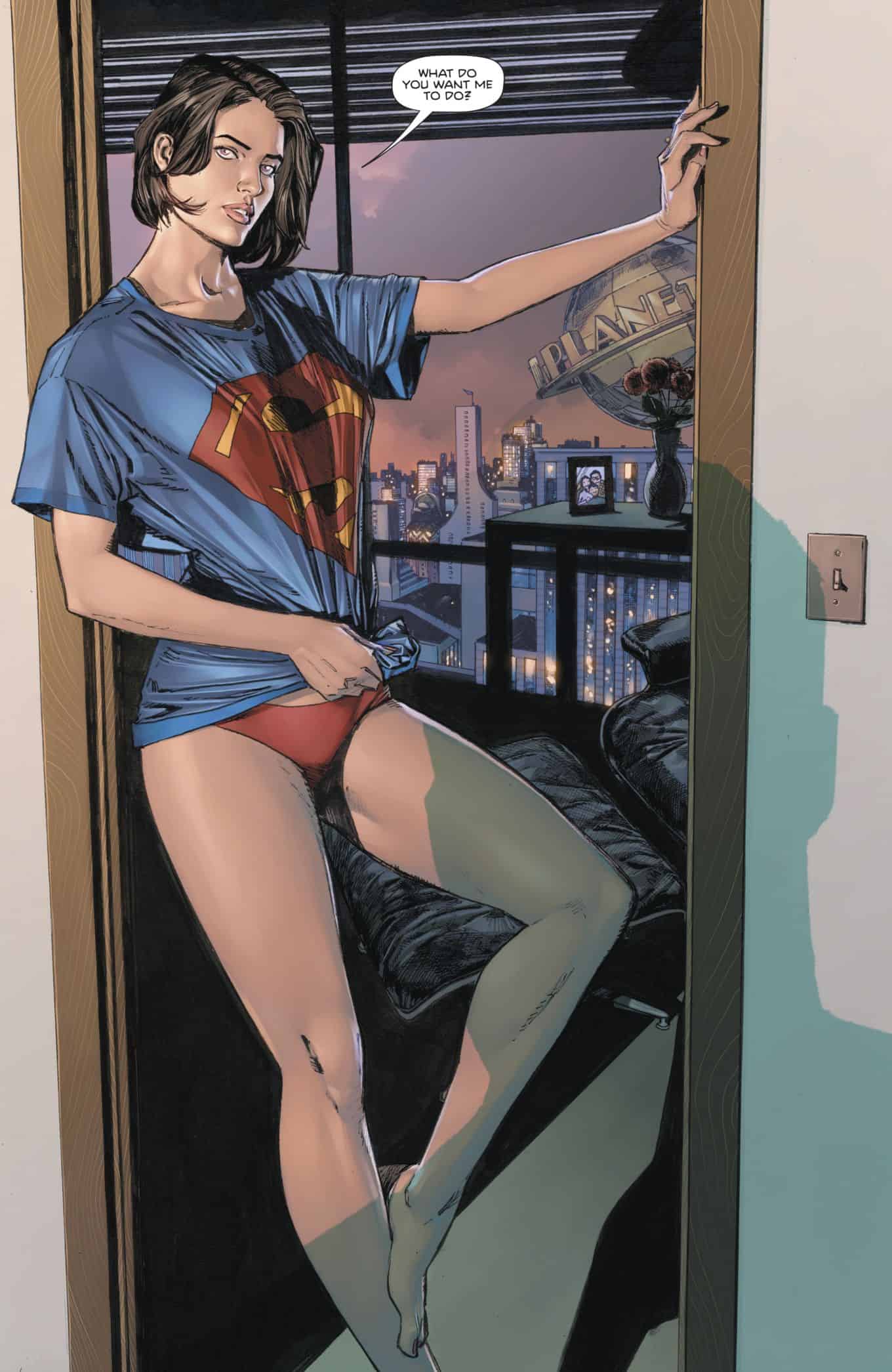
Because if there's one thing this story about mental health and mass murder needed, it's fanservice.
Anyway, Lois tells Clark that she receives a new Sanctuary confession video from the Puddler every day and that if she doesn't publish something about it soon, the videos will start going to someone with less discretion and not as connected with the superhero community as she is.
Elsewhere, Batgirl has located Harley at one of Joker's old hideouts. Harley wants a fight but Batgirl is able to calm her down. She tells Harley that Batman would be able to find her as easy as she did, saying "he'll take you and he'll judge you. He'll see you. The same way he sees me. As pitiful. Broken." This is in obvious reference to "The Killing Joke" where Joker shot Barbara point blank and crippled her; unlike the pre-Flashpoint continuity though, Barbara healed and returned to being Batgirl. That being said, what the hell is Barbara talking about? I admittedly don't read Batgirl's solo book, but based on her interactions with Batman in books I have read, I never got this impression of Batman's feelings toward Barbara. I even did some digging and way back in Batgirl's sixth issue of her New 52 series (which was set after her return to the role), Bruce assured Barbara she was always meant to be Batgirl. Between comics pre and post Flashpoint and the Arkham video games, Bruce has always treated Barbara as a valuable partner as both Batgirl and Oracle. Now, I'm kind of hoping Barbara is just saying this to connect with Harley, but what I think would have made this seem genuine is if they bonded over being hurt by the same man, i.e. the Joker. In any case, Batgirl is able to settle down Harley and the two agree to work together to find the real killer.
Wait a minute...Barbara's judgment is still bizarre here. Harley may be trying to redeem herself, but she's been a Bat-family villain for the longest time. Between her and Booster, Harley would be the one more likely to kill anyone. Why the hell is Barbara trusting Harley all of a sudden?!
Back at the Hall of Justice, Booster is in a holding cell and being visited by his best friend, Blue Beetle Ted Kord. Booster tells Ted that even under the lasso's influence, just because he believes he didn't kill the heroes at Sanctuary, it doesn't mean he didn't, which does make sense given his mental issues. Well apparently Ted's been taking the same stupid pills as Booster as he uses his airship, the Bug, to blast a hole in the wall and breaks Booster out. The two decide to solve the case themselves, declaring "bros before heroes."
Later in the Batcave, the trinity are fuming over Ted and Booster's jailbreak. Superman adds to the bad news though as he reveals to the other two about Lois receiving the Sanctuary videos and that she's publishing an article, but will let the heroes remain anonymous as she can. Batman doesn't believe this as any videos taken by Sanctuary would have been deleted immediately, but Superman assures him that he's seen the videos himself. All this does is make me wonder why the Sanctuary AI needed to record anything in the first place, especially if any footage was going to be deleted anyway. Batman is furious and noting how between the murders and Lois receiving the videos that it can't be a coincidence. Wonder Woman asks Superman when Lois will be posting the story, with Superman's reply that "she sent it 35 seconds ago."
All I really have to say about issue four is that it's all over the place.

Issue five begins with Booster and Beetle hard at work on the case...sitting on the couch, watching TV, drinking beer, and eating pizza. Lucky for the reader, we peer in on them at the moment Booster comes up with an idea. They should go see Barry Allen and look over the clues he's gathered for themselves. Beetle points out that he tried that before and got locked up, but Booster says they wouldn't expect them to do the same plan twice. I mean, I guess there's some logic to that.
In the Batcave, Batgirl is convincing Batman to let her take a look at Skeets, using his tech to try and find Booster. Batman has already done this but Batgirl claims that she has developed another method to analyze him, hoping it could pick up something he missed. Batman agrees and Batgirl's response is a little off: "Fine? Really? Cool. That's cool. Thank you Batman. You rock." It comes off like she's a teenager (keep in mind Barbara is in her twenties) trying to convince their parent to do something that's just a cover for something else. That's obviously the case since she's working with Harley, but she doesn't have to sound like she's covering something up. It's dialogue that unfortunately reminds me of her immature behavior in the prologue story in the "Killing Joke" animated movie.
We cut to Lois and Clark's apartment, where Clark is preparing a statement for a press conference Superman and Wonder Woman are to give concerning Sanctuary. Clark hopes to ease people's fears because they're scared about the idea of superheroes having such psychological problems that they need to seek help. At the press conference itself, Superman gives a pretty good speech, basically saying that people shouldn't be afraid of heroes having such problems, but that they should be comforted that these heroes, who know the risks of their job, realize their problems and are working to better themselves.
So this whole idea of people worried about superheroes having psychological troubles...I kind of get it. Compared to Marvel heroes, DC heroes represent more of an ideal and something to aspire to; I feel this would be true in universe and out. Powered or not, the people have witnessed these heroes perform tasks that make them appear to be gods among men; they've even seen Superman die and come back from the dead. Considering the level of power some of these characters have, it's understandable to fear that such beings could reach a breaking point and hurt others. Even in the real world, many people have had someone they've looked up to and had that perfect image shattered in some way. The problem though is this idea isn't fully realized as we don't actually SEE how the public is reacting; we're only told about it. Not only that, but this plot point doesn't become relevant for the rest of the series.
This also brings me to one of my points concerning Tom King and Alan Moore. I believe "Heroes in Crisis" is Tom King's attempt to make a "Watchmen" story with DC heroes. "Watchmen" introduced us to heroes who were obviously flawed, turning the ideal of superheroes upside down, along with the public's love-hate relationship with them. "Heroes in Crisis" is all about superheroes coming to terms with their flaws and to some degree how people perceive them once they learn of such flaws. Here's the thing though: Tom King may try to be like Alan Moore, but his writing style makes him come off like Brian Michael Bendis trying to be Alan Moore. In terms of dialogue, King reminds me a lot of Bendis. It's hard to explain exactly, but sometimes these two write dialogue in such a way that it doesn't come off naturally, where it borders on rambling or trying too hard to hammer in the point the characters are trying to make. I've made it a point to only bring up King's dialogue when I feel necesssary, or this review would be much much longer. If anyone's captured Moore's style well, it's Geoff Johns on "Doomsday Clock", the story that's actually a "Watchmen" sequel and the culmination of the Dr. Manhattan plotline introduced way back at the beginning of "Rebirth." Since issue one of that story, Johns has done a brilliant job of recreating Moore's style as we're reintroduced to the world and characters of "Watchmen".
Let's get back to "Heroes in Crisis" though. Batgirl takes Skeets to a playground and tells him that he knows he has a way to track Booster and explains her plan: Harley Quinn is going to beat the hell out of Skeets until he tells them where Booster is.
This actually works by the way. So to be clear, Batman couldn't figure out how to track Booster by analyzing Skeets' systems, but Harley is able to torture the robot to the point where he tells her and Batgirl. Oooookay. As the two head towards Booster's location, Batgirl reminds Harley she promised no killing. Harley replies "You worry too much, Girl Bat. I won't kill him. I'll just murder him." Batgirl has to tell her that's the same thing and we have to remind ourselves that Batgirl is working with the ex-supervillain murder suspect instead of bringing her in.
Speaking of Booster though, he crashes through the window of Barry's lab with a smile saying "Hey Barry! How's the whole mystery solving going? Did I do it?" Much like in "The Gift", Booster still can't act appropriately in certain situations. Deservedly so, Barry decks Booster again and screams what most readers are thinking when King writes him: "WHAT THE HELL IS WRONG WITH YOU?" This time around though, Booster has his weapons back online and knocks Barry out with an energy blast. This allows Booster and Beetle to go over the evidence and thanks to some time travel forensics Booster knows, they discover that the body of Wally West is five days older than it's supposed to be. And just because it was these two that found that out doesn't mean I was wrong about Beetle breaking Booster out. Before they can do anything with this knowledge though, Batgirl and Harley arrive on the scene.
Issue five is when I started having serious problems with the story the first time around, mainly because the public reacting to Sanctuary doesn't live up to its potential. But I was also worried because it was with this issue where I and probably a lot of readers realized who the killer was, even though we were wishing it wasn't so.

Issue six is the second character insight interlude issue. It is in my opinion the worst issue of the series and where I and probably a lot of people lost any hope with this book.
So imagine you're reading this series as it was coming out. We just got a major clue concerning Wally, you wait a month to see where that leads, and nothing comes of it in the next issue, so you have to wait yet another month. I get that King wanted to do more character insight, but he should have done it in a way where the central conflict of the story, i.e. the murder mystery, doesn't lose its momentum. Hell, we've been getting these insights since issue one with the nine-panel confessional pages. That's why I said before that you can skip issues three and six and miss nothing. And to compare to "Watchmen" again, Moore did take the time to dive deep into the characters, but they were his own creations that readers needed to know more about. King is using established characters and trying to make it seem like he has a deep understanding of everyone he's writing (keyword is "trying"). Even Geoff Johns does a better job at this with "Doomsday Clock", looking into the backstories of new characters like the criminal duo Mime and Marionette, as well as the new Rorschach. Also, despite the constant delays "Doomsday Clock" has faced (the book started in November 2017 and at the time of this writing has only reached issue ten of its twelve issue run), whenever a new issue does come out, the story does progress and leaves you looking forward to the next one.
But like issue three, issue six takes a look at three characters:
* Gnarkk, a caveman. King has Gnarkk talk about a lot of philosophical stuff, but doing so in caveman speak. It's really hard to get through, so I honestly just skipped his scenes.
* Another look at Wally West as he reflects on how everyone from Barry to Superman to the Titans were glad to have him back and that his return was a sign of hope. However, Wally is upset that he doesn't have his family, and that despite the fanfare he's received from everyone, they didn't lose as much as he did. From a story standpoint, this is showing Wally at a low point, creating a parallel to issue three, where he was trying to live out having his family again and enjoying himself. However, from a meta standpoint, this kind of pisses me off because it shows that King knew what Wally meant to "Rebirth" and the old and new fans it brought in, and he still decided to kill him.
* Ivy is helping Harley, who is not actually supposed to be at Sanctuary, work out some of her issues, mostly by using chamber sessions so she can kill Joker over and over again. And we have this freaking page:
First off, could they have at least color-coded the speech balloons so we can keep track of who was saying what? But more importantly, this is another dialogue issue. THIS IS NOT HOW PEOPLE TALK. I genuinely want to know, has anyone in real life ever had this kind of back and forth conversation full of short sentences and fragments?
Anyway, Harley and Ivy are in a chamber session when the emergency alert sounds. Ivy tells her to stay put, thinking it's just a drill and to come out if she doesn't come back. However, Harley does see Gnarkk cradling Protector has he succumbs to his own injuries. More importantly though, we see the opposite of issue three, as she witnesses Booster killing Wally with an energy blast as he was cradling Roy's body. If you're confused considering what was shown before, this all makes sense later.
After the release of this issue, I was basically trudging along when it came to the rest of this series, just wanting to get it over with. Seriously, by this point, I was slamming my head with this and every following issue.

Issue seven gets back to the plot again with Harley attacking Booster, with her mallet shattering on Booster's energy shield, constantly saying she's going to kill him. So what are Batgirl and Beetle doing during this? Are they fighting each other or trying to break the two up? Nope, Barbara's facepalming and just hanging back with Ted as they watch the two duke it out. This is sitcom level writing here, like in one episode of "Archer" where an annoyed Lana just casually makes some coffee while Archer is fighting another agent they're supposed to work with.
As the two keep fighting, Ted offhandedly mentions that Booster's energy shield is remotely hooked up to the Bug's operating system, which is tied into Ted's consciousness that only really works while Ted's conscious...so Batgirl then punches Ted out. She then tells Harley that the shield's out followed by "Remember, no killing!". As a reminder, Batgirl's saying this to the girl who keeps talking about killing Booster. Harley says she's going to kill him again, and Batgirl replies "Did I not just say no killing?! […] C'mon!" "C'mon"?! For Pete's sake Barbara, this isn't like telling a kid not to eat glue when they keep trying to. SOMEONE IS ABOUT TO BE MURDERED!
Booster is at Harley's mercy, and Booster pretty much gives up, admitting in anguish that he's a failure and begging Harley to kill him. Is it bad that I'm not exactly hoping she stops? Harley picks up the broken handle from her mallet and slams it down, making a "CKKRKK" sound, but the next panel shows she pierced it down on the floor right beside his head. She curses and collapses down next to him.
The four settle down and talk about how Wally may still be alive, but they have to find him quick because it's been five days since the massacre. They develop the plan to hook up Skeets to Kord's satellites, so they can scan for any time travel disturbances on the planet. Ted thinks they should bring in the League on this, but Barbara thinks they should keep it small since Wally is probably in a bad place. Booster points out that the League doesn't trust the lot of them anyway: "Everyone thinks we're nothing. Even we think that. That's why they think we did it. Because only nothings could do it." So his logic is A-list heroes could never do anything so terrible; I'd make a Hal Jordan/Parallax joke, but that would be redundant with what we're about to find out. The point is, Booster says the four of them are the only ones who can save Wally and solve the mystery. Given Boosters's track record under King's writing, those aren't good odds.
Elsewhere, we see Wally West in a field of flowers planting the rose Harley dropped in Gotham River. He flicks some Speed Force lighting at the flower. It then grows and blooms, unleashing a reborn Poison Ivy, as seen in probably the best drawn page of the series.
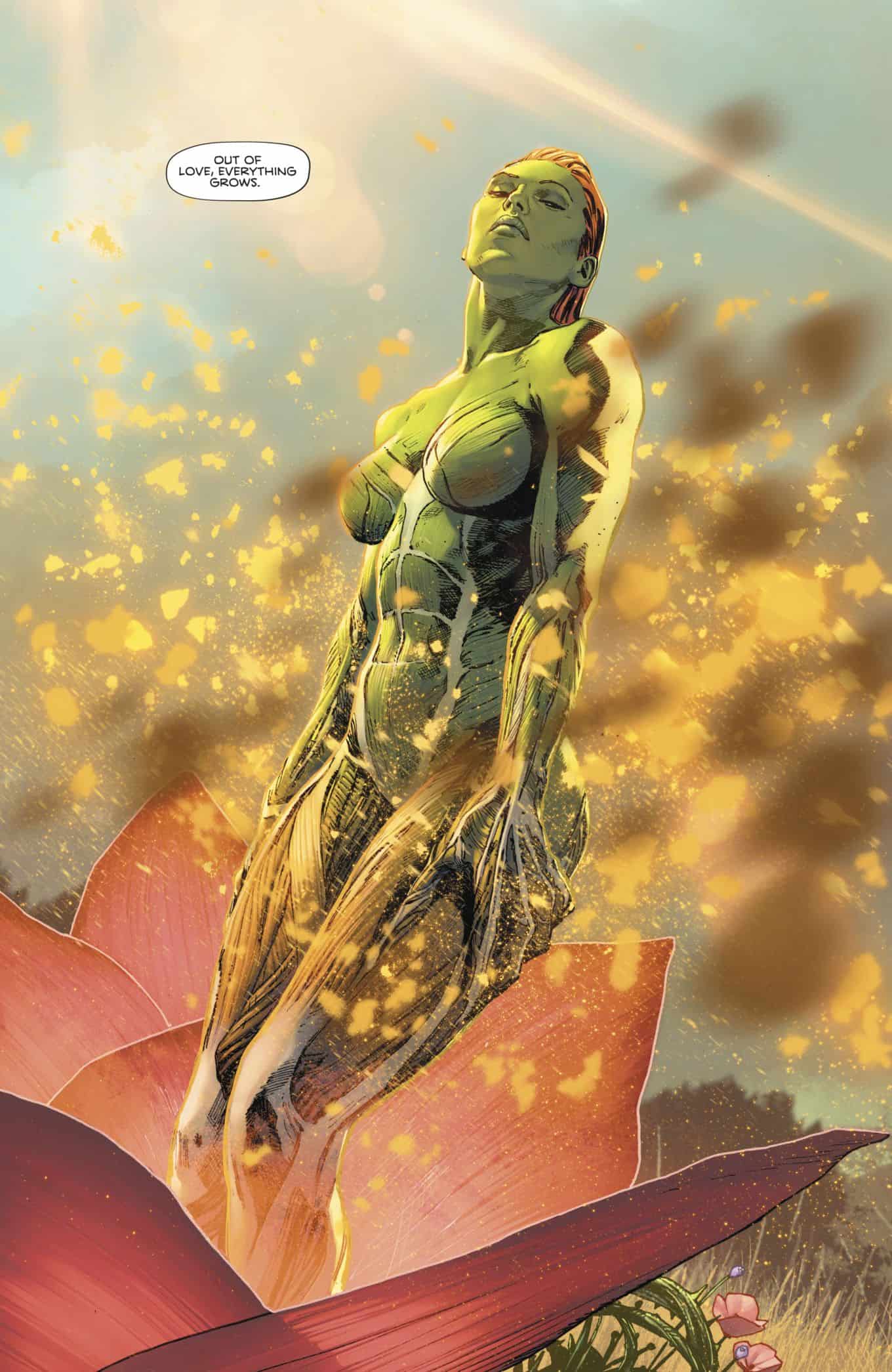
I haven't said much about the art from Clay Mann, but it's one of the few great things about this series. There are some fill-in artists, but none of them match what Mann brings to this book.
Ivy thanks Wally for helping her, but Wally apologizes for hurting her and for what she's about to see. Suddenly, another Wally West appears as the original Wally tells Ivy, "Death. You'll see my death."
Like issue six, it's confusing, but thankfully(?) we have all questions answered in the next issue.

Issue eight depicts the final confessional video sent to Lois, that of Wally West. And I have to give credit to King; he actually subdued himself with the confessional room scenes in this issue and didn't make them nine panel pages. Wally talks about how despite being at Sanctuary over three weeks and thinking he's made progress, he still feels alone. The Sanctuary AI keeps telling Wally that he's not alone and that there are other heroes hurting like he is. Wally believes no one could be feeling the pain he is, even going so far as to think Sanctuary was built just for him and that anyone else there is just trying to make him feel better about himself. Wally had begged Sanctuary to show him someone else, but was told it was meant to be anonymous and that any data collected is immediately deleted and scattered to the point where the average man would never be able to piece it back together. But Wally, being the fastest man alive, was able to recover every piece of the heroes' confessionals (which again makes me wonder why they needed to be recorded just to be deleted). The way the book displays it, it seems like Wally was able to do this by running into cyberspace itself; if that's indeed what happened, even for comics, that's pushing the level of absurdity.

Anyway, Wally watched every confessional, experiencing "the totality of a thousand heroes in crisis" (roll credits). It overwhelms Wally and he rushes outside the farmhouse into the field, trying to collect himself. This actually sets off the emergency alarm, causing the other heroes to head outside and then towards Wally to try and help him. A distraught Wally is building up too much Speed Force energy, and in a moment of weakness, he unleashes a surge of lightning that kills everyone surrounding him and scattering them across the field.

As much as it sucks that Wally was the killer, in the context of the story, it makes sense. Out of everyone in the aftermath of "Flashpoint" and the New 52 reboot, no one had lost more than Wally. He didn't just lose his family; he lost his place in the universe. Sure, he was able to jog the memories of his friends, but to the rest of the world, he didn't exist; worst of all, he was just a stranger to the woman he loved. I take some solace in that Wally did it by accident, but what he did next was inexcusable.
After what happened, Wally ran back into Sanctuary, seeing that Booster and Harley were still in chamber sessions. With Wally basically in control of Sanctuary now, he reprogrammed the chamber sessions and used his speed (going so fast that no one notices him) to make Booster and Harley believe they had gone outside when in actuality though, they were still in the chamber and were made to watch the other kill Wally, eventually placing them back outside after making sure they saw what he wanted them to see. Wally would also steal Booster's time travel tech to travel five days into the future to kill himself (with his future self telling him to find Ivy's flower in Gotham River) and then bring the body back to place with everyone else at Sanctuary; if anyone's wondering why Wally didn't just go back and stop himself from killing everyone, it's revealed in the final issue that he had worried about causing another "Flashpoint" like Barry did, which was the reason his children were erased in the first place. Following that, Wally would lay out the clues that would fool both Barry and Batman into believing Booster or Harley could be the killer. Wally also ransacks Sanctuary, destroying the computer and robots, and writing the Puddlers message on the wall. Wally talks about how puddlers died young because of their work, "almost as if what was wrong with the iron went into them". But said iron was used to build cities and create a beautiful new world. Wally finishes his confession, admitting he set everything up to distract everyone, so that he could have five days not only to kill himself, but to finally tell the truth.
The moment Wally decided to cover up what he did was the moment the character himself was assassinated. He elaborately framed two innocent people who were seeking help as he and everyone else at Sanctuary was, even going so far as to shove a pair of chattering teeth down Commander Steel's throat. Wally may be admitting his misdeeds and planning to kill himself as penance, but the way it's written sounds like he's trying to justify his actions. His talk about the puddlers and how some good came from their sacrifice makes it sound like he and the other heroes being gone would make the world a better place. Not only that, but he says he "made everyone focus on the murders that weren't". Admittedly, what Wally did was involuntary manslaughter, but his cover up attempts make it just as bad as murder. Wally was understandably in a bad spot, but I feel things could have gone better for him if he just waited for the trinity to arrive and explain what happened.
Still, this makes me think back to Batman's autopsy of Commander Steel back in issue two. Everyone at Sanctuary essentially died from being struck by lightning; could the WORLD'S GREATEST DETECTIVE not tell this from his examinations?! I know Batman can't just solve everything, but I feel between this and not being able to ascertain Booster's location from Skeets, his skills are being severely underplayed in this story.

Okay, one issue left. Let's get this over with. Past Wally is about to kill present Wally, which is interrupted by our motley crew of Harley, Booster, Beetle and Batgirl CRASHING THE BUG and NEARLY HITTING Ivy and the two Wally's, moving out of the way thanks to their speed. I'm sure they expected Wally to move out of the way, but that was a huge risk; they basically tried to save Wally by nearly killing him.
The four heroes come out of the crashed ship and put the situation together after seeing the two Wally's, which is followed by a nice reunion between Harley and Ivy. Past Wally starts to have a breakdown knowing what he has to do, but present Wally is actually there to console him. Present Wally, inspired by Superman's speech from issue five, assures his past self that he's truly not alone as he thought. He points to the other heroes around them, the problems they've all had to deal with, and the fact they were all there to help him. My main takeaway from this is that this all could have been avoided if Sanctuary had just included a group therapy option.
The problem is if Wally doesn't kill himself, it will create a time paradox. Booster then chimes in saying they don't need to kill Wally, they just need a dead body. To elaborate, Booster and Beetle will go into the future to make a lifeless clone of Wally, which past Wally can bring back with him to ensure there's no time discrepancies. Before this plan is put into motion, Harley puts her two cents in, by kneeing past Wally in the groin and cursing him out for killing Ivy and framing her. If this was supposed to be an attempt at comedy, someone should have told King that any chance at comedy died along with the rest of the heroes in issue one.
And so, Booster and Harley are cleared and free to hang with their best friends, Barbara is checking herself into the reopened Sanctuary (hopefully with that group therapy option), and Wally West is locked up by the League...somewhere. Wally plans to embrace his pain, hoping it can make him better and that he can one day redeem himself as the series FINALLY ends not with a bang but a whimper and allow those reading the story to be able to move on.


If I hadn't made it clear, this comic sucks. I thought maybe holding off a month to review this would have lessened my rage at this story since it ended, but looking back just made me find more to hate. There's a lot more I could have talked about, but I just wanted to cover what I felt was important.
As I said at the beginning, "Heroes in Crisis" is a story that had potential to be great, but it ends up combining the worst parts of past DC stories like "Identity Crisis" and "Cry for Justice", with needless deaths and bad character depictions. It's drawn out too long and its attempts to be deep are hindered by writing that makes characters' actions and dialogue seem really off. It wants to be both a look into the mental health of superheroes and a murder mystery but is unable to balance it well enough to the point where it should have just been one or the other. Hell, it doesn't even work well enough as a murder mystery. Issue eight gives us all the answers anyway, and I think it probably would have been better if they had Wally reveal everything after Booster, Harley, Beetle, and Batgirl arrived before he killed himself so they could piece it together as well.
And while I'm somewhat happy Wally didn't die, the path they put the character on could be viewed as a worse fate. I'll admit, I didn't really know much about Flash history until just before "Flashpoint", but for fans who started reading the Flash between the late 80's to the 2000's, their Flash was Wally West. For twenty years, he was THE Flash, so much so that it was the Wally West version used in the Justice League animated series. As much as I hate what's been done to Wally, I can't imagine how fans who hold Wally dear to their hearts must feel. If there is a path to redemption for Wally, it won't be an easy one.
I haven't hated a comic this much since "Civil War II". In a way, "Heroes in Crisis" is definitely the worse of the two. "Civil War II" may have had characters acting stupidly, but the issues actually progressed from one to the next and wasn't so far up its own ass. To give "Heroes in Crisis" a little credit, it doesn't hurt DC Comics as a whole for me like "Civil War II" did to Marvel for awhile. "Heroes in Crisis" may have left a bad taste in my mouth and burnt off a lot of good will DC had built with "Rebirth", but DC still makes up a majority of my pulllist with a lot of good stuff to read. In short, "Civil War II" is worse as an event whereas "Heroes in Crisis" is worse as a story.
Still, this story has really soured me on Tom King's writing. Like Brian Michael Bendis, I'm intending to avoid King if I'm able to from here on out. I just need to make it through the rest of his run on Batman, which should wrap up by December; after three years and over seventy issues, I think I'm in too deep to drop out now and it could still have a good ending.

I do have a couple ideas on how the story could have worked better.
1) Have it so that the Sanctuary house AI was behind the murders. Say it gained sentience and after compiling so much data from the heroes, in its own demented way decided to end their pain by killing those on site at the time, even going so far as to play/frame both Booster and Harley. It would then appear as if it were offline, but actually transferred offsite and leaked the videos to Lois Lane from there. I feel like this way, it would feel even more like a personal defeat for the trinity, creating a place that was intended to help only for it to become as fractured as the heroes it treated.
2. Have it be A murder mystery, i.e. a SINGLE murder. Someone is killed in Sanctuary, and the house is locked down until the trinity arrives. They would interview everyone present at Sanctuary, in turn being forced to compromise the anonymity they had intended for the heroes who came there.

Overall, "Heroes in Crisis" is a book that will make you need your own therapy session after reading, and I am so glad that I can put this book behind me after months of thinking about it.

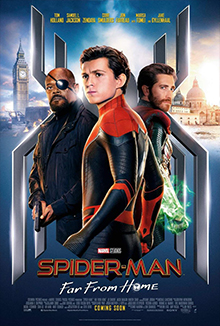
Wednesday, July 3, 2019

Movie Review: "Spider-Man: Far From Home" - Swinging High Again


"Spider-Man: Far From Home" is a lot of things. It's the second Spider-Man film in the MCU, the epilogue to the three phase spanning "Infinity Saga", and our first look at a post-"Endgame" world. While the latter two are important for the larger universe as a whole, this installment is important for the Spider-Man franchise and the tedious partnership between Marvel and Sony regarding the character. Said partnership is based on a limited contract and how many films, both solo and ensemble, they include Spider-Man in, and some fans think Sony could pull the character out at any moment. Not only is that idea ridiculous since Sony makes all the money on the Spider-Man movies while allowing Marvel to do all the work and ride on their coattails, but I feel that "Far From Home" cements Spider-Man's MCU future for years to come.

As mentioned before, the film takes place after "Endgame" and we get to see how the typical person deals with the fallout of them or someone they knew being gone for five years. For some, younger siblings could now be older than them now. But a more prominent issue are those displaced, as between Thanos and Bruce's snaps, some people may have no place to live. One of the things that come from that are outreach programs to help those affected that way, and we even see Aunt May working in such a place, similar to her work with FEAST in the comics. I'm sure more fallout will be explored in future films, but I like how just as "Endgame" didn't just erase "Infinity War", things aren't just getting swept under the rug and returning back to normal; there are true consequences.

With four movies already under his belt, Tom Holland delivers his best performance as the character yet. In "Homecoming", Peter was more concerned about becoming a big time superhero rather than being a normal teenager. This time around, it's the opposite. With everything that's happened to Peter since "Infinity War", it's understandable that the teenage hero would just like a break. It's hard though when he gets roped into a new adventure he makes it clear he didn't want to be on and the pressure he feels he's under due to being Tony's apprentice. If you didn't care for Peter's story in "Homecoming", "Far From Home" delivers a more emotional, relatable journey as we get the classic dilemma of the character trying to balance his hero and civilian lives. But still like "Homecoming", they make it clear that Peter's just a teenager dealing with the problems you'd expect one to have at that age.

Zendaya returns as Michelle Jones, nicknamed "MJ". And let me get this off my chest: people just need to accept that she's the MCU Mary Jane, even if she's not named that. I know people have a specific look in their heads when they think of the character, but considering how many changes the MCU makes to characters in the transition from comic to screen, I don't know why this one gets some riled up.
As for the character herself, I'm thankful she has a much bigger role here compared to "Homecoming". In the intervening time, Peter and MJ have become closer friends, with Peter beginning to reciprocate a crush she already had on him, but neither not sure how the other feels. Her personality from before remains in tact and we get to see through Peter's eyes what he likes about her. The chemistry between Holland and Zendaya is adorable. The romance isn't as passionate like Tobey and Kirsten or Andrew and Emma, but it works because they're both awkward teenagers, and they make a cute couple. But much like Emma Stone's Gwen Stacy though, she does try to help Peter as Spider-Man in some instances.

When it was revealed Samuel L. Jackson was playing Nick Fury again for this movie, I was really excited to see him and Spider-Man interact since I really enjoyed their relationship in Ultimate Spider-Man (the comic, not the cartoon). Compared to Tony, Nick is a much sterner mentor to Peter, getting real close to asshole territory. It sounds bad, but it's just about what I expected. And much like the Ultimate comics, Fury gets put in his place over his treatment of Peter by Happy, much like the Thing had done.

Now let's talk about our villain of the movie, Jake Gyllenhaal as Quentin Beck/Mysterio. Yes, he's the villain, and I feel like anyone who knows anything about the character wouldn't have bought the whole "hero from another universe" story; being a conman is his whole schtick. Putting away the obvious non-twist, Gyllenhaal is one of the finest villains to come from a Marvel or Spider-Man film. He plays "the part" of the hero well, manipulates Peter in a way that he comes off like a mentor, and we get to see his composure go from confident to unhinged as he becomes more desperate to complete his plan; it's similar to how Michael Keaton's Vulture started to lose it more and more. Being behind the Elementals is one thing, but we also get to see Mysterio live up to his title of the Master of Illusion, giving us the most trippy scenes ever seen in a Spider-Man film. It also creates some paranoia, with Spidey and the viewer questioning if what they're seeing in certain scenes are real. Without spoiling anything, much like Thanos, Mysterio is a villain that's been building up since "Iron Man", but in a more subtle way. This goes in line with "Far From Home" being the true finale of Phase Three and the "Infinity Saga". Finally, fans wondering why Fury recruits Spider-Man out of all the other heroes is also part of Mysterio's grand plan.

The action and visuals in this film are spectacular. Along with Mysterio's illusions, we get a lot more excitement when it comes to Spider-Man's acrobatics. I felt with "Homecoming" that some of the swinging and action was somewhat subdued, something I hadn't realized until I saw Spider-Man actually swinging between buildings in "Infinity War". In "Far From Home" though, they really cut lose, giving us the best Spider-Man swinging action since the "Amazing Spider-Man" movies. The final battle also shows Peter in his most ravaging battle yet, forcing him to think more on his feet and making his victory even more satisfying.

Like a Spider-Man video game, we get a good variety of suits in this film. All the previous suits are present, from homemade to Iron Spider, and then there are two new ones. The first is the Stealth suit, which will probably start being called the "Night Monkey" suit; I love how there was some influence from the Noir version of the character, making it a more modern design. Then there's the upgraded suit, which is more or less the MCU version of the advanced suit from the PS4 game; it's like the old suit but with slight modifications and a unique design. What's nice though is that this is actually the first Spider-Man suit Peter has actually created himself since the homemade one, and it's a sign he's finally starting to become his own hero without anyone holding his hand.

The film includes a mid-credits and post-credits scene, both of which are important to the future of the MCU.
The mid-credits scene is a real game changer to Spider-Man's world and the shock value of this scene is on par with the end of "Infinity War" with all the characters getting dusted. Rest assured, this will make the next Spider-Man film very different from any that had come before.
The post-credits scene can be a little confusing, but doing a little research, I think it's set-up for the next major threat to the MCU.
In both cases, they imply a necessity for a new Avengers team to form going into Phase Four.

Overall, when it comes to the live action films, "Far From Home" is the best Spider-Man film yet and while I may be biased due to my love for the character, I also found it to be one of the best MCU films as well. Dramatic, action packed, and pretty damn trippy, "Far From Home" is another must see for fans of the wall-crawler and Marvel as a whole.

My Marvel Cinematic Universe Film Rankings:
1/2. Avengers: Infinity War/Avengers: Endgame
3. Spider-Man: Far From Home
4. Guardians of the Galaxy Vol. 2
5. Black Panther
6. Captain America: Civil War
7. Thor: Ragnarok
8. Avengers: Age of Ultron
9. Captain America: The Winter Soldier
10. The Avengers
11. Guardians of the Galaxy
12. Doctor Strange
13. Spider-Man: Homecoming
14. Ant-Man and the Wasp
15. Ant-Man
16. Captain Marvel
17. Iron Man 3
18. Thor
19. Captain America: The First Avenger
20. Iron Man
21. The Incredible Hulk
22. Iron Man 2
23. Thor: The Dark World

One last comment: f*** Brad. That will make sense when you see the movie.

Thursday, June 27, 2019

Series Analysis: Power Rangers Ninja Steel


POWER RANGERS NINJA STEEL (2017-18)
Adapted from Shuriken Sentai Ninninger
Neo-Saban Era

When people think back on the Mighty Morphin' days of Power Rangers, two things may come to mind: dinosaurs and ninjas. While the Mighty Morphin' suits remained dino-based for its three years, the last year introduced ninja based powers and zords, with the Alien Rangers having a more ninja-based design (keeping in mind that this was all due to different Sentai seasons being used). Coincidentally, much like how the dinosaur motif has occurred at almost 10 year intervals with Dino Thunder and Dino Charge, the same can now be said for ninjas. Along with Ninja Storm in 2003, now we have Ninja Steel.
I found Dino Charge to be a sign of the franchise getting back on track after years of a downward spiral. Does Ninja Steel keep that momentum going?

The series is centered around the Ninja Nexus Prism, a sentient object that travels across the universe granting power to those in need at times where great evil needs to be fought, similar to how the Quasar Sabers work in Lost Galaxy. The villain Galvanax seeks this power himself but is unsuccessful, making it even more complicated once the Prism creates the Ninja Power Stars, bestowing them on those worthy of becoming the Ninja Steel Power Rangers. While taking the Prism is still the main goal, the villains at the very least attempt to defeat the Rangers and steal their Power Stars.

Tonally, Ninja Steel is a back-to-basics approach to the franchise, trying to evoke the Mighty Morphin' days. Megaforce also attempted to do this at first until they decided to drop actual character driven stories in favor of non-stop fights and action. Ninja Steel, however, is actually able to succeed in this respect and keep it going to the very end. We have Rangers in high school once again, and in between fighting monsters, we see them dealing with real life problems, like overcoming fears, learning life lessons, and dealing with family drama. We even have recurring characters like other students, school staff, as well some of the Rangers' parents appearing. Coupled with the improved acting, Ninja Steel created what I felt to be an authentic environment (at least as much as you can get from Power Rangers) with characters we can actually care about and relate too.
Problematically though, I noticed a lot of similar plot points shared with Dino Charge, particularly at the beginning. You have the main villains seeking a power source that grants the Rangers their abilities, the Red Ranger searching for a missing relative who also becomes a ranger, and one of the villains capturing the Gold Ranger and using their power for their own means. It's not odd that different seasons would have resemblances in story, but when it's back to back seasons, it just kind of feels like they copy and pasted.

The theme song is fine, if a bit basic. It's actually kind of bizarre too, where the lyrics are sang quite fast and yet the tail end of the song kind of lingers like they were about finished but needed to go just a little longer. I also think it's a bit of a sign your theme song is lackluster when during the Megazord finishing moves, they're either playing instrumentals of "Go Go Power Rangers" or the Dino Charge theme; if anything, it just reminds me of how good the Dino Charge theme was.

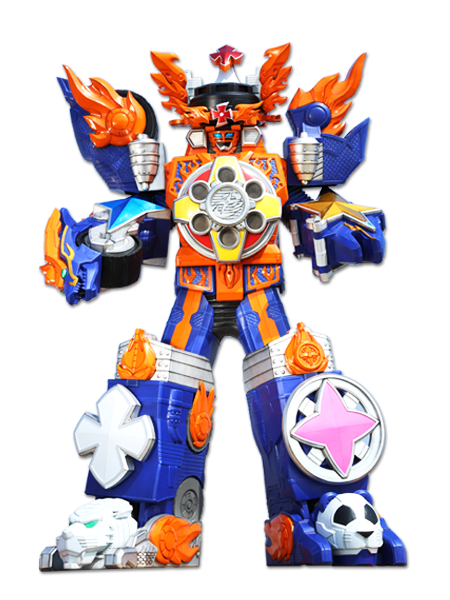
Speaking of zords though, they're a bit all over the place. Usually sets of zords are based on humanoids, animals, or vehicles, but this time around they're mixed. The initial zords are a robot, a dragon, a dump truck, a train, and a dog, with auxiliary zords including an elephant and UFO.
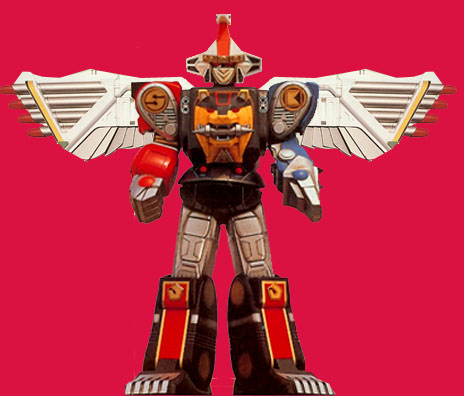
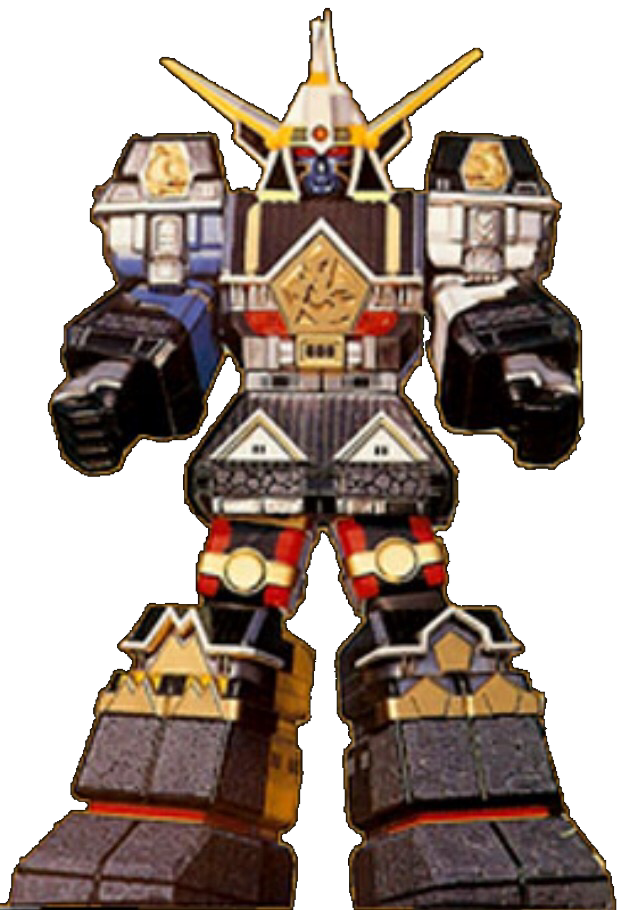
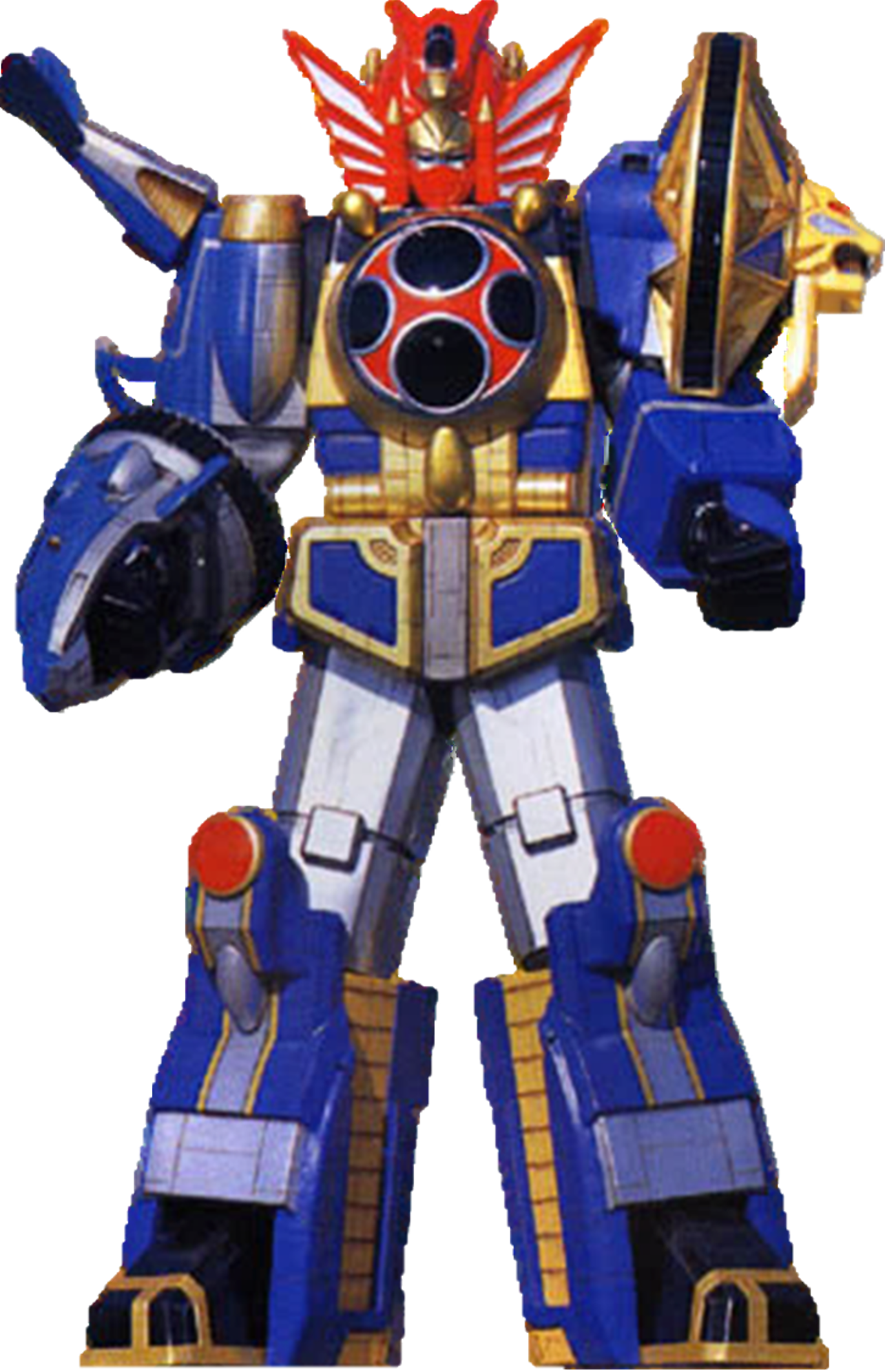
I will say though that with the new set of zords they get later, the Ninja Blaze Zords, they're a bit more focused. They're all based on animals and when they combine into the Ninja Blaze Megazord, it makes me think they took some inspiration from Megazords from past ninja based seasons, including the Ninja Megafalconzord and the Shogun Megazord from Mighty Morphin', and the Storm Megazord from Ninja Storm.

Primarily blue, animal heads making up the fists, circular chest, prominent symbols on the legs, and birds making up the head. I even looked into the Sentai source, Ninninger, to see if aside from behind the scenes decisions, maybe the past ninja sentai teams, Kakuranger and Hurricanger, had a hand in helping develop it, but not so much.

The Rangers this season don't have much when it comes to complex characters, pretty much being goody-goodies like the original Mighty Morphin' team. Still, I'll go through what I liked and didn't like about them.
Brody, the Red Ranger, had a lot of potential when the season began. He was kidnapped at a young age by Galvanax after watching his father apparently die, and he was made a slave on Galvanax's ship for ten years before escaping with fellow slaves Redbot and Mick. Once he enrolls in school with the other Rangers, there's not much of a "fish out of water" story considering he was gone from Earth for so long. One of his main goals is finding his older brother, much like Tyler was looking for his dad in Dino Charge. After finding his brother though, there's not much of a journey for him. Still, he does have stuff to offer like teaching the other Rangers ninja skills like his father taught him and his brother, and he later offers lessons to those wanting to learn at school too. That aspect reminds me of Jason teaching karate classes at the juice bar; and honestly, Brody kind of reminds me of Jason to some degree altogether. Though his constant saying of how something is "epic" can get a little annoying once you catch on to how often it happens.
Preston, the Blue Ranger, is a non-annoying and actually fun version of Dax from Overdrive in how they're both aspiring showmen. He's wanted to be a magician since he was young, and thanks to his Ranger powers, his magic amplifies from simple tricks to actual spells which come in handy quite often. He's not in everyone's face about it though like Dax was like saying how something could be like a movie or wanting to be an actor.
Sarah, the Pink Ranger, is kind of what I'd expect if Kimberly and Billy had a kid. Like Kimberly, she's very attractive and has a similar fashion sense (and I bet kids today watching had a crush on her like kids did on Kimberly back in the day). Like Billy though, she's the smartest of the Rangers, taking pride in school and inventing a lot of crazy devices. The first time she appears on the series, she's riding a freaking hoverboard she invented herself; that's comparable to Billy creating the Radbug, the flying car they used at times when the teleportation system was down Granted, we learn that hoverboards are a common thing now, but she's also invented holographic clones of herself and a device that can create delicious cookies out of any kind of food.
The interesting thing about Calvin and Hayley, the Yellow and White Rangers, is they start out the season as a couple, and a good one at that in my opinion. Usually, Rangers become closer as the season goes on and hook up by the end so this is a nice change of pace. I partly wondered how much drama we'd get and if they'd do a break-up storyline, and we partly get that in the finale, but nothing extensive. There's also one episode where Calvin thinks Hayley is cheating on him with Preston, when in reality they're just part of a surprise Romeo and Juliet performance with the two in the title roles; misunderstanding aside, infidelity is a pretty heavy topic for a show like Power Rangers in my opinion, and my dad cheated on my mom so that's a sore spot for me. Individually though, Calvin is an aspiring mechanic whereas Hayley doesn't have much going for her aside from the acting thing, but it doesn't come until the second half of the season and it only in two episodes at that.
Levi is the Gold Ranger, Brody's brother, and a country music star. When he first debuted, I wondered if he would put his music first since he's such a public figure, similar to how Phillip in Dino Charge was a prince. Thankfully though, realizing Ranger duties are more important, he takes a break from touring and even enrolls back in high school, not to mention spend some time with his long lost brother. Levi's a likable character and he does come off as a charming celebrity. His Ranger design can be described in no other way than "ninja cowboy". His helmet has a hat shape to it, his sword is also designed like a guitar, and his shield is similar to a poncho which gets a cloth extension thanks to a power-up he receives later (which had a little more build-up than it needed). It sounds silly, and it kind of is, but it does help differentiate him from the core Ranger team.

Compared to the last few seasons, the Rangers have a bit of a supporting cast this season.
First there's Mick, portrayed by Kelson Henderson, who has done a number of roles on Power Rangers, through voice work and live characters, since production moved to New Zealand with Ninja Storm. His best role was probably Boom on SPD. Mick is the one who helps develop the Rangers' weapons and zords, forging Ninja Stars that he throws into the Prism, which completes the process. At first I thought he was just going to be the tech guy like he was in SPD, but Mick turns out to be an unlikely mentor. Throughout the series, he helps the Rangers learn life lessons in a way that's unique and where the Rangers are able to come to the realization themselves without Mick having to spell it out. Overall, Mick is likable and one of my favorite characters on the show.
Redbot is pretty much the Alpha of the series, helping when he can and having some interaction with other people like Alpha used to. He does have an edge over Alpha though in that he has rocket feet and can help fight a little bit.
Then you have Victor and Monty, who are essentially the Bulk and Skull of the series. I don't make that comparison lightly though, as they do at some point get a new version of Bulk and Skull's theme music playing during their own scenes (funny enough, I was imagining their theme song over those scenes even before the actual music became part of the show). Another good comparison for the two though is Gaston and Lefou from "Beauty and the Beast." Victor is the stereotypical jock, and a well accomplished one at that, and Monty is the stereotypical nerd, and I kind of think they're jock and nerd the other jocks and nerds don't want to hang out with. The main goal of these two throughout the series is Victor getting his 50th trophy, at times lying or trying to sabotage others to do so. Like Bulk and Skull, they're the victims of a lot of physical comedy in the series. Unfortunately though, a good portion of such comedy is fart jokes. Fart jokes can work and done in moderation, but it has to be for the right audience; Power Rangers may be a kids show, but it's had a fair share of very dramatic moments where it feels so out of place, especially over two decades in. Victor and Monty don't have any real character development compared to Bulk and Skull, but they do have their heroic moments. They're able to prevent one of Madame Odius' plans to destroy the Rangers and in the finale, they're able to transport a number of human captives off of the villains' ship, even killing villains Cosmo and Badonna in the process. So it shows they may be a-holes, but they're not 100% dicks.

Much like Sledge being a bounty hunter in Dino Charge and using his prisoners to fight the Rangers, the villains of Ninja Steel do have a uniqueness to them. Galvanax runs a intergalactic television show called "Galaxy Warriors", which is he is the champion of. The show initially pits alien monsters to fight each other, but with the debut of the Power Rangers, the format changes with Galvanax sending monsters to fight the Rangers and retrieve their Power Stars. It's an interesting concept and it's a win-win situation, as the monster gets recognition for themselves in addition to getting the Power Stars for the main villains.
With this concept, Galvanax reminds me a lot of Mongul from DC Comics, who ruled Warworld and entertained audiences with gladiatorial fights but sought more power for himself. There's also an interesting aspect in that he doesn't fight the Rangers himself because he's out of practice, and that even if he's not destroyed, a loss could be a blow to his reputation as the Galaxy Warriors champion. He had good potential as a villain and was even able to steal a number of the Rangers' Ninja Stars, but he is ultimately defeated.
Madame Odius becomes the main villain from that point, though she had been planning to betray Galvanax the whole time, even kidnapping Levi and trying to take the Gold Ranger power for herself. She continues trying to get the Power Stars for herself, though she's more inclined to use magic compared to Galvanax. She reminds me a bit of Rita and they even updated her theme song to use for Odius, similar to the updated Bulk and Skull theme for Victor and Monty.
Ripcon was Galvanax's original second-in-command and battled frequently with Brody, keeping the tradition of the Red Ranger/villain general rivalry going all the way back to Jason and Goldar alive. Unfortunately, Ripcon is killed off very early, partly due to Odius making him look back to Galvanax repeatedly, with his last chance to prove himself leading to his demise by the Rangers.
The proper Galaxy Warriors show is hosted by Cosmo Royale, who has a demonic ringmaster like design and has quite the flair as a showman that makes him fun to watch. He introduces the monsters, works to get the crowd excited, and he's in charge of making the monsters big with the "GIGANTIFY!" button.
The only other villain that stood out to me was Badonna, who's pretty much Odius' second-in-command. She doesn't really do much, but she had a distinct voice.
Overall, the villains of Ninja Steel are okay, but don't stand out that much compared to past villains.

The 25th anniversary of Power Rangers was also marked with this season, and as tradition, a team-up special was included. "Dimensions in Danger" involved a villain from the Anti-Verse named Lord Dravon kidnapping past Rangers and stealing their powers to create an army to conquer all the separate Ranger dimensions.
It's here we get confirmation that Ninja Steel takes place in the main timeline (Mighty Morphin' through Jungle Fury, Samurai and Megaforce), and that Dino Charge was in its own universe in the same vain as RPM. Like other seasons though, Ninja Steel started out confused about whether it was in the same universe or not. I'm happy Ninja Steel is part of the main timeline though, as I prefer Power Rangers to have this continuously building history. One-off seasons can be fine once in awhile, but constantly doing it can come off as lazy and not wanting to put in work to connect things.
The past rangers in this special include:
* Tommy, who has built a master morpher that allows him to morph into his previous ranger forms, from Mighty Morphin' Green and White, Red Zeo, and Black Dino Thunder Rangers. It's also worth mentioning that since Dino Thunder, Tommy has married and had a son named JJ. It's not explicitly stated, but it's implied that he did indeed marry Katherine, as the two are shown holding hands, and it lines up with the Christmas episode in Zeo where they're shown as old, married, and even have grandchildren.
* Rocky as the Mighty Morphin' Red Ranger.
* Katherine as the Pink Turbo Ranger.
* TJ as the Blue Space Ranger.
* Wes as the Red Time Force Ranger.
* Trent as the White Dino Thunder Ranger.
* Gemma as the Silver RPM Ranger.
* Antonio as the Gold Samurai Ranger.
* Gia as the Yellow Megaforce Ranger.
* Koda as the Blue Dino Charge Ranger. (Fun fact: the actors who play Koda and Preston are real life brothers.)
"Dimensions in Danger" is probably my favorite of the anniversary specials. It brought back a number of Rangers I thought I would never see again and had good diversity in terms of different eras and a variety of Ranger colors. Thankfully, unlike Megaforce's so-called "Legendary Battle", "Dimensions in Danger" don't treat the veteran Rangers like a literal after-thought, and we get to see rangers of old and present interacting in and out of costume without either side overshadowing the other. Like Wild Force's "Forever Red" though, I feel it could have benefited from being a two-parter, giving all the old Rangers some good moments, as well as actually including their morphing sequences instead the flash-morphs. For what it was though, "Dimensions in Danger" was able to satisfy this long-time Ranger fan.

In terms of where I would rank Ninja Steel on my list, I would put it just under Dino Charge. I did struggle on where I would place it during my watch through, I had to take three things into account. How it compared to the previous season (Dino Charge), how it compares to a similar anniversary season (Wild Force), and how it compares to the last ninja based season (Ninja Storm). I place it just below Dino Charge due to how it seemed like certain plotpoints were repeated so soon after, but compared to Wild Force and Ninja Storm as a whole, Ninja Steel didn't have anything that outright frustrated me (aside from the fart jokes but it's not like those were crucial to the plot). If anything, Ninja Steel is a safe season. It's not extraordinary, but it's not exactly bad either. It's like the eleventh season of Doctor Who with Jodie Whitaker. It just wants you to have fun.

Ninja Steel marks the end of the Neo-Saban era as Hasbro bought the Power Rangers franchise last year. As a whole, the Neo-Saban era was kind of rough, from the change in broadcast schedule and the varying degrees of effort put into each season. I'm not sure how much if anything will change with Hasbro in charge, but we'll see how they fare with their first production, Power Rangers Beast Morphers.

My Rankings of Power Rangers Seasons:
13. Ninja Steel

Wednesday, June 19, 2019

TV Review: Jessica Jones Season Three - Final Redemption


Season three of Jessica Jones not only wraps up its own series, but it is the final set of Marvel episodes produced under Netflix. In a way, the timing is fitting. With "Endgame" concluding one era of the MCU on the film side, the end of the Netflix partnership is just one of the many changes coming to the TV side (if only it was Marvel's decision). Jessica Jones has had the most consistency with good seasons of all the Netflix shows, and while season three couldn't possibly mark the end of the line altogether, it at least concludes its own story in a satisfying way that brings about a conflict building up since season one.

First and foremost, unlike last season, we once again have a clear and present villain with Gregory Salinger, known in the comics as Foolkiller. Compared to Kilgrave and Alisa, Salinger is just a serial killer with no super powers. He's just cold, calculating, and precise. Think of him as the Lex Luthor to Jessica's Superman. He's even able to play the public by coming off as the innocent victim to Jessica's "harassment." Between his non-threatening exterior and scary voice, I really have to applaud Jeremy Bobb for his performance.

While there is a main villain, the struggle against him isn't the main conflict. Like season two, one of the main themes that's even more present this time around is that of morality. With Trish essentially becoming Hellcat this season, she's constantly at odds with Jessica over methodology, and the two are already in a bad spot since she killed Jessica's mother at the end of last season. The Salinger situation pushes them to their limit, making them question what the right thing to do is, as well as compromising their own beliefs at some points. Jessica knows there are areas of gray while Trish sees black and white; it's all about whether bad people should receive a punishment fitting of their crime. Much like what "Civil War" did to Tony and Steve, you can understand both sides of the argument and it leads to the two sisters coming to blows in a battle that brings just as much heartache.

The question of morality and character isn't just limited to Jessica and Trish though.
There's a new character, Erik, who initially believes that bad people just do bad things, and that's there's no point trying to change them or turn them in. His meeting Jessica and Trish and the actions he takes throughout the season puts him on a journey that I feel makes him a better person in the end.
Trish realizes this season that despite her issues with her mother and how she was raised, Dorothy still meant a lot to other people. Dorothy has a pretty upfront personality, and when it comes to perception, how you feel or what you know about one person won't necessarily be the norm for everyone.
Working under Hogarth, Malcolm finds himself performing tasks that makes him question his ethics; considering I think of him as the nicest character of the series, it's really hard to watch him pretty much going to the dark side. Thankfully he's able to come back from the edge as the season progresses.
As for Hogarth herself, she's a real piece of work this season. You'd think with her ALS diagnosis, she'd try to make amends for her past or act more altruistically, but she acts just as selfish as she ever does. Her actions in the finale show she does have a soul, but I don't think it excuses her actions, and I think she does end up getting what she deserves by the end.

Much like Daredevil and Punisher, the season ends in a way that concludes the character's journey, as well as leaves it open to another season. Compared to the Bullseye tease from Daredevil though, the tease at the end of Jessica Jones' finale is a bit more compelling. Keep in mind that unlike the other Netflix shows, they announced in advance that season three was the end for Jessica Jones. They could have just let the season end without such a tease but left it in anyway. This gets me thinking that maybe once the Netflix drama cools down, Marvel really may have plans for these characters. Here's hoping.

If this is the last we see of these characters though, I'd like to thank Krysten Ritter and by extension the casts of all the Marvel-Netflix series (yes, even you Iron Fist) for bringing a different side of the Marvel Cinematic Universe and showing it can go darker and more serious than one would have thought.

Overall, if you enjoyed the previous seasons, take one more trip to Alias Investigations to see how it all ends.

My Final Marvel-Netflix Season Rankings:
1. Daredevil Season Three
2-4. Jessica Jones Season One, Two, Three
5. Daredevil Season One
6. Punisher Season One
7. Punisher Season Two
8. Luke Cage Season Two
9. Luke Cage Season One
10. Iron Fist Season Two
11. Daredevil Season Two
12. Defenders
13. Iron Fist Season One

Monday, June 10, 2019

Movie Review: "X-Men: Dark PhoeniX" - X-Meh


Despite its ups and downs, the X-Men franchise under Fox deserves some respect. Along with the Blade movies and Sam Raimi's original Spider-Man trilogy, the first X-Men film ushered in a new age of superhero movies that would eventually lead to the Marvel Cinematic Universe. It also deserves props for lasting nearly 20 years without under going a full-on reboot. But all things must come to an end. Fox has been bought out by Disney, and as a result, the X-Men film rights have reverted back to Marvel's control, ensuring their spot in the MCU. Before their reboot in a few years though, we still have one more X-Men movie to go (two with New Mutants next year) as Fox tries to redeem themselves by once again attempting to adapt the Dark Phoenix saga that was botched so badly in "X-Men: The Last Stand". The results this time around are better, but only slightly.

"Dark Phoenix" hits a lot of similar notes from "Last Stand", even going so far as behind the scenes with a new director picking up from Bryan Singer's set-up for the Phoenix from the previous movie. But story-wise, we see Jean's power going through a major increase after a traumatic event, the Professor revealing he put up psychic barriers in Jean's mind, Jean causing a major death that makes her teammates question whether she's redeemable, other villains hoping to use her power for their own use, and a sense of peaceful co-existence between humans and mutants. So yeah, it's basically "Last Stand" again, but it does take some of these plot-points and makes them work a little better.
What helps most of all is that we are totally focused on the Dark Phoenix. The main plot of "Last Stand" was based on the "Gifted" storyline and the mutant cure, and it felt like the Phoenix plot was shoehorned in because they were wrapping up the trilogy and needed to finish what Singer set up.
Jean's turn to evil shows much more internal conflict as she struggles with her increased powers and the revelations of her past. Compare that to X3 where she basically went full villain with barely any self-resistance and hardly did anything to help Magneto after joining his side, that's a point to "Dark Phoenix."
The Professor messing with Jean's head is still problematic in my eyes, and the situation is even worse compared to X3 depending on your viewpoint. But what helps make it better in "Dark Phoenix" is that Charles is actually more repentant of his actions. Charles in X3 couldn't admit he did anything wrong, even stoking the fire inside Jean which lead to her blowing him up. Here, Charles is more subdued and trying to reach Jean's heart rather than her head.
I still think it was a mistake to spoil Mystique's death in the trailer, but damn it if they still made it emotional. This is thanks in part to the acting of Nicholas Hoult's Beast and Michael Fassbender's Magneto and their reactions to her death. Thinking back to when I first saw "Last Stand", my response to both Cyclops' and Charles' deaths were more shock that they actually did it. But another part of why I feel Mystique's death was handled better is because I've found myself more invested in the younger versions of these characters since "First Class" compared to the original trilogy. As much as I love the characters there, they were always overshadowed by Wolverine and there was real growth to follow with the "First Class" versions.

There are a lot of good action pieces in the movie, though my favorite is probably the train scene. Apparently they had to rework the climax due to the original script's similarities to Captain Marvel's, but I can see they tried to make the best of it, as it had a lot of cool moments with characters doing things we hadn't seen them do before, or at least in a different way.

Where the film lacks is quite a bit though.
The movie jumps another decade like the other "First Class" movies, but unlike those movies, they don't take full advantage of being set in the 90's, something "Captain Marvel" succeeded at. No fashion, no music, and they don't even have George H.W. Bush as president.
When it comes to characters, unless you're Charles, Jean, Beast, Cyclops, Magneto, or Mystique, you're pretty much there for the sake of being there. Even Magneto's two new henchmen are so underdeveloped and forgettable that I had to look up who they were on Wikipedia; hell, I thought Selene was Psylocke at first. It's nothing new to have characters in an X-Men movie not have much beyond the surface, but characters like Bishop or Blink at least had cool powers and unique looks.
As for the rest of the X-Men, Storm has some good action moments but nothing added to her character aside from giving Cyclops essentially the same speech she gave Wolverine in "X3". Also, I may not know Storm's full capabilities, but I'm pretty sure she can't just make ice cubes. She controls the weather; she's not Iceman.
There seemed to be some intended character development for Nightcrawler, but I think it was cut, because a big character change for him comes out of nowhere when he becomes bloodthirsty and starts killing the D'Bari aliens coming after Jean left and right. I know they're aliens, but I've always kind of seen Kurt as one of the most innocent X-Men characters, who only fought when he needed to. Add that into conjunction with his religious nature and it's what helps add contrast to his demonic appearance; it's basically "don't judge a book by its cover". Between his appearances in "X2" and "Apocalypse", Kurt never showed such violent nature of his own accord. Hell, even his absence in "Last Stand" was explained in a technically non-canon video game set between movies, where he chose to leave the X-Men because of their violent lifestyle.
Quicksilver, who arguably had the best moments in "Days of Future Past" and "Apocalypse", is barely in this one. He almost has one of his signature moments, but there's no accompanying song, and it's cut short as Jean violently knocks him aside, which results in him being injured for the rest of movie. There also isn't any development between him and his father Magneto, with no character interaction or even mention of one by the other.

"Dark Phoenix" is ultimately the superior adaptation of the story compared to "Last Stand", thanks to better focus and the performances of certain characters, but not by that much. It's definitely not as bad as the critics are making it out to be, as I sense they were trying to do better this time around. I think their response is due in part to people growing weary of the franchise and lack of investment knowing it's about to be restarted anyway.
Before the Disney buyout of Fox, this film was supposed to kick off the next saga of X-Men movies as there are plot points set up that probably would have been explored in sequels, but it doesn't matter now. As a result, it doesn't really serve as a proper conclusion to the franchise as one would hope or expect. If you've been following the franchise and want to see the final entry, just know it doesn't really end with a bang or a whimper. It just ends.

Sunday, June 9, 2019

Comics Review: "Superior Spider-Man: Full Otto" - I Am SpOck

Initially, my next comics review was going to be "Heroes in Crisis". But due to its length and Tom King's convoluted writing, it's one I think will need some time to focus on and properly analyze. There are also a number of other reviews I planned over the next month like Dark Phoenix, season three of Jessica Jones, and hopefully my series analysis of Power Rangers Ninja Steel. So my "Heroes in Crisis" review will out in July at the latest, but until then, let's take a look at some actually good comics.


I've made it no secret that the "Superior Spider-Man" storyline from 2013-14 is one of my favorites of the character. A dying Doctor Octopus had swapped bodies with Peter Parker, but despite his evil intentions, Ock had been inspired by Peter's selfless acts and sacrifices, promising his former enemy that he would not only carry on his legacy but be a better hero as well. Thus, the Superior Spider-Man was born. The story was a shot in the arm the character needed at the time. Peter Parker would obviously and eventually return, but Otto's time as Spider-Man was a memorable one with critics and fans (or at least the fans who actually gave the story a chance). Cut to 2019, and the Superior Spider-Man has returned.
But wait, Otto erased his consciousness and gave Peter back control of his own body. How is he back, you ask? Well, a lot happened in between series, but here are the basics. During the "Necessary Evil" story, Ock had been transported to the year 2099 and participated in the events of "Spider-Verse", where he had learned that Peter would eventually return to his body. Ock would then be transported back to his proper place in the timeline with no memory of what happened; prior to that however, Ock created a digital copy of his consciousness and set a timer to activate at some point in the future. Once activated, Ock transferred his mind into the robot body of the Living Brain, biding his time until he could take over Peter's body again. During "The Clone Conspiracy", Ock would transfer his mind into a new clone body and by the end of that storyline, he would transfer again into a new clone body made up of both his and Peter's DNA, allowing him to even have spider-powers. Following that, Otto would head to one of his weapon caches only to find it occupied by HYDRA. With no other choice, Otto joins the organization to use their resources, creating a pretty cool new suit that embodies his time as Doctor Octopus and Spider-Man, dubbing himself the Superior Octopus.


Admittedly, I did find it sad to see Ock go back to villainy even if his mind at that point was still too arrogant to give up control of Peter's body, feeling that Peter's influence must have corrupted his judgment.
Ock would work with HYDRA during the events of "Secret Empire", eventually breaking from them after their defeat. Ock would later be seen in Amazing Spider-Man #800, where he saved Aunt May from a Carnage-possessed Norman Osborn. This act leads to Peter and Otto burying the hatchet, giving his enemy a clean slate. Otto would then move out west to San Francisco and under the new alias Elliot Tolliver gains a job at Horizon University, working alongside his former love interest while he was in Peter's body, Anna Maria Marconi. The Superior Octopus would be San Francisco's new hero, but during the events of "Spider-Geddon" (the sequel to "Spider-Verse"), Ock would once again become the Superior Spider-Man, with the new series picking up after that storyline.
Original "Superior" writer Dan Slott had stepped down from the Spider-Man books last year, so Christos Gage would take the reigns of the new book, and it's a good fit. Gage has been a long time collaborator with Slott and had written the two annuals and "Age of Ultron" tie-in to the original series. So will the new Superior Spider-Man live up to its predecessor and tread new ground as well? Let's take a look at the first six issues and find out.

Issue one begins with Otto fighting Stilt-Man. The villain calls him out for not being the real Spider-Man, to which Otto clarifies he is the "superior" one. Otto is irritated that this fight is taking so long because he has to give a lecture as Elliot Tolliver at the university, so Otto decides to wrap it up quickly. He webs Stilt-Man's long legs, who boasts that the real Spider-Man knows his webbing won't stick. But Otto's developed much stronger webbing than Peter's, which means it does stick and he is able to knock Stilt-Man off balance, who begins to fall but stops just a few feet off the ground. Otto webs up Stilt-Man as the villain says Otto's stunt could've killed him, to which Otto replies the problem still would have been solved. Otto swings off, still fuming that a criminal would have kept him from his personal commitments, chastising Peter for allowing himself to do that in the past.
Along with his lecture as Tolliver that goes over well with those in attendance, these first few scenes do a good job at introducing our protagonist. If this was anyone's first experience with the Superior Spider-Man, they'd be able to pick up right away how different he is than Peter Parker. We even get a quick recap of Ock's life to this point, from his childhood with his abusive father and overbearing mother and the events that lead to him being Doctor Octopus and Spider-Man. We also get a glimpse of Otto's apartment, which can transform into his own personal lab when needed as well as stores his suit. But what's really going to make this new title so different from the original run is that despite living under a new alias, this is pure Otto Octavius. He no longer has to worry about Peter Parker's relationship or keeping face with the other heroes. Otto can make the life he wants without fretting over anyone's past but his own.
We then cut to Otto fighting members of a cult trying resurrect their dead master named Master Pandemonium. Assisting Otto are a group of supernatural mercenaries he's hired called the Night Shift. More members appear later, but the only two helping Otto at the moment are Digger, who has increased durability and no sense of pain to where he's essentially a zombie, and Dansen Macrabe, who uses her hypnotic dancing to control the cultists to turn themselves into the police. Afterwards, Dansen hits on Otto, but Otto rebuffs and leaves in a hurry. Otto's hesitant about relationships considering his last one with Anna Maria was while he was in Peter's body and she outright hates Ock for lying to her.
Speaking of which, Anna Maria confronts Elliot in his lab at the university, telling him she knows he's Doc Ock, commenting that he even looks similar to Peter and a young Otto. There's also the fact that he's swinging around as the Superior Spider-Man again, so that may have been a giveaway.
Anna's a smart cookie; soon after Peter got control of his body back, he got in a fight that was televised that resulted in his whole costume being destroyed, save for his mask, and Anna Maria figured out who he was just based on marks on his body. I feel like if you gave her just enough clues, she could figure out any superperson's secret identity.
Realizing he's made, Otto assures Anna that he know there's no chance their relationship resuming and that he's only trying to make a new life for himself as both Tolliver and Spider-Man. Anna doesn't care about Otto's intentions and plans to turn him in for his past crimes, even summoning a rebuilt Living Brain to assist her. Their argument is interrupted by the school's emergency alarm going off and they turn on the TV to see the cosmic villain Terrax touching down in San Francisco intending to conquer the planet; to emphasize how major this is, Terrax was once a herald for Galactus, so he's on the same level as the Silver Surfer. The issue ends with Anna telling Otto to go, but that their situation isn't over.

Issue two starts with Otto saving an elderly couple from being killed by Terrax by throwing a freaking bus with his robotic spider legs at him while swinging in in a real badass moment. As the two begin their fight, Anna watches on TV while asking the Living Brain to contact Peter, the Avengers, or any other superheroes, but there are no responses. Anna tries to bare with the idea that "the only thing standing between San Francisco and agonizing death is Otto freakin' Octavius."
Otto's Night Shift team arrives, and along with Digger and Dansen are Wax Man, Skein and the Brothers Grimm. When it comes to the Brothers Grimm, is it me, or do they remind anyone else of Watch and Ward from the Venture Bros.? I mean, I'm at least hearing the latter's voices when I read the Brothers' lines.


Anyway, Terrax immediately cuts Digger in half with his axe (he's still alive though and just needs to be stitched back together), which prompts the rest of the Night Shift to run away in a really funny moment. Otto continues to battle Terrax using all he can, including sonic and electric based attacks, but nothing's working. Otto contacts Anna, asking for help in building a device his miniature spider-bots were working on to fight Terrax. Anna reluctantly agrees to finish up the device for him. Otto tries to hold out in the fight until then, but between Terrax's power cosmic and his ability to move the Earth itself, he might not last that long. Otto's near the end of his rope with his costume in tatters when Anna contacts him to let him know the device is ready, so Otto sends the remaining Night Shift members who didn't flat out abandon him, Skein and the Brothers Grimm, to pick it up. They arrive and Anna insists they bring her and the Living Brain along.
Before Terrax delivers the death blow to Otto, the device is dropped around Terrax's neck and Otto uses his remaining strength to get on Terrax's back and turn the handles. This harness allows Otto to siphon off some of Terrax's cosmic energy into himself, allowing him to reform his costume and become "the cosmic-powered Superior Spider-Man!" The issue ends with Anna hoping she "didn't just make a colossal mistake." Yeah, as big of an ego Otto has, the last thing he needs is god-like power.

Issue three sees Otto using Terrax's own power against him, but Terrax still has the upper hand given his longer experience with said abilities. Anna believes there may be something they can do if they had a chance to study Terrax's cosmic energy, so Otto is able to get Terrax's axe, which is an extension of himself, away from him long enough for her to scan. After a brief moment, Otto summons the axe himself and uses it on Terrax. Terrax still has a connection to the Axe and summons it back to him, which is what Otto intended. From my understanding, Otto's use of the axe altered its energy in a way that would counter Terrax's own, creating a blowback that finally takes down villain. Otto ponders on the idea of keeping the power cosmic for himself, but quickly decides to siphon the energy back into the harness, deciding to rely on his natural talents. Well at least we won't have another "Superior Venom" situation. The battle takes its toll though as Otto passes out soon after. He then wakes up in the medical wing at Horizon, being brought there by Anna and the Living Brain with the cover story that Elliot was caught up in the battle. Among his injuries are a concussion and some broken ribs and arm. Otto thanks Anna but is confused by her actions considering what she wanted before. Between seeing no selfish angle to Otto's battle with Terrax and finally being able to get a hold of Peter about the Otto situation, she's decided to give Otto a chance. She'll basically act as the angel on his shoulder, keeping him in line until the moment she thinks he's going bad again. I really like this idea since I'm a fan of superheroes having at least one confidante that helps them in their crusade, and Otto's definitely someone who needs a north star so to speak.
The issue ends with the reveal that Anna's keeping Otto's Cosmic Harness hidden in her own lab, as she plans to use the energy still inside it in case she has to take down Otto herself. I'm really curious how this will play out in the future; Anna could well use it herself, but I see someone else stealing it and this could cause a rift between Otto and Anna about her hypocritically keeping secrets herself.

Issue four deals with the aftermath of the devastating battle between Otto and Terrax, as Anna Maria pretty much forces Otto into suiting up and helping with the clean-up and rescue. Otto thinks he's done enough by stopping Terrax and reminds her of his injuries, but Anna says he needs to get up close and personal with the people he's protecting. She has a point, as being a superhero is helping people even when there aren't any bad guys around involved. Otto's attitude at first shows he still has room to grow, as he continues to correct people who call him simply Spider-Man that he's the "Superior Spider-Man", directing firefighters to high priority spots so they can save the most people instead of all (essentially advocating letting others die), and being rude to a woman he saved and offered to make him kielbasa. Anna's in his ear the whole time, chastising him and making him be nice to others so that he doesn't come off as a complete tool. His demeanor changes though when he finds a child and his mother under some rubble. Unfortunately, the mother is dead and the child seems too young to understand what happened to her. This leaves Otto in the position to tell the terrible news to the child. The following page speaks for itself.


No words were needed to make this scene emotionally powerful. This gives Otto a little more motivation afterwards, as we see him helping as many people as he can, including finding a little girl's puppy to using his webbing to help strap a woman to a stretcher. Otto is worn out as Anna says the police radio says they're pretty sure they've helped everyone they could find.
Upon returning to Horizon, Otto sends his suit back to his lab, which has an artificial intelligence that allows it to walk, as well as avoid any contact with anyone or cameras. More importantly, the suit can walk on its own. I felt I should emphasize that part because it seems pretty creepy, and there's a whole episode of Jimmy Neutron about why you shouldn't bring your clothes to life. Anyway, Otto tells Anna he realizes that even though not everyone is as smart as he is, they all live their lives the best they can and are special in their own ways. Although Otto follows this up with saying that any looters or anyone selling bottled water at huge prices during this crisis are being tased by his spider-bots. Well, I still see this as progress on Otto's part.
Following this, Otto (as Elliot) is met by a colleague named Emma Hernandez, who asks him out to dinner. The two have been shown to be getting close and somewhat flirtatious in this issue and previously in issue one. Emma is significantly older and worries about the age difference since Otto's new body is much younger, but Elliot assures her he's attracted to women for their minds. The two set a date for the night after tomorrow, as Otto as Spider-Man takes part in a large kielbasa dinner for the city's rescue workers made by the old lady he saved earlier.
Issue four ends with two clean-up workers in what remains of the building the cultists from issue one were, who are then killed by miniature demons who pop out of a puddle of blood on the ground. Out of the blood rises Master Pandemonium, who plans "to bring about hell on Earth."

Issue five begins with Elliot and Emma's date, but we have a flashback to Anna telling Otto she thinks it's a bad idea of him pursuing romance given what happened between the two of them. Anna relents but advises that if things are leading somewhere between them that Otto should tell her the truth. Cut back to the date, the two of them have a splendid time that ends in a kiss, and then Elliot flat out tells her everything. And I mean EVERYTHING, from him being Otto, to the body jumping, and that he's Spider-Man; there's even a handy caption box saying it takes him fifteen minutes to do so. Emma is understandably freaked out and leaves after saying she's going to use the restroom. This is probably the worst bomb I've seen dropped on a first date since Ted told Robin he was in love with her in the first episode of "How I Met Your Mother". Seriously, this is like one of those moments from the original Superior run where Ock made pride himself on his intelligence but still does really stupid things that lack common sense.
Otto suits up as Spider-Man and catches Emma outside before she can reach some police officers. Otto is unsuccessful at calming her down, attracting the nearby officers. As it turns out though, the officers are possessed by demons, one of whom flings another demon into Emma's mouth, and then she herself is possessed. Otto takes down the two officers and webs up Emma, carrying her back to his apartment and leaving her on the couch. Believing there could be more demons, Otto re-calibrates his lenses to find any more hiding, and it turns out the city is infested with them.
Realizing he needs help, Otto contacts Dr. Strange, despite his disdain for magic. Before Otto can explain the situation, Strange teleports to his location, stating his magic knows he's Otto Octavius and the two begin fighting. First off, I just realized that when Ock took over Peter's body the first time, he must not have encountered Strange, otherwise he might have seen through him. Secondly, there has to be an unwritten rule that heroes always have to fight before they team up, because this seems to happen every time.
The two calm down once Strange finally sees the demons. Otto believes Master Pandemonium is behind this, and for those new with said character (like myself), this issue explains he was an actor named Martin Preston who "made a deal with a demonic entity to regain lost body parts" which "were replaced with demons". He also has a hole in his chest that's a gateway to hell. Strange is able to trace Pandemonium to the Palace of Fine Arts where the possessed citizens seem to be gathering. As Pandemonium said in the previous issue, he plans to make a "hell on Earth", which he intends to rule over and the more souls he has possessed, the more powerful he becomes. Issue five ends with the revelation that Pandemonium isn't using these people as batteries or shields, but that they're becoming part of his body as they conglomerate on him, making him giant.

Issue six begins with two flashbacks between Strange and Otto before they developed their super abilities. The first is before Strange's accident, where she blows off Otto about a business opportunity. The second is after Strange's accident but before he learns magic as he's passed out on the street and not looking so well. He's passed by Otto on the street, and while he takes some joy in seeing Strange fall due to his arrogance, he still drops a twenty dollar bill on him. It's interesting to see these two in a way where their stories intertwined and how far they've come now compared to then.
Back in the present, Pandemonium is growing more powerful and Otto and Strange aren't getting along well, both on their own preferences of magic or science and whether they should hurt the possessed civilians attacking them or becoming part of Pandemonium's body. When they get a chance to talk strategy, Otto's scans show that Pandemonium's true body is located where the brain would be in the large conglomerate body and devise a plan. The two attack Pandemonium, only now Strange is using Otto's robotic spider legs and Otto has the cloak of levitation. Strange is able to use the legs to get through Pandemonium's forehead and fights his way through the demons inside to get to his true body. On the outside, Otto keeps distracting Pandemonium by insulting his work as an actor. I guess if Otto learned anything from Peter in their past fights, it's how to attack one's ego. Otto holds him off long enough for Strange to break Pandemonium's hold on everyone he has possessed. Pandemonium brags he still has the power to crush them thanks to his chest gateway, but then Strange uses a spell that changes which hell dimension his gateway leads as a familiar red hand comes out of his chest and grabs Pandemonium by the head. Off panel, we can pretty much assume Pandemonium got his whole body pulled through his own chest in a fashion Otto deems "painfully impossible."
Afterwards, Strange casts a calming spell on all of Pandemonium's victims, sending them home safely. Otto then asks a favor of Strange to make everyone forget that Elliot Tolliver and the Superior Spider-Man are Doctor Octopus, referring to what Strange did for Peter after "Civil War" in the story "One Moment in Time" (which was the re-written history created by "One More Day"). Strange says he would need help with such a spell, but that he wouldn't do it for Otto anyway, saying he needs to make up for his past rather than run from it. As Strange teleports away, he tells Otto that if he has a problem, he shouldn't be afraid to ask for help.
Afterwards, Otto brings Anna Maria back to his apartment, who chastises Otto for telling Emma his true identity on their FIRST DATE. Emma is no longer possessed, but still webbed up on Otto's couch, and luckily for Otto, she remembers the demon cops and being taken over herself. Anna is able to talk Emma into not calling the cops on him just yet, and that he's trying to do some good, such as dealing with Terrax and Pandemonium. Emma agrees, saying that she'll see them at work and "never speak of this again." If anything, this story shows why it's not always a good idea to date co-worker. Sometimes they reveal they're a reformed supervillain. Sometimes you get possessed by a demon. These things happen.
The issue ends revealing Mephisto being the one who dragged Pandemonium back to hell, who find it amusing to have Pandemonium "home", as well as finding out Otto Octavius is trying to be good man. And I'm only just now realizing this issue makes references to both "One More Day" and "One Moment in Time", stories that rewrote and ultimately wrecked Spider-Man's history. Still, if there's more to come from Mephisto in this series, this will make Otto the third Spider-Man the demon has messed around with, the second being Ben Reilly. It makes me wonder what Mephisto's interest in people with Peter Parker's DNA is, but at the same time, it kind of comes off as writers trying to make Mephisto's involvement in Spider-Man's history mean something more than an editorial mandate; it made sense with Ben, but doing it with Otto may be pushing it.

Overall, these comics are great. Putting Otto in a new city under a new identity helps do something new with the concept, and using cosmic and supernatural villains elevates threat levels we haven't seen him face as Spider-Man before. There's good character development for Otto, as he's not only trying to be a better hero than Peter, but also better than himself in the original run, which I think is a real possibility depending how long the series lasts. I also really enjoyed the team-up with Dr. Strange, not only because of it putting polar opposites together, but because it was always entertaining seeing Ock as Spider-Man work with other heroes and see how they play off of each other. I like the artwork by Mike Hawthorne, particularly how he's able to make a good composite of Peter's and Otto's facial features for Elliot Tolliver. If I had one complaint though, it's that I miss Ock's black lenses he originally he had; it really helped his Spider-Man look stand out.


If you were a fan of the original Superior Spider-Man run, you'll likely enjoy the return of the title. Considering a timeclock won't be involved for Peter's eventual return, there's no telling how long Otto's tenure as the Superior Spider-Man will last this time, but here's hoping it's a good while.

Wednesday, June 5, 2019

Movie Review: "Batman vs. Teenage Mutant Ninja Turtles" - What Took So Long?


It hadn't occurred to me until recently how similar the Batman and Ninja Turtles franchises are. Both involve vigilantes in major cities who use a combination of martial arts, scientific knowledge, and variety of gadgets to fight crime. They also shared high points of popularity in the 90's thanks to their respective animated series, movies, and massive toy lines; hell, even their last movies of said decade were both so bad that they put their film series in a long hiatus. Despite all this though, we never actually got a crossover between the two until 2015. The comic team-up was such a success that it spawned two sequels as well as another crossover between their animated counterparts (Batman: The Animated Series and Teenage Mutant Ninja Turtles 2012). Comic crossovers are one thing, but an actual animated movie between the two? I was very surprised when this film was officially announced, considering the two properties being owned by separate studios, Batman by Warner Bros. and TMNT by Nickelodeon. I find it quite similar to when WB and Disney worked together on "Who Framed Roger Rabbit?" As for this film, I never realized how well the worlds of Batman and Ninja Turtles could mesh together.

The film does such a good job combining the franchises that I could find it very plausible for the Ninja Turtles to be part of the DC universe. It's here we find even more similarities of the franchises, particularly on the villains side, like secret ninja organizations (League of Assassins and the Foot Clan) and chemical companies used for nefarious purposes (TCRI's mutagen and Ace Chemical's Joker venom). The best of both worlds combine when Shredder and Ra's al Ghul unleash the inmates at Arkham Asylum and expose them to mutagen; it's interesting to see that given the right circumstances, even Batman's rogues gallery could be worked into enemies of the Turtles.

All the characters are written well, and the interactions are stellar, thanks in part to the voice acting. On that part, I give props to Troy Baker for pulling double duty in reprising both Batman and Joker, who he voiced in the Telltale Series and Arkham Origins, respectively.
There's common ground made between characters like Donatello and Batgirl and Raphael and Robin. Given the setting for the movie is Gotham, this allows for TMNT characters to have different reactions to their surroundings. Shredder is irritated and disgusted by the inmates at Arkham, while conversely, Michelangelo is having the time of his life and embracing the craziness. He geeks out about Penguin's swiss-army umbrella, thinks Batman is cool even after he and his brothers got beat in their fight, tries on a bat-cowl and climbs on top of the t-rex when they find the Batcave, and so on. Honestly, Mikey is probably the most entertaining character of the whole film, especially when Alfred has to put up with his carefree personality.

The animation lends itself to both franchises as even separately, it could work solely as either a Batman cartoon or a TMNT cartoon. The fights are also very entertaining, making the best use of the 
combat styles of both the Bat-family and the Turtles. It's hard to pick a favorite, but the best that come to mind are Batman vs. the Turtles, Batman vs. Shredder, and Ra's al Ghul vs. Leonardo.
It is worth noting though that despite the family friendly look, there are moments that may not be appropriate for kids. The film is rated PG-13 (which is actually a first for the TMNT), but by animation standards, this could translate to a live action R. There are quite a few moments of brutality, ranging from blood to dismemberment, as well as Donatello getting his arm broken by Ra's.

Anything negative I have to say is inconsequential, because overall, this film is an absolute delight. This is a must-own for fans of both franchises, combining elements of the two that flow well together without one side overshadowing the other. There's a post-credits scene that sets up a potential sequel, and considering there are comic sequels to pull inspiration from, I don't see why they couldn't make another one. We still need new actually good animated Turtles to watch after all.

While any sequel would be pretty far out, let's just say I may have another Batman/TMNT related post coming in the future. Stay tuned.