Friday, August 10, 2018

Top 10 Futurama Episodes


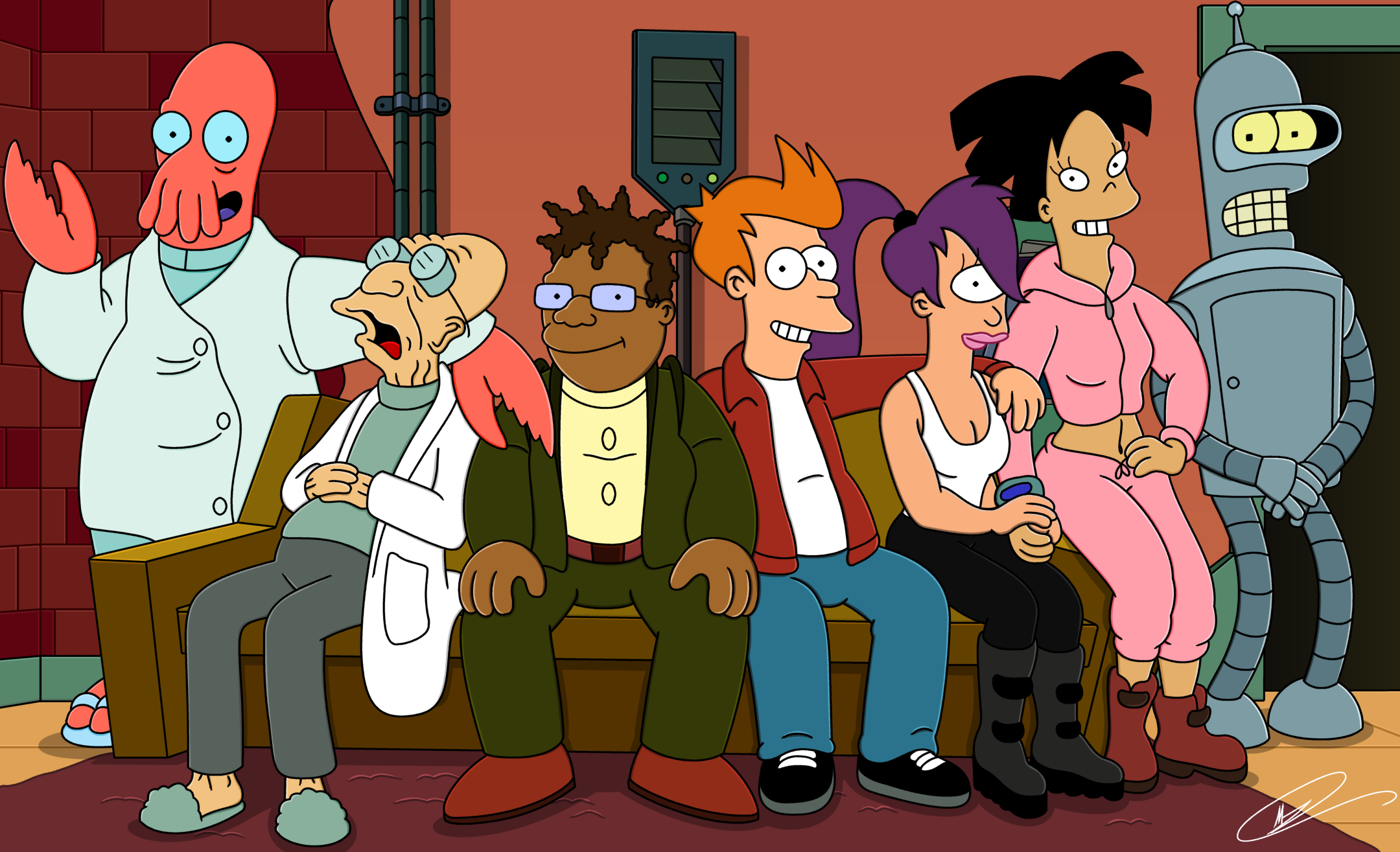
Matt Groening's other well known cartoon series, "Futurama", has really stood the test of time. For those who are unaware of the show, it is set in the 31st century and mostly follows Philip J. Fry, a slacker from the 20th century 'accidentally' frozen in a cryogenic tube, awakening in the future and getting a job at his distant relative's interstellar delivery company, working with a quirky staff of characters. In addition to the comedy and science fiction, it also had a lot of drama that really made you feel for all these strange characters, caring for them as if they were real people. And unlike the Simpsons, Futurama never really had a major dip in quality, indicating how much everyone cared about working on it.
Much like my SpongeBob list from 2015, I wanted to take a look back and share what I feel are the 10 best episodes of Futurama. And while I will keep spoilers to a minimum, there still will be some.


10. THE SIX MILLION DOLLAR MON

PREMISE: Hermes keeps upgrading his body with robotic enhancements to feel adequate in his job and as a man.
WHY IT MAKES THE LIST: The episode begins with Hermes conducting the annual performance review and planning to fire the least necessary employee. We get a montage of the Planet Express crew doing their usual thing, which makes for some funny moments. Ultimately, Hermes decides to fire himself due to his constant performance reviews (oh sweet irony). He's replaced by a new robot, and coupling that with him and his wife Labarbara being mugged by psychotic robot Roberto (who ends up being executed for the crime), Hermes has Bender use his black market connections to get a robotic enhancement to initially get his job back. But as feelings of inadequacy continue, he keeps getting robotic enhancements to the point where the only human part of him left is his brain.
The real star of this episode though is Zoidberg. While he's usually the most hated member of the Planet Express crew, he takes it in strides, even considering Hermes his best friend. As Hermes continues to upgrade himself, Zoidberg is the only one noticing Hermes' personality becoming less and less like himself, indicated by how tame his insults toward Zoidberg become. Missing his "friend", Zoidberg creates a ventriloquist doll from Hermes' discarded body parts. It sounds morbid, but it's funny when he actually puts on an act with the "doll" at a comedy club.
Eventually, Hermes wants a robot brain, even going with Bender and the Professor to rob a robot graveyard (unknowingly robbing Roberto's grave). While the Professor is asked to do the procedure, he changes his mind due to the pleas of Labarbara. When Hermes doesn't take "no" for an answer, Zoidberg offers to do it, even doing the procedure while singing an entertaining parody of "Monster Mash". But it's all a ploy so Zoidberg can put Hermes' brain back into the fixed up body of Hermes he was using before (which apparently still had all his working organs since Hermes is able to function it before).
But the threat isn't over as Roberto does take over the Mecha-Hermes body, though there's a bit of a continuity error as the body acts like Roberto before putting his brain in. Ignoring that however, Roberto is defeated after he eats a piece of Hermes' skin, but it's so saturated from Labarbara's spicy cooking that it causes him to melt into a puddle.
Overall, it's just a fun and weird episode, and part of it is thanks to Zoidberg. It shows that even with the way he's treated by everyone, he still cares for his friends and not really expecting anything in return. It's a good personality trait.


9. LUCK OF THE FRYRISH

PREMISE: After a day at the horsetrack leads to many losses and an electrocution, Fry travels underground to the ruins of old New York to find his lucky seven leaf clover.
WHY IT MAKES THE LIST: The heart of this episode is through the flashbacks told of Fry's life growing up with his family, including his over-patriotic/doomsday prepping dad, his sports obsessed mother, and his jerky older brother Yancy. The relationship with Yancy is the main focus, as it shows how much they fought and how Yancy always felt the need to copy his brother in all their activities from basketball to break-dancing. I think it indicates a hint of jealousy over how creative his brother appears to be, going so far as wanting to steal the seven leaf clover, forcing Fry to hide it in a record vault.
When Fry, Bender, and Leela go to retrieve the clover, they discover it missing where Fry left it. Soon enough, they discover a statue of a man in a business suit that looks like Yancy, including the likeness of the clover in the lapel. Noticing the name on the statue read "Philip J. Fry", Fry theorizes that Yancy stole his clover and his name and used it for his own success, later learning that "Philip J. Fry" was also a rock star and the first person on Mars. Finding out that the clover was buried with him, Fry leads Leela and Bender to steal it back from his grave (and I just realized that's two episodes already on this list that involve grave robbing).
Without spoiling too much about how the episode goes from there, I believe this is the first overly emotional tear jerking ending to come from Futurama, a trope that would come when you'd least expect it on the show (and prepare for more of those episodes on this list). I will just say that it's a real eye-opener for Fry, and I love how the episode is bookended with the births of both Philip J. Frys.


8. LETHAL INSPECTION

PREMISE: With the aid of Hermes, Bender seeks "Inspector #5", the main who approved Bender despite him not being built with a back-up program.
WHY IT MAKES THE LIST: After the episode opens with a reenactment of the "Sith-al War", which is the Planet Express crew in Union soldier costumes play-fighting with a group of nerds in Star Wars costumes and lightsabers (which was pretty funny), Bender discovers an oil leak. Upon inspection, the Professor discovers Bender to be defective, being built without a back-up program. This means if Bender's body is destroyed, his programming can't be transferred to a new one. Realizing his mortality, Bender seeks revenge on "Inspector #5". Hermes aids Bender by going to the Central Bureaucracy to discover the inspector's identity, only to find no trace of him. A dejected Bender then calls Mom, the head of the robot company who built him, to file a complaint. However, not wanting a defective robot under her name running around, Mom sends a group of killer robots to eliminate Bender. They're not very competent though, as they continue to shoot and destroy each other in hilarious fashion. Bender and Hermes eventually wind up in Tijuana, where Bender was built, leading Bender to believe Inspector #5 may still live there, only to find his house abandoned.
Hermes comforts Bender in the fact that he may never find Inspector #5 or the answers he seeks, telling him that he should enjoy his life even if it is finite. This is actually why this episode makes my list. Before this, we never had any real extended interaction between Bender and Hermes, and this episode shows them become true friends.
Watching the episode the first time, I was able to figure out that Hermes was Inspector #5. However, that didn't take away any emotion from the flashback at the end of the episode, showing a young Hermes and baby Bender. Despite Bender being defective, Hermes couldn't bring himself to throw the cute little robot away, overriding the system so Bender could live.

7. THE DUH-VINCI CODE

PREMISE: The Professor leads the Planet Express crew to discover the dark secrets of Leonardo Da Vinci.
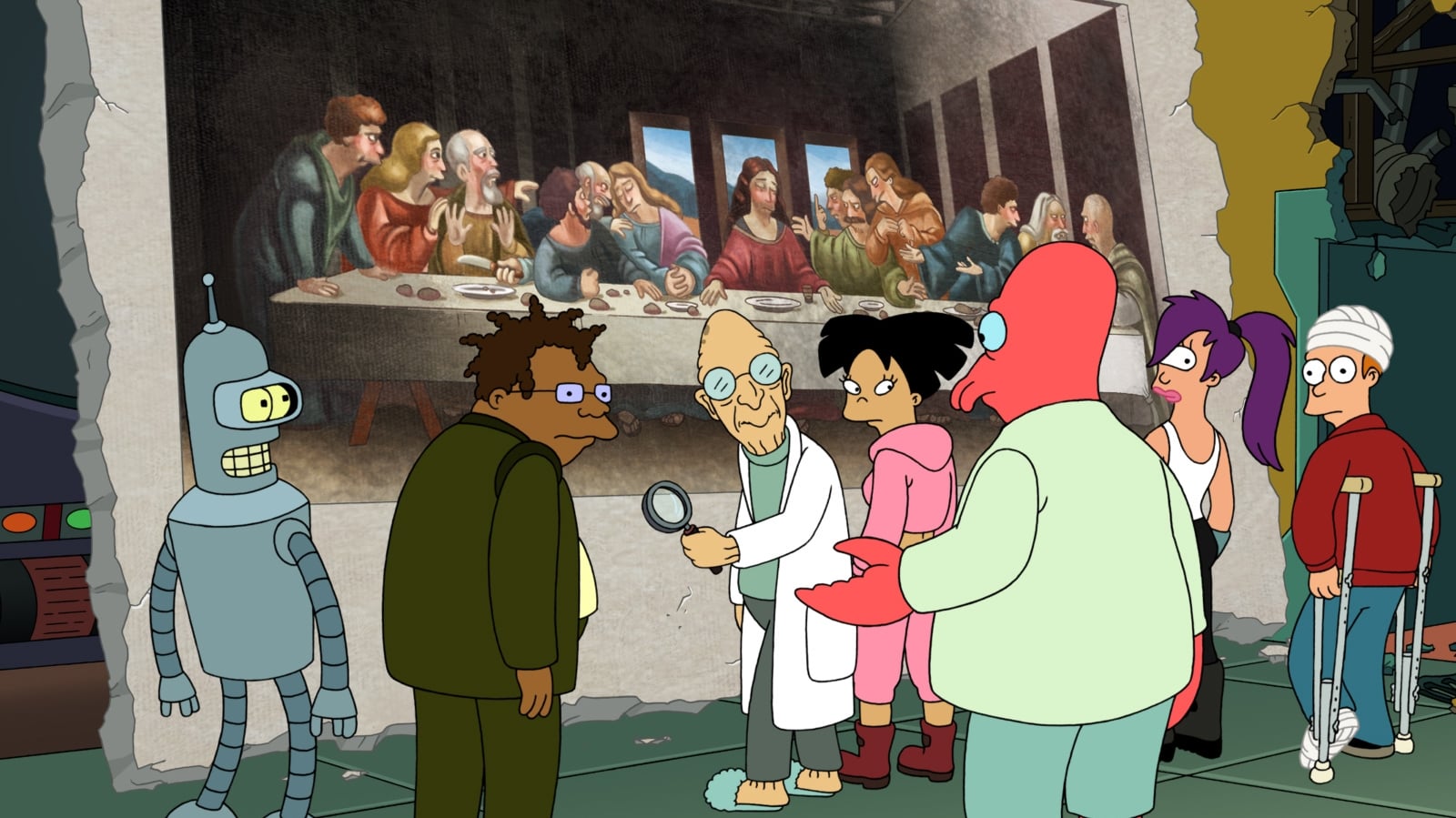
WHY IT MAKES THE LIST: Much like how "Lethal Inspection" focused on Bender and Hermes, "The Duh-Vinci Code" gives the relationship between Fry and the Professor much needed spotlight. It's very easy to forget the two are actually related. The episode shows Fry wanting to be closer with the Professor, but finds Fry's stupidity too off-putting. Trying to explain to Fry how he was inspired by the likes of Leonardo Da Vinci, the Professor discovers the blue prints to Da Vinci's lost invention in his beard (which he bought from a famous people's body parts auction). Inspecting the "Last Supper" painting, they discover that St. James was a robot, leading them to Rome to find his body. In the tomb of St. James though is a robot known as Animatronio, the guardian of Da Vinci's greatest secrets. Fortunately for the Professor, Animatronio is very bad at this job, letting clues slip out of his mouth. This eventually leads to Fry and the Professor to blast off into space after accidentally assembling a spaceship from multiple inventions in Da Vinci's lost workshop. They end up on the planet Vinci, a utopia for geniuses, where they meet Leonardo himself. While the Professor takes part in the society, Leonardo laments to Fry that on his own planet, he's considered an idiot and mocked mercilessly for it. When Fry gives Leonardo the lost blueprints he found, the two work to build it, only for Fry to find out that it's a doomsday device for Leonardo to get revenge on everyone who tormented him. Even the Professor wants in on it after he has been mocked by the planet's inhabitants himself ("Just because I'm dumber than them, they think they're smarter than me!"). This leaves Fry of all people to be the voice of reason, saying that there's always going to be someone smarter than you and that people should make due with what they have. In his own klutzy way, Fry disables the doomsday device, which smashes down on Leonardo, killing him.
The episode ends with Fry and the Professor making amends, and I think there's a good lesson in this. No matter how smart or dumb someone is, it's how you treat people that matters. The people of Vinci mocked Leonardo and the Professor, who in turn wanted to make them pay for how they made them feel. You can be a good person or an asshole no matter your level of intelligence.
Besides that, this episode has some of my favorite Futurama moments. It's here we learn that Zoidberg's doctorate is in art history (keeping in mind he works at Planet Express as its physician) and Hermes questioning "Didn't we use to be a delivery company?" which is so funny considering all the crazy adventures they go on. And of course, you have Fry casually saying "Hi Animatronio" to the robot, no matter how tense the situation. It's just funny every time I hear him say it. 

6. A FLIGHT TO REMEMBER

PREMISE: The Planet Express crew take a vacation on a space cruise called the Titanic.
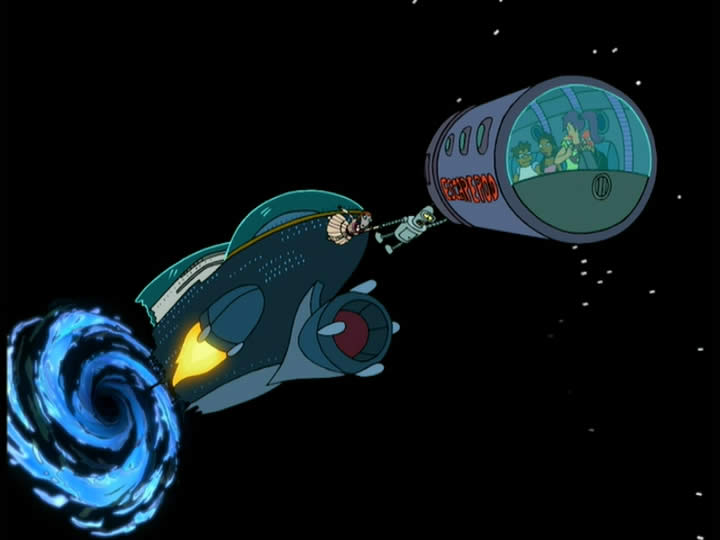
WHY IT MAKES THE LIST: As you can probably tell from the premise, this is a parody of the 1997 Titanic film, so that involves some romantic plots and a doomed voyage (that part being thanks to the ineptitude of Captain Zapp Branigan).
One of the main storylines of the episode involves Fry being caught up in some charades by having to pretend to be boyfriend to both Leela, who is trying to avoid the advances of Branigan, and Amy, who is trying to avoid being set up with someone by her parents. While this involves some hijinks, the episode is really the first hints of Fry and Leela's relationship, from their "first kiss" which was just Leela trying to avoid Zapp, to Leela's jealousy having to watch Fry and Amy kiss. This leads to a deep moment between the two that almost leads to their first real kiss before the ship begins getting sucked into a blackhole.
In being one of the earliest episodes of the show, the relationship between Fry and Leela isn't the only recurring plotpoint that would run for the rest of the series. It's in this episode where Amy meets Kif, where the chemistry is so instant that the two immediately kiss. Of course, the two don't officially become a couple for over another season due to Kif's shyness. I know that sounds weird considering how forward he was in this episode, but I'm willing to chalk it up to the adrenaline rush of the terrifying situation they were in. We also learn in this episode of Hermes' past as an Olympic level limbo competitor; Hermes' limbo skills become a running gag for the rest of the series.
There's one element of this episode that I don't think gets enough attention, that being Bender's romance with the rich fembot, Countess de la Roca. While Bender initially intends to steal from her, the two truly fall in love with each other. In true tragic romance though, the Countess sacrifices herself to the Black Hole so Bender and his friends can escape. This is the obvious Jack and Rose relationship stand-in for this Titanic parody, but in rewatching this episode for this list, I've developed a theory: the Countess was Bender's true love. Of all the relationships Bender has had in the show, the Countess is the only one Bender never felt the need to test or have a change of heart about. You could even say that losing the Countess is what makes Bender unable to keep any relationship for the rest of the series.
Even watching this episode for the first time as a kid, it really resonated with me for some reason, so its place on my list was assured.


5. JURASSIC BARK

PREMISE: Fry discovers the fossilized body of Seymour, his dog from before he was frozen.
WHY IT MAKES THE LIST: It's another tear jerker episode, and one that should hit the dog and pet lovers right in the heart.
After Fry discovers the fossilized body of his dog Seymour on exhibit in a museum, he attempts and succeeds to reclaim it, with plans for the Professor to clone the canine. This leads to jealousy from Bender, who thinks he's losing his best friend. Bender gets so mad that he throws Seymour into the lava that was powering the cloning machine. After seeing Fry cry, coupled with the fact Seymour was encased in the durable mineral dolomite, Bender feels remorse and saves Seymour at risk to himself.
Much like "Luck of the Fryrish", the heart of this episode is in its flashbacks. We start with Fry first meeting and becoming friends with Seymour, followed by Seymour becoming the unofficial of Panucci's Pizza, the place Fry used to work as a delivery boy. This includes some cute yet unhygienic moments at the restaurant. Fry also taught him to sing "Walking on Sunshine", and every time I hear that song, I can't help but think of this episode (as well as Charlie from "Supernatural). We also see that Seymour may have been the smartest person in Fry's life back in the 20th century. He tried to keep Fry from going on the delivery that would lead to him being frozen, sensing something bad would happen. Afterwards, he was the only one who tracked Fry down to his cryogenic tube, as no one else afterwards were smart enough to listen to him.
The end of the episode sees Fry discovering that Seymour lived for 12 more years after he was frozen, deciding to not clone him believing Seymour most likely forgot about him. But it turns out Fry was wrong. Following Fry's last command to wait for him, the final scene shows Seymour outside Panucci's through the years waiting for Fry to return, all the way to his death by natural causes. This is regarded as one of the saddest endings to not only a Futurama episode, but in all of TV history. Even the mere reference to this episode's ending can stir up sad feelings. It just goes to show not to underestimate the loyalty pets can feel towards their owner.


4. LEELA'S HOMEWORLD

PREMISE: Leela seeks answers when she finds a shrine built to her within the lair of the sewer mutants.
WHY IT MAKES THE LIST: One of the long running mysteries since Futurama began was Leela's lineage. Orphaned as a new born, Leela was believed to be an alien from an unknown planet, and she always longed to know where she came from and who her parents were. This episode adds a real twist to the mystery as instead of looking up, we should have been looking down.
As Fry, Leela, and Bender are being chased through the sewer by its mutant inhabitants (due to Bender pouring toxic waste into their lair), they discover in one of the mutants' homes a shrine to Leela, made up of newspaper clippings of her and personal belongings she discarded. Believing two cloaked mutants to know something about her past, Leela leaves Fry and Bender to escape while she goes after answers. Fry does some investigating on his own, by having the Professor examine the note left with Leela at the orphanage. First off, I like this subplot because it continues to show how much Fry cares for Leela and what he'll do to try and make her happy.
If you hadn't already guessed, it turns out Leela's parents were mutants, making her one herself. In a flashback scene to the day Leela was born, seeing how normal looking she is, with the doctor claiming her to be the least mutated mutant in history, her parents decide that she deserves to have a happier, normal life than one of a mutant. So they decide to leave her at an orphanage, making it appear that she's an alien, hoping she never has to learn the truth of what she is. Back to the present, Leela tracks down the cloaked figures, theorizing that the two killed her parents and plans to do the same to them. Rather than tell the truth, the two accept their impending fate until Fry drops in (literally) to reveal their true identities. This results in a tearful family reunion that always makes me join in with them. And if that wasn't enough, the final moments of the episode are a montage of scenes showing Leela's parents in the shadows looking out for their daughter through her own life. It's a nice touch, showing that they didn't outright abandon her.
It's an intense, emotional episode that wraps up a long running mystery. If I had any gripes, it's that they could have built up the reveal a little more, but it's easy to overlook.


3. GAME OF TONES

PREMISE: The key to Earth's survival lies within a memory of Fry's from the day he was frozen.
WHY IT MAKES THE LIST: As an alien ship approaches Earth continually blasting 4 musical tones, sending shockwaves that will soon destroy the planet, Fry recognizes the tones but can't recall from where. A brain analysis concludes that the memory originates from the day Fry was frozen. To discover its origins, Fry is put into a dream state that allows him to relive his last day in the 20th century to find the source of the tones. But Fry goes off plan as he begins to spend time with his family, and it's actually nice to see. Episodes like "Luck of the Fryrish" or "Jurassic Bark" kind of made it look like Fry's past kind of sucked. But here, even if it is supposed to be a dream, it shows that Fry supposedly did have good times with his family. With time running out though, the rest of the Planet Express crew, as well as President Richard Nixon's head, enter the dream to drag Fry out of his house and continue with the rest of the day. This devastates Fry, who only wanted to find closure with his mom. Fry, along with everyone else, begrudgingly goes through the rest of the day up until he gets frozen, where he hears the tones from the ship, followed by two more. With that information, Fry plays back the two tones, leading to the ship landing in front of them. It's revealed that the pilot of the ship is another Nibloian named Digby, who had helped Nibbler ensure Fry would end up in the future (for more on that, see the episode "The Why of Fry"). The sound Fry heard was Digby locking up their ship. Celebrating their mission accomplished, the two get drunk and lose the keys to their ship, having to take a space cab off Earth. Digby had only been using a spare set of keys to find the "company car". All ends well with Fry leading them to the ransacked ship on top of the cryogenics building, with Nibbler saying he'll repay Fry for his help.
Later that night, Fry has a dream about his mother watching the 2000 Rose Bowl, confusing Fry since that game happened after he was frozen. Nibbler then enters stating that he (somehow) transported Fry into a dream of his mother's in the past, giving Fry the chance to say what he wanted. When his mom asks what he wants to talk about, the only thing Fry can do is hug her. And honestly, that's all that's needed to end the episode.
This episode has a good traditional sci-fi threat to deal with an unexpected twist to its conclusion and gives us yet another look at Fry's past, albeit a happier one compared to others. But that ending is probably the most tear-jerking of all the tear-jerking endings the show has had. Hell, I'm tearing up thinking about it while typing this out. Even if you never watched an episode of Futurama before this one, if you're not crying like a baby by the end of this episode, you may not have a heart.


2. THE STING

PREMISE: Leela is racked with guilt after Fry dies on a mission.
WHY IT MAKES THE LIST: The episode begins with Leela forcing Fry and Bender to take on a mission that killed the Professor's last crew: collecting honey from giant space bees.

I'm actually not that far off with that reference, as the mission does wind up with Fry being impaled by a bee's stinger as he tries to protect Leela. Despite the nature of cartoons and how things do tend to go back to normal by the end, it was a real shock to me when I saw Fry die for the first time. I mean, they killed off the essentially main character of the show. And considering that this was during what was meant to be the final season of the show, it might not have been that far out for the creators to go this route. Fry's funeral included quite a few minor characters in attendance, with Terry from the cryogenics lab bidding him "Farewell from the world of tomorrow!", a callback to his line from the first episode ("Welcome to the world of tomorrow!")
The focus of the episode is on Leela. This all started with her wanting to prove herself, which is reasonable for her character (especially compared to a later episode, "Mobius Dick"). So she definitely feels responsible for Fry's death. Soon after, Leela begins having dreams of Fry, believing him to actually be alive and contacting her in her sleep. Everyone at Planet Express believes she's going crazy from guilt. They actually have some merit to this, as Leela's insanity begins to intensify, from imagining the crew performing a musical number to "Don't Worry, Be Happy" and even seeing each character on the walls and floor of her apartment chanting "You killed Fry!" over and over. You really start to wonder what's real and what's happening in this episode.
We then get the twist ending: it turns out Fry survived the impalement from the bee sting while the tip still poisoned Leela, placing her in a coma. Leela lies in a hospital bed for two weeks with Fry not leaving her side, continually talking to her hoping he'll get through. It's a really admirable act on Fry's part as another display of his love for Leela.
This is another pretty good story twist and it makes sense when you look back at it. In her coma, Leela was happier in her dreams with Fry while appearing to go crazy in the real world. She has the chance to sleep forever, but it's Fry's words getting through to her telling her not to give up. Leela is essentially hanging by a thread between life and death, and Fry is the beacon trying to bring her home.
Besides all that, this had a couple of my favorite Professor moments from the series. The first is at Fry's funeral when he's trying to console Leela as she blames herself for his death, the Professor then turns to Bender and unknowingly shouts "I'm lying to make her feel better!", causing Leela to cry harder. The other is later on when the Professor tries to cut off Leela's head with a guillotine. Leela asks "Can't you examine my brain without removing it?" to which the Professor replies "Yes. Easily." and then pulls out a device to do such.

And finally, in my opinion, the best episode of Futurama is...
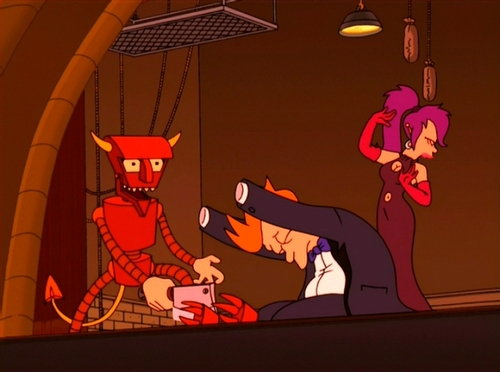

THE DEVIL'S HANDS ARE IDLE PLAYTHINGS

PREMISE: Fry makes a deal with the Robot Devil to trade hands.
WHY IT MAKES THE LIST: This was intended to be, and for five years was, the final episode of Futurama due to its cancellation by Fox. And for what it's worth, it was really damn good finale.
The episode is actually a follow-up to a previous episode, "Parasites Lost", as Fry continues to perfect his skills on the holophonor, a musical instrument that also produces a holographic story, to woo Leela. He is so desperate that Bender leads him down to Robot Hell to make a deal with the Robot Devil. The Robot Devil offers Fry to switch his hands with that of a random robot in the universe. Fry accepts and the Robot Devil spins the Wheel of Robots to see who Fry will swap hands with; as it turns out, the wheel lands on the Robot Devil and the two switch hands. Thanks to the Robot Devil's hands, Fry becomes a sensation on the holophonor, putting out his own albums and being commissioned to write an opera, which he decides to make about Leela. However, the Robot Devil wants his hands back and creates a convoluted plan to do so. He engineers it so Leela will be deafened, making her unable to hear Fry's opera. Desperate, Leela makes a deal with the Robot Devil for robot ears in exchange for one of her hands. As the opera goes on, the Robot Devil is angered by how he is depicted and interrupts the show, leading to a musical number involving him, Fry, Leela, and the rest of the Planet Express crew. It's a really entertaining moment and I find myself thinking about and singing it in my head from time to time. It's during this number where the Robot Devil reveals he tricked Leela and that the contract she signed said she would give him her hand in marriage ("You should have checked the wording in the fine...print.") The Robot Devil tells Fry he'll call off the marriage if he returns his hands. Fry reluctantly agrees, and when he's asked to continue the opera, his skills on the holophonor revert back to miniscule levels. It's here where the show gives birth to what would be one of its most famous memes:
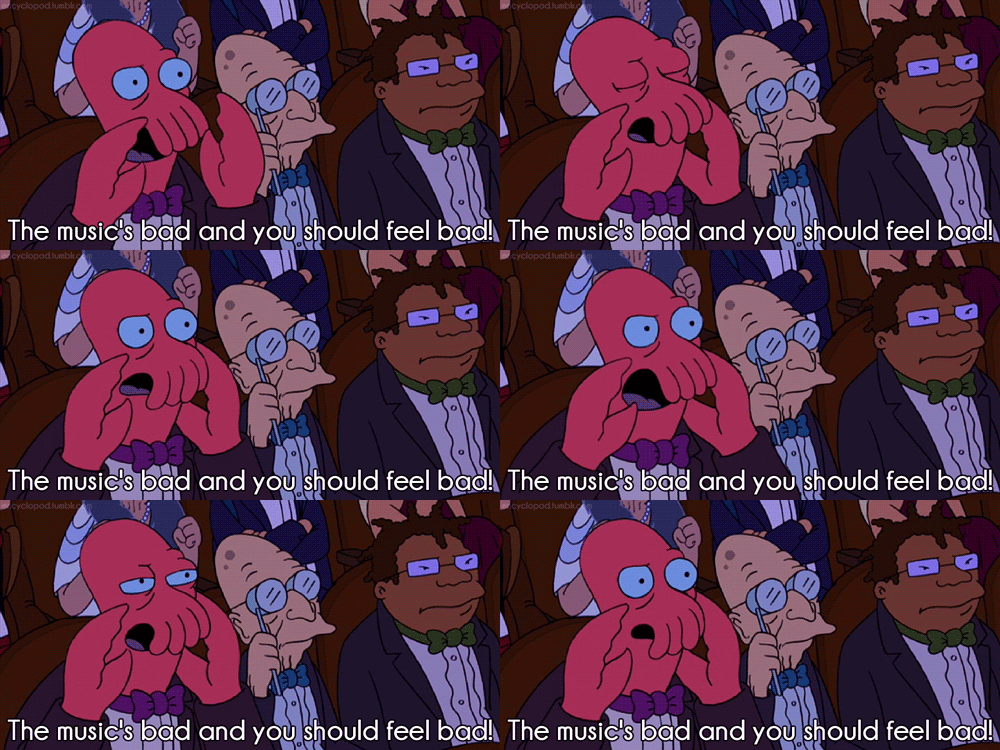
Everyone storms out except Leela, who wants to hear how the show ends. And with that...the show ends. At least for five years, as thanks to fan support, Comedy Central picked the show up, and ran it for five more years before ending it again.
"The Devil's Hands are Idle Playthings" was an excellent episode in its own right and what would have been a great finale. It signified the official beginning to Fry and Leela's relationship, although it would take another whole season before they actually became a couple for the rest of the series. The series' actual final episode "Meanwhile" was also very well done, but it was done with the possibility of another season pick-up. With "Devil's Hands", there was more of a sense of finality to everything. In any case, "The Devil's Hands are Idle Playthings" is without a doubt of my favorite episode to come from such a spectacular series.

Saturday, August 4, 2018

My Top 5 Non-DC/Marvel Villains

Whether you've been following my blog for awhile or just take a first glance at it, it's painfully obvious that I have very heavy focus on DC and Marvel in all forms of media. If you dig deep though, you'll find the rare music review (which I haven't really done one since 2014's "Dream Walker" review) or the occasional look at other shows like SpongeBob or Dragon Ball GT (and on a related note, be on the lookout for my upcoming "Top 10 Episodes of Futurama" post). Also taking into account that all I've really done this year is reviews, I figured I kill two birds with one stone in a top five list.
It's easy to love the hero of a story, but when there's a villain you just love to hate, that's what makes them memorable. With that said, let me share my top five villains from outside DC and Marvel comics.


5. Destroyah
Godzilla vs. Destroyah (1995)

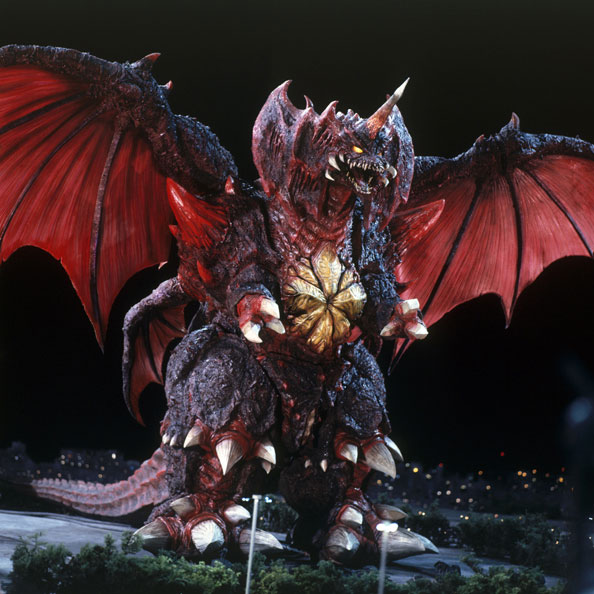
As the Godzilla series was going on hiatus once again in the mid 90's, they wanted to give a proper conclusion with the death of the title character. So what better opponent for the King of the Monster's last stand than a creature born from the Oxygen Destroyer that apparently killed him in his very first movie in 1954. Enter: Destroyah, a colony of Precambrian organisms mutated by the Oxygen Destroyer. Destroyah starts off as multiple man sized crab creatures, combining into larger crab creatures and soon enough into the giant satanic looking figure pictured above. All of Destroyah's forms are pretty scary, but his final form really takes the cake. His personality is one to match his namesake, as he only lives to kill. This leads to one of the most heartbreaking scenes of the Godzilla franchise. Once Destroyah evolves into his final form, he attacks Godzilla Junior, who bested him in battle earlier, taking him high into the air and dropping him onto sports arena. And if that wasn't bad enough, Destroyah continues to blast Junior with his energy beam, leading to Junior's death.
Destroyah may have likely killed the senior Godzilla as well, had it not been for the over abundance of radiation in Godzilla's body at that point, giving him enough power to take down his son's killer. So while it wasn't Destroyah himself that killed Godzilla, it was a driving factor; between the anger of losing his son and the battle pushing his power to dangerous levels, Godzilla's meltdown was all but assured. I won't go into what happens at the end of the movie to avoid spoilers for those who haven't seen it, but I will say that "Godzilla vs. Destroyah" is one of my favorite Godzilla movies along with 1991's "Godzilla vs. King Ghidorah".
On that note, while King Ghidorah is without a doubt Godzilla's biggest and most well known adversary, I partly chalk that up to overexposure. Don't get me wrong, I love Ghidorah, but Destroyah has a little more edge over him, dealing the most devastating blows to Godzilla.


4. The Psycho Rangers
Power Rangers in Space, (1998), Power Rangers Lost Galaxy (1999)

I knew I had to pick someone from Power Rangers for this list, but after nearly 25 years, I asked myself who stood out the most and had a major impact? While many villains from the Zordon era are iconic, I think the Psycho Rangers are probably the best. I already talked about the Psychos way back in my Power Rangers retrospective, but it's worth going into again.
While beforehand there were evil copies or attempts to make evil versions of Power Rangers, the Psycho Rangers stood out by having a unique design. Created by Astronema using energy from an unknowing Dark Specter, the Psychos had a never ending drive to defeat their respective Ranger. In fact, in their first appearance, the Psychos nearly did destroy the Space Rangers, only to be teleported away by Astronema, as she want to use them as long as she could so they could steal all of Dark Specter's energy so she could usurp him as the monarch of the United Alliance of Evil.
While the Psychos were created as a team, they only worked well when it served their interests, that being to destroy their own Ranger. They would even attack each other if they got in the way of their goal. Despite their lack of teamwork, they were still a formidable force against the Rangers, only able to take down one at a time with Pink and Blue before destroying Red, Black, and Yellow with combined might of the Megazords.
But they couldn't keep the Psychos down for long, as a year later in "Lost Galaxy", Deviot revived the Psychos to destroy the Galaxy Rangers, and it took the combined might of the Space and Galaxy Rangers to defeat them again. However, Psycho Pink survived and while she was finally defeated, her actions resulted in the death of Kendrix, the Pink Galaxy Ranger, this being the first death of a Ranger in the franchise at this point.
The Psycho Ranger story arc is one of the best parts of "Power Rangers in Space" and they were involved in one of the franchise's greatest team-ups. While there have been attempts at more evil Rangers afterwards, none of them match the impact the Psychos did. It's probably unlikely, but I would love if the Psycho Rangers were to come back in another anniversary special.


3. The Master/Harold Saxon
Doctor Who (2007, 2009-10, 2017)

Doctor Who has a lot of iconic villains. Daleks, Cybermen, Weeping Angels, Sontarans, the Silence, I can go on. And then you have the Master. Admittedly, I've only really watched the modern era of Doctor Who, and while I know there have been past Masters, John Simm was my first Master.
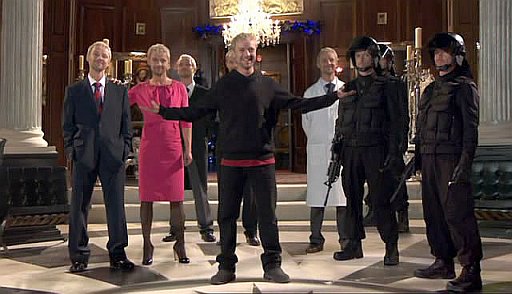
For those who don't know, the Master is a Time-Lord like the Doctor, who seeks both power and to see the Doctor suffer. In the arc that introduced me to the Master, he fabricated the identity of Harold Saxon and was able to hypnotize the populace of the United Kingdom into electing him Prime Minister. His personality is very unprofessional for a politician (boy, isn't that relevant?), which annoys some of his colleagues, who eventually wind up dead at his hand. But really, it's his personality that makes him stand out to me. He has fun in the evil things he does, and it's when he gets serious when you should be scared of him. One of the fascinating aspects of this version of the Master is that he's driven mad by a constant drumbeat in his head, placed there from when he looked into the Untempered Schism, a gap in the fabric of space and time, during his initiation as a Time-Lord. It's this sound of drums that makes for one of my favorite scores; it's a catchy beat I find myself thinking about from time to time.


In his first arc, the Master's endgame was to take over Earth by bringing from the future the Toclafane, the cybernetic remains of humanity from the future. In addition to this, he puts the wife he had taken through psychological hell and made servants out of the family of the Doctor's then current companion, Martha Jones. This really speaks to how demented the Master is. His plan ultimately fails though, leading to him being shot by his own wife. As the Doctor cradles him in his arms claiming he can regenerate, the Master chooses death as it would be a loss for the Doctor. Years later in "The End of Time", the Master is revived by his disciples, leading to his new plan to turn all of humanity into clones of himself. This involved John Simm wearing all kinds of different clothes, and you just know he had to have fun filming these scenes.

After his defeat there, this was believed to be the last of this version of the Master, as a new female regeneration of the character appeared, going by the name "Missy". Missy would start off again as the Doctor's enemy, but as time went on, she would become an unlikely ally. A wrench is thrown in the gears though as the Harold Saxon version of the Master returned once again in all his crazy glory, playing a hand in the creation of the Mondasian Cybermen, even turning the Doctor's then current companion Bill Potts into one. The interaction between the two Masters was fun to see, especially with Missy's conflicting loyalties to the Doctor and her old self. This would actually be the last we see of both versions of the Master though, as they end up fatally wounding the other. But while Saxon would regenerate into Missy, Saxon's blow to Missy was meant to disable her regeneration abilities, most likely leading to her death. His reasoning is he can't bear to see himself becoming an ally of the Doctor. While we may never see Missy again, I very much doubt that's the end of the Master. (And for those who wonder why Missy doesn't remember meeting her future self, the time travel rules of Doctor Who include characters being unable to retain memories of meeting with their future selves, so as not to disrupt the timeline of events.)
All in all, John Simm was great as the Master, bringing a gleeful psychopathy that's entertaining to watch. He's a truly dedicated villain in that even if he can't win, he'll make sure the Doctor doesn't have a full victory.


2. Bill Cipher
Gravity Falls (2012-16)

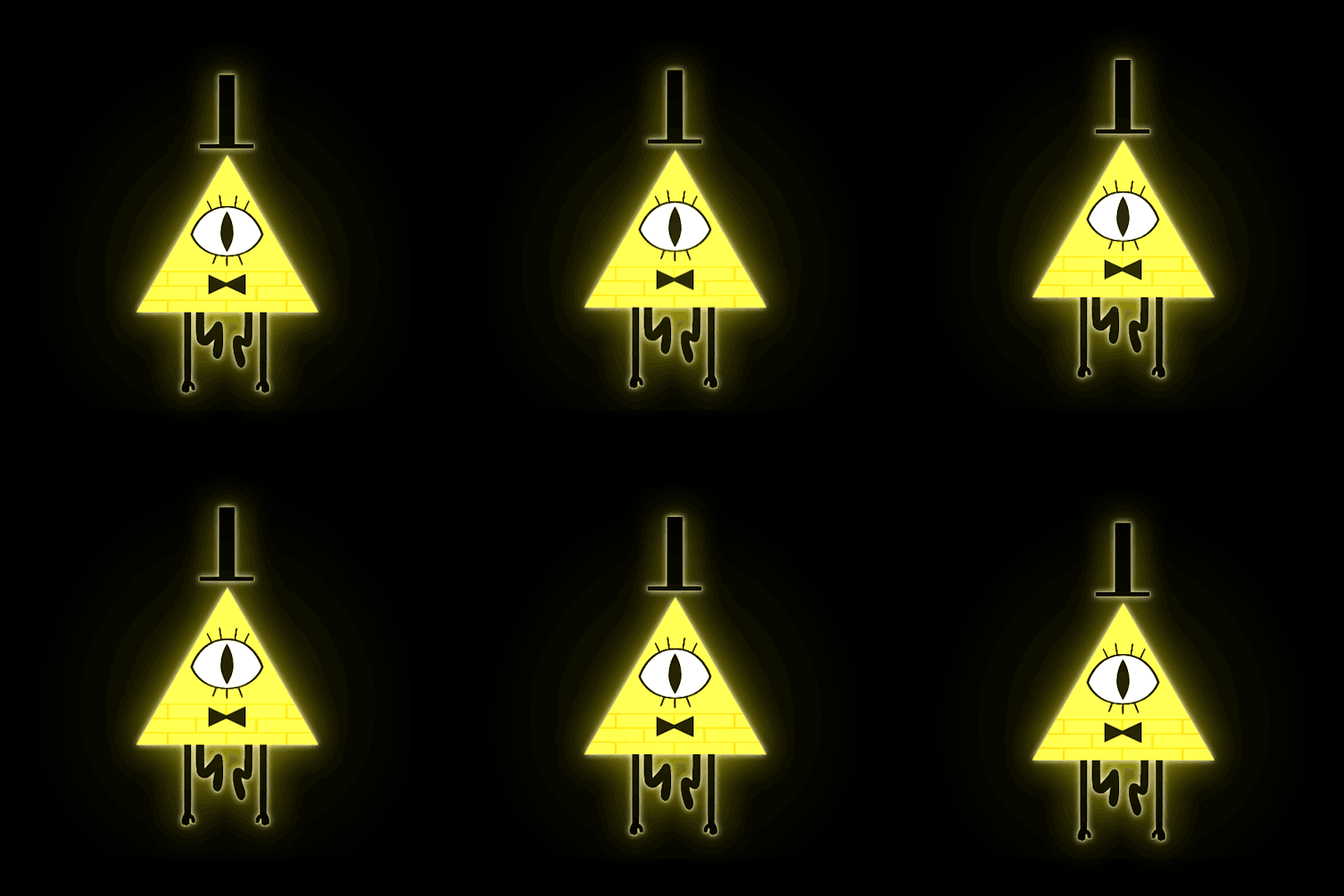
"Gravity Falls" is definitely one of the best cartoons in modern history. It's full of comedy, drama, mystery, action and horror; there's pretty much something for everyone, keeping you hooked all the way until the finale. One of the big parts of the series is its main villain, Bill Cipher, an interdimensional demon from the Nightmare Realm bent on taking over the real world. He's very conniving and manipulative, tricking others, even possessing them, in order to further his own goals. In a way, he's kind of a shifty salesman, and this can really be heard in his speech pattern. He talks fast and has very upbeat personality, despite the demented things he says and does. Hell, in his first appearance, he rips all the teeth out of a deer and offers them as a gift. And during the final arc of the series, he shuffles the functions of a man's face. 

(There's your nightmare fuel for tonight.)
But it's when he gets angry that you should really be scared as his voice deepens to a demonic level and he'll sometimes shapeshift into a form to match.


Whenever Bill's on screen, he's always entertaining to watch since he's so different from other villains and unpredictable in his actions. He very well would have won had he not underestimated the main characters of the show.
I highly recommend checking out "Gravity Falls", and Bill Cipher is just one of the many reasons to watch.

And my number one non-DC/Marvel villain is...


Frieza
Dragon Ball (1990-present)

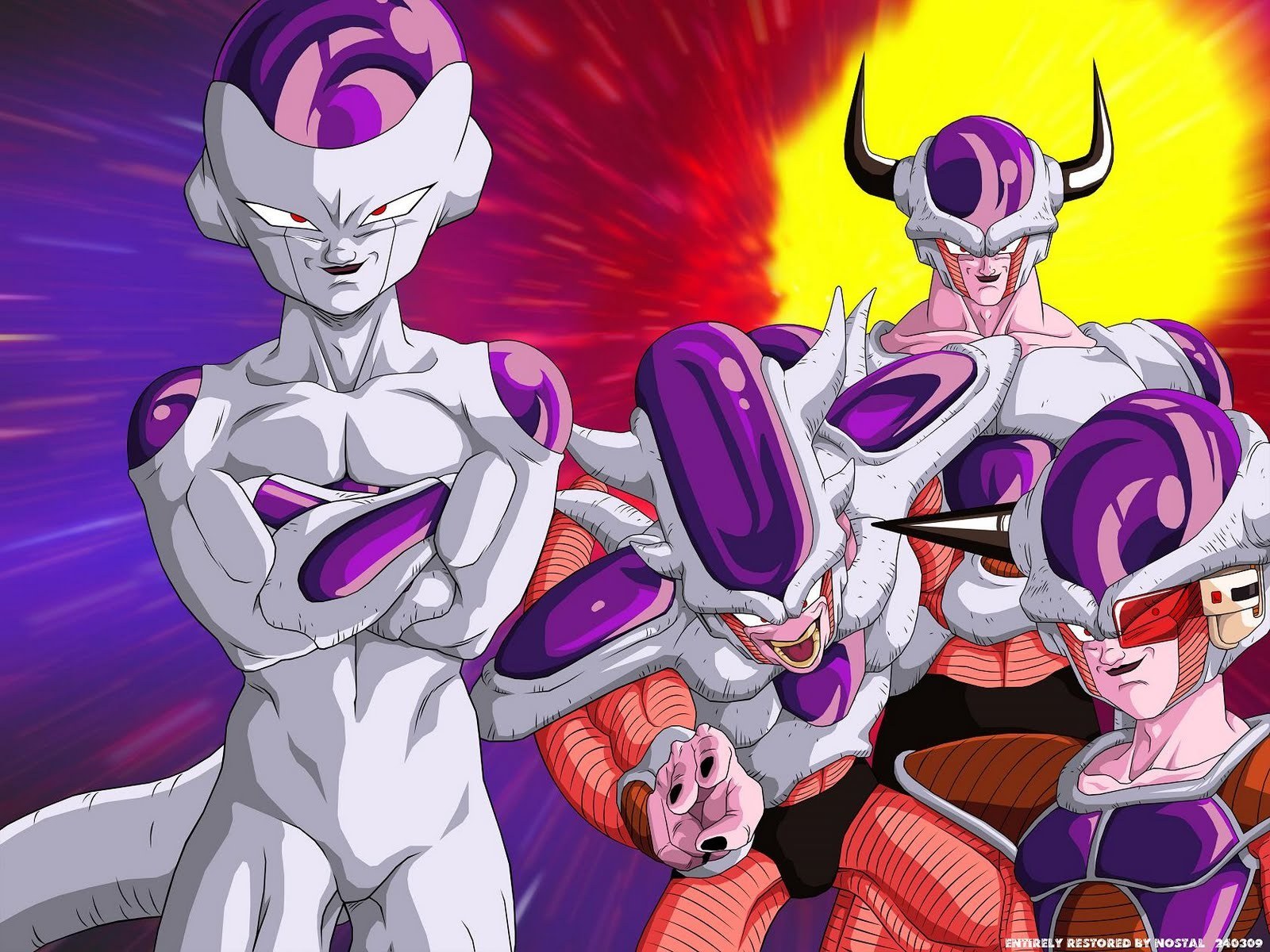
Frieza may very well be the most feared villain in all of anime, and his reputation preceded him before he even made his first appearance in Dragon Ball Z. Even when he did appear, there was so much build up of just how much of threat he was all the way to the point where he actually decided to take matters in his own hands. And that threat just kept building after three transformations that increased his power and gave him a new terrifying form. Of all the villains of Dragon Ball, Frieza has to be the most pure evil of the bunch. King Piccolo was Kami's expunged evil half, we had villains created from science or magic (Cell, Buu, Baby), and even Zamasu believed his evil acts were for the good of the universe. Frieza was just straight up born evil, seeking nothing but absolute rule of the universe. He brought out an immense feeling of terror from not just his opponents or intended victims, but from his own soldiers, who he would kill for something as small as bringing him bad news. This is a character who destroyed the home planet of Goku and Vegeta, and wiped out all the Namekians (including the children) in his quest for their Dragon Balls. Despite most of the Namekians being revived with Earth's Dragon Balls, that's essentially two acts of genocide (that we know about). And you just know he did it partly for his own enjoyment; he's just that sadistic. For a show that is marketed to kids, that's some pretty heavy stuff. Not only that, but Frieza built up a galactic empire that even over a decade after his death, his loyalists still remained to the point where they revived him with Earth's Dragon Balls. And even years after his initial defeat, the thought of Frieza returned from the dead still brought fear to the Z Fighters.
For the longest time, I considered Cell to be the best Dragon Ball villain. I mean, he was made up of the DNA of Goku, Vegeta, Piccolo, Frieza, and many others. He was essentially the ultimate enemy, and much like Frieza, Cell was meant to be the final villain of the series until creator Akira Toriyama decided to continue with the Buu saga. But I've had a revelation recently: Cell only works within the context of his own saga. Cell may still be powerful, but after increasing threats like Buu and Beerus (a literal god), Cell kind of seems insignificant. Even with his appearance in GT, he didn't seem like much of a threat to Goku, who had reached Super Saiyan 4 at that point. Cell's flaw is that he's limited by the characters he's made up of, not really having any unique techniques of his own.
With Frieza though, after he was resurrected, he learned from his past mistakes and decided to train and increase his power, eventually reaching his golden form, becoming strong enough to fight Goku's Super Saiyan Blue form. If Cell were to return, I feel his personality would keep him from bettering himself, as he believes himself to already be perfect.
In a way, Cell is still my favorite DBZ villain for what he represents, but in terms of character, Frieza really has him beat as the undisputed best villain of Dragon Ball as well as my favorite non-DC/Marvel villain.

Monday, July 9, 2018

Movie Review: Ant-Man and the Wasp - The ANT-idote to Infinity War Blues


After "Infinity War" left Marvel fans on a devastating cliffhanger, we needed a real pick-me-up. Enter "Ant-Man and the Wasp". While not originally a part of the Phase Three slate, the "Ant-Man" sequel was added to the schedule after the first film's surprise success. The shrinking hero wasn't coming alone this time as the new Wasp makes her MCU debut. The result is a film that's not afraid to have fun, bringing new kinds of action to the MCU and possibly being the franchise's most hilarious entry.

Paul Rudd outdoes himself in this film from his previous performances as Scott Lang/Ant-Man. Whereas before he was trying to find a new path for himself, here, he's more or less content with his life and more confident in the Ant-Man suit. He's a bit more happier than before, enjoying himself and making more jokes. Since Rudd is a more comedic actor, this film allows him to play more to his strengths. If it wasn't for him, the film would just be way too serious. Admittedly, he does become the butt of jokes, but that's the point; he's still one of those people you'd least expect to be a superhero.
Like "Spider-Man: Homecoming" and "Black Panther", this film deals with some fallout from "Civil War", but this time from the side of someone on Captain America's team. The film opens on Scott nearing the end of his house arrest when he's pulled back into action by Hank and Hope. This makes for some hilarious moments when Scott has to rush back to his house before the FBI gets there and act like he never left. It's like those movies where the kid is grounded and has to make it back home before their parents find out.

Evangeline Lilly reprises her role of Hope Van Dyne from the previous film and is now following in her mother's footsteps as the new Wasp. She is without a doubt a major badass and probably the best female fighter in the MCU, giving Black Widow a run for her money. And before you say "Well it's not fair because she can shrink", remember that she was able to hold her own against Ant-Man back in "Civil War"; given Hope already has years of training compared to Scott, it could be a pretty even fight. But besides her fighting capability, she still has great chemistry with Rudd and adds a lot of the emotional backdrop to the film. My only wish was that she was able to interact with Scott's daughter Cassie.
Which brings me to my next point. Abby Ryder Fortson continues to be an adorable delight from the first film as we see more of the father-daughter bond between her and Scott, whether they're just playing or when she covers for her dad when the FBI try to catch him breaking his house arrest. We even see she not only shares her dad's sense of humor, but his willingness to do good as well. She wants to be a hero like him, and I say in a few more years we'll see just that.

Everyone else from the first film is great as well, from the serious Michael Douglas as Hank Pym to the hilarious Michael Pena as Luis (who doesn't love the way he tells a story?). Then you have newcomers in Laurence Fishburne as Bill Foster and Michelle Pfeiffer as Janet Van Dyne. Fishburne is usually pretty good in whatever he's in, especially when he acts in a fatherly role (in this case to Ghost). And while Pfeiffer has a very minor role in the film, her reunited moments with Hank and Hope are some of my favorite moments of the film.
Finally, there's the main villain of the film, Hannah John-Kamen as Ava Starr, AKA the Ghost. Her powers are new visual treat for the MCU and her story makes her one of its most tragic villains. In some aspect, she reminds me of Bucky when he was the Winter Soldier. Having her powers since she was a child, she was used by SHIELD on missions with the promise/lie of a cure; I can't help but wonder if HYDRA was using her as well. In any case, the way she was used her whole life made her how she is, leading to her more villainous tendencies, despite only wanting to be normal. When it comes to Phase Three of the MCU, Marvel seems to have finally solved its villain problem with a five compelling villains in a row.

As for the action, they definitely had more fun with the shrinking and growing this time around. It focuses a little less on working with ants and more on shrinking pretty much everything, from cars (to which Hank carries around in a Hot Wheels container) to buildings. Not only does it make for entertaining fight scenes, but also another memorable car chase scene on par with the one in "Black Panther".

Now for some MINOR SPOILERS so you might want to skip this paragraph. I think we all pretty much expected some kind of tie-in with "Infinity War" and Avengers 4, and it happened with the mid-credits scene showing Hope, Hank, and Janet disintegrating because of Thanos' use of the Infinity Gauntlet. While I knew something like that was going to happen, it still left with me with the same devastated feeling from "Infinity War". But not only that, the stinger at the end of the film said "Ant-Man and the Wasp will return" and then a "?" fades in. I think at this point, Marvel's just trolling us. It's like "Wasn't that a fun movie? Well, time to remove that nice feeling you had." I mean, we all know what happened will be undone, but come on, Marvel. It still hurts to watch these characters die. But I digress.

Nevertheless, "Ant-Man and the Wasp" is the feel good movie of the summer, with lots of laughs, action and emotion.

Friday, June 29, 2018

TV Review: Luke Cage Season Two - Harder, Better, Faster, Stronger


I think it would be safe to assume that Luke Cage has had the most exposure of all the Marvel Netflix heroes. He debuted in Jessica Jones before starring in his own series and then finally forming the Defenders. In each series, Mike Colter shines as the bulletproof hero and now it's finally time for the spotlight to focus on him again with season two. And for the first time since the Netflix shows began, the second season of a series finally without question triumphs over the first.

Much of what made the first season great is still prevalent here. The atmosphere still feels natural accompanied by entertaining music (with another new song about Luke created in the finale) and Luke is still the "man of the people" hero, even embracing it a little more this season. Tonally, this season is very akin to "The Dark Knight". That's a comparison I do use a lot when it comes to sequels, but it's just where my mind goes, not to mention that said film did so well that it shouldn't be surprising when others try to emulate it. To get in specifics though, we have the hero getting comfortable in his position until a new threat (who has a flare for the dramatic) escalates problems to a new level, leading the hero to question his methods and what he's willing to do (or in some cases not do) to prevail.
One of the main threats this season is new villain Bushmaster, coming to Harlem for revenge on Mariah Dillard for what her family did to his in the past. Similar to Diamondback, he poses a real challenge to Luke, taking a concoction that amplifies his strength and durability, even allowing him to be impervious to bullets, but not at Cage's level. In addition, Bushmaster has some formal training and some tricks up his sleeve, making him more than just a physical threat to Cage.

That brings me to the action of the season. Along with the Luke/Bushmaster fight scenes, the season is able to come up with new ways to surprise me. One of my favorite moments is when Luke is able to ricochet a bullet back into the gunman's leg. Then there's the issue of the violence. Just when you think the Marvel Netflix shows can't take things up a notch, they do. I still find myself going "Oh ****" at some moments, and there's one scene in episode ten that's unnerving and kind of hard to watch, especially when you consider how frequent mass shootings are.

What I really think makes this season better than the first is that it has a bigger emotional punch this time around, and the best moments come from the relationships between characters. These were some of my favorites:
* Luke Cage and James Lucas: Luke's estranged father makes his debut, and is pretty much the catalyst of Luke's emotional journey this season. Seeing his father brings about the pain of Luke's past, and this has a major effect on his mission to protect Harlem and his relationships. Despite a rocky start though, the two slowly mend their relationship and their interactions are some of my favorite parts of the season. Colter and the late Reg E. Cathy have brilliant chemistry together. On that note, Cathy really is an amazing actor, and I did think he was good in Fant4stic despite not having much to do there. It's only a shame he won't be able to return for another season.
* Shades and Comanche: Comanche was in prison with Shades and Luke in the flashback episode in season one, and this season he's out and working with Shades and Mariah. It's here we see the bond between him and Shades, and what ends up happening between the two begins a real character turn for Shades, and you start to see there is a bit of a good side to him.
* Mariah Dillard and Tilda Johnson: Mariah sets out to make amends with her daughter this season, but things don't really go well with Bushmaster trying to kill her. As the season progresses, Tilda learns the horrible truths about her mother, eventually leading up to a pivotal moment in episode 9 with what some may see as a twist reveal. Alfre Woodard delivers one of the most powerful performances I've ever seen in this episode, and it's this moment that reveals how much of a monster Mariah is. But that's only the beginning as for the rest of the season, she fully embraces her dark side and in my opinion, cements herself as one of the MCU's best villains.

Another thing I liked about this season is that we see some real fallout from the Defenders, unlike Jessica Jones' second season. The prime example is Misty Knight, who lost her arm during the final battle with the Hand. Misty's journey is about trying to rise above her injury both personally and professionally, eventually receiving a cybernetic arm made by the company owned by Danny Rand (Iron Fist), which does give her a little strength boost. On that note, I liked Misty a little more this time around as she's more willing to work with Luke after all they've been through. She also still struggles with the line of working within and outside the law and I think it works better this season than the last.
And of course, episode ten of the season guest stars Finn Jones reprising his role of Danny Rand, "the immortal Iron Fist, protector of..." oh you know the rest by now. It's no secret that Iron Fist got the short end of the stick when it came to his series and his appearance in the Defenders. With the Hand defeated though, Danny's shown to become a more lighthearted character. Luke mentions that Danny seems different, and in my head I imagined him saying "Yeah, I got better writers". Seriously though, I guess when you can't keep claiming you're the chosen one in a secret war, you get a major personality overhaul. Much like in the Defenders though, I loved Luke and Danny's interactions; they just play so well off of each other. Like I said before, these two definitely need a "Heroes for Hire" series, but based on the way this season ended, I think we're going to need another solo season for Luke before we get there.

Speaking of the finale though, it not only wraps up some plot threads from season one but it also creates a massive status quo shift. What happens is kind of cool, but at the same time, kind of unsettling. It's going to be interesting to see where Luke's character goes from here as he now walks the thin line between hero and villain.

Overall, the second season of Luke Cage is one of the best to come from Marvel and Netflix, retaining and elevating much of what made its first season so great, as well as taking things in a bold direction for the future.

RATING: 10/10

Monday, May 21, 2018

Movie Review: Deadpool 2 - Another Serving of DP...Phrasing


The first Deadpool movie in 2016 was a surprise hit. Despite Fox not having faith in the project and being given a limited budget, the film was a success with critics and audiences and broke many box office records. A sequel was without question, but now with full support from Fox and almost double the budget of the first film. But like many surprise hits, there's the question of whether the second time around can be just as good as the first. In my view, Deadpool 2 goes bigger and badder than the first film but doesn't stand out as much.

The first film was a lot more "in your face", certainly like they had something to prove. That makes sense considering that along with the low budget, it was Tim Miller's first time directing a movie and Ryan Reynolds' fourth superhero movie after three flops (Blade: Trinity, X-Men Origins: Wolverine, and Green Lantern). Against all odds though, everyone involved in the first film worked with what they were given and turned out something memorable. With more faith and money going into Deadpool 2, in some ways, it does feel like any other modern superhero movie. But because of that, we do get more action scenes on a bigger scale, more characters, cameo appearances, and the return of a past X-Men villain finally done justice in live action. The comedy not only makes call backs to the first film, but pushes the envelope even further. Honestly, I can't remember the last time I laughed so hard during a movie where I actually had to catch my breath. In a way, I kind of see the Deadpool movies as a mix of real superhero movie and spoof superhero movie. It makes fun of the tropes of other superhero movies from DC, Marvel, and the X-Men series itself (no one is safe), while also doing its own thing.

What does help Deadpool 2 stand out from the original is that there's a lot more emotional depth. In the first one, Deadpool's mission is mostly a selfish one, but here he's a lot more altruistic while still being the wisecracking asshole we know and love him as. It shows real character development Even the ending has potential to go out on the same emotional level as "Logan", which I kind of think they should have went with, but the ending we do get does fit more with the tone of these films.

All the returning cast from the first one don't skip a beat, bringing more hilarious performances. One particular aspect I like is that Dopinder interacts more with Weasel and Blind Al, even wanting to become a contract killer like Deadpool and taking a job at Weasel's bar to learn the ropes.
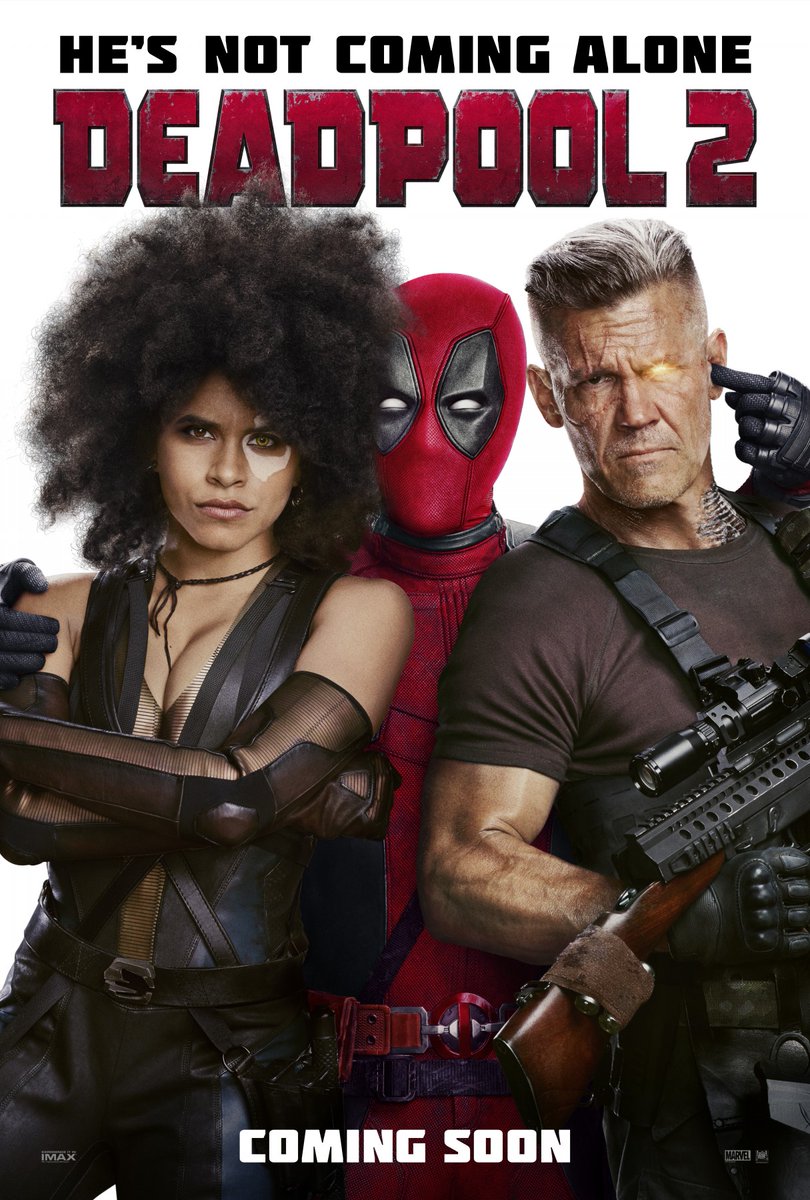
Of course we also have the new characters. Let's start with Cable, played by Josh "Man, he's having a good month" Brolin. In a way, Cable and Thanos are quite similar. Both believe what they're doing is right and have some emotional resonance to them. The difference though is that Cable is still a straight up hero, even if he's going to extreme tactics. He's a pretty good antithesis to Deadpool, with the gruff voice and serious attitude compared to the witty fun-loving Wade. Is it any wonder these two are best friends in the comics; they complete each other. It's also probably good they didn't delve into Cable's complicated comics backstory, but a subtle hint at his parentage would have been nice; I'll settle for the Hope reference though.
Standing out just as much as Cable though was Zazie Beetz as Domino. The first scene where she uses her powers in the field shows just how badass she is. I also kind of see her as the middle ground between Deadpool and Cable, having fun but not always putting up with Wade's shenanigans.

All in all, Deadpool 2 hits the same marks as the original while going bigger with the action and comedy, adding in more emotional depth than before, despite almost losing itself in the large pool of superhero movies.

Monday, April 30, 2018

Movie Review: "Avengers: Infinity War" - Epic in Every Sense


10 years. I don't think that anyone could have imagined where things have lead to when the first Iron Man movie came out back then. Against all odds, Marvel changed the film industry by creating a cinematic universe full of so many different types of heroes. With "Avengers: Infinity War", it was time to bring everything together and to an end. There may be some point where the MCU will become too large and collapse into itself, but today is not that day.

"Infinity War" is as ambitious as first Avengers film was, not only uniting all the heroes of Earth, but the space-faring Guardians of the Galaxy as well. And when you have a villain bent on wiping out half the universe, it's going to take all the big guns. Considering the stories this film is based on, what we have here is the first true event comic book movie, where the story is so massive in scale that it will affect every corner and bring characters together that never met before. We see new and every entertaining interactions between Avengers and Guardians, including Thor and Rocket, Iron Man and Star-Lord, and (albeit briefly) Captain America and Groot.

Tonally, this is probably the darkest film to come from the MCU, and it makes it clear from the beginning not just with the first scene, but by the opening Marvel Studios logo not including its usual fanfare music. Shit was definitely about to get real. That's not to say that the film doesn't include the trademark humor the films have been known for. Hell, it's probably the most I've laughed at a first viewing of a Marvel movie. In fact, it's those moments that are needed to alleviate the dark moments, otherwise, I think the movie would be downright depressing.
The action is top notch as always, and I would say probably the most graphic from these films (the opening scene and Vision getting stabbed from behind come to mind). One of my favorite moments though was Spider-Man swinging through New York during a fight scene; I know we've seen Spider-Man swinging through the city in past films before, but this is the first time we've seen him do it in the MCU. It was quite a big deal for me.

But let's talk about the real star of the film: Thanos, voiced by Josh Brolin. Having been teased since the first Avengers film and Brolin being cast four years prior to "Infinity War", this has been built up for a long time. What we get is not only without a doubt the best MCU villain probably ever, but Thanos will go down as one of the greatest villains in cinematic history, right there with Darth Vader. His very presence is imposing and with the power at his disposal, there's true fear in what he'll do next. In a way, he's a natural disaster, like a hurricane brewing in the ocean that has finally made landfall.  Thankfully he's not just evil for evil's sake, as he's shown to be a complex character. He truly believes his goals are noble and he does have some shred of love in his heart. All villains before pale to the glory of Thanos (which isn't hard in some cases).

The film is full of a lot of shocks and twists that fans won't see coming, especially the ending, even though we probably should have. I myself am still in awe of what happened. It's best to remember that when the film was announced, it was a two-parter, with the second coming out in 2019. Despite the name change, it's still definitely a two-parter. That being the case, even though this is definitely the best MCU film to date, the story's not over yet and I will wait until Avengers 4 is released next year before updating my ranking list.

All in all, "Avengers: Infinity War" is an epic event of heroes coming together against a great evil that needs to be experienced in theaters with a finale no one can be prepared for. For those of us who've followed these characters since the beginning, it's an emotional roller coaster. It only hurts that we must wait a year to find out how it all truly ends.

Thursday, April 12, 2018

Movie Review: "Suicide Squad: Hell to Pay" - Another Mixed Bag (SPOILERS)


It goes without saying that Suicide Squad has become a household name recently. The 2016 live action film, despite not being critically well received, was still able to find an audience. That said, I guess I should have seen an animated film coming. And much like it's real life counterpart, "Suicide Squad: Hell to Pay" had potential but doesn't necessarily live up to it.

To give the film some initial props, the characters definitely feel more in line with their comic book counterparts. They make it clear that these are bad guys, who will fight and betray each other, not looking for any kind of redemption. However, there is still a level comradery between some of the characters. This is most evident in Deadshot and Bronze Tiger. Tiger is more noble to contrast Deadshot's selfishness, but they have as much similarities as they do differences, especially in their backstories.

As another R rated entry into DC's animated film line, the level of action is allowed to be as graphic as possible, aiming for the same vain as splatter exploitation films. While the initial scene achieves that, I found it down hill from there. The rest of the action in the film isn't bad, but it doesn't really stand out compared to that opening scene or any other DC animated film.

This film is pretty much a who's who of supervillains. That's a strength and weakness to me. On one hand, you get to see a bunch of villains who may not have had much spotlight on them before. However, some of them are gone as quickly as they appear, and unless you're familiar with the comics, you won't even know who they are, and even if you do, you still may not even care for them here. The point is, a lot of characters are superfluous to the plot.

For the most part, the voice cast is pretty good. We have Christian Slater as Deadshot, who definitely fits the roll well. Vanessa Williams plays Amanda Waller, who does such a good job, you'd almost think it was CCH Pounder again. For what little time she appeared, I liked Dania Ramirez as Scandal Savage. You also have C. Thomas Howell reprising the role of the Reverse-Flash, which is not only a call back to "The Flashpoint Paradox", but also connects to that film.
If I had a problem with anyone, it's Tara Strong, once again playing Harley Quinn. While she's usually great as the character, I couldn't help but feel her heart wasn't in it this time around; some lines weren't delivered as well as they could have been. Besides that, I just didn't feel Tara's voice fit with Harley's character design here. On another note, she is the main source of comedy in the film, usually from her or characters reacting to her. It lands half the time, but grating the other half, which I again attribute to Tara's line deliveries. It also doesn't help that there were awkward moments of silence like they're spacing it out for the viewer to laugh (and that's for comedic moments not just involving Harley as well).

The plot of this film is in my opinion kind of silly. The base of it is Amanda Waller sending the Suicide Squad to retrieve a "Get out of Hell Free" card, which is also being sought by Vandal Savage and the Reverse-Flash. And I'm not simplifying it there; the card literally says "Get out of Hell Free" in plain English on it. Whoever possesses the card at the moment of their death is immediately sent to Heaven. Now, the idea of such a macguffin isn't bad, but I have a hard time taking it seriously when a magical item like that literally says "Get out of Hell Free" instead of some ancient magic language.
This also ties into two other problems I have. The first being that we didn't need two sets of villains going after the card. You could have left Vandal Savage out entirely and just have the Reverse-Flash seeking the card; he definitely had the more interesting motive, trying to prolong his death long enough to get the card. The second being their use of the hero Doctor Fate, who had possession of the card before it was stolen. This is a new version of the character created for the film called Steel Maxum, who was chosen by Nabu for his fitness to become the new Doctor Fate. Aside from his fitness, the guy is your typical douchebag in love with himself who loses the card because of his own stupidity, leading Nabu to revoke the title from him, but I'm just left bewildered that he was chosen in the first place.

I was really excited for this film, and while it does well in some areas, I just can't overlook its flaws enough to recommend it, not even to fans of the live action film. And while I thought the live action film had good elements that were misused, "Hell to Pay" is bloated with characters and a plot that's all over the place.
As it stands, the best depiction of the Suicide Squad in film still remains "Batman: Assault on Arkham", which was essentially a Suicide Squad movie that despite my problems with it when it first came out, has actually improved with age.

Coming up next from DC's animated movie line is a two parter: "Death of Superman" and "Reign of the Supermen". In this instance, I'm going to wait until the second part is released to watch both and review them all at once; so don't expect that until next year.