Wednesday, November 6, 2019

Comics Review: "Superior Spider-Man: Otto-Matic" - That's All, Folks


So a couple things I said back in my last Superior Spider-Man review five months ago didn't really age well. The first was my belief that this volume would have significant longevity. As it turns out, this story is the conclusion to the series. The second was my thoughts on Mephisto's presence, and ooh boy, does he come back into play.
Issues seven and eight of the series are tie-ins to "War of the Realms", a Thor-centered event written by Jason Aaron that was occurring at the time. Said issues featured Otto teaming up with both the West Coast Avengers and the Fantastic Four as they dealt with the Ice Giants roaming across the United States. I'm skipping these issues given the broader scope of the event itself and me wanting to keep focused on Otto's own stories. On a side note, I will say though that I found "War of the Realms" the best Marvel event I've read since "AXIS". It's easily accessible, features a wide cast from many corners of the Marvel universe, and it's just plain fun. With that said, it's time to look the final four issues of the Superior Spider-Man.

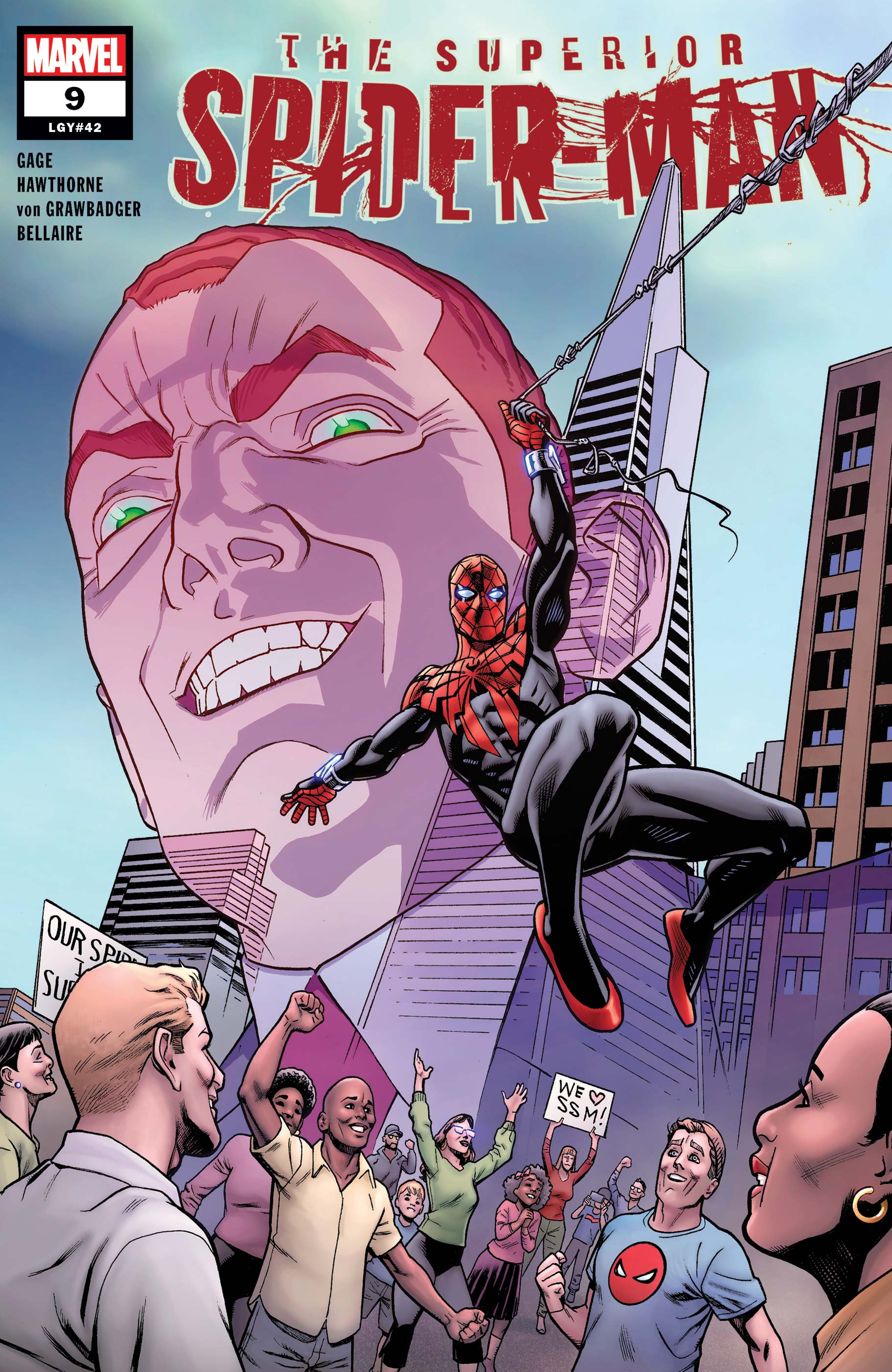
Issue nine begins with Otto as Spider-Man being presented the key to the city by the mayor of San Francisco for all his heroic accomplishments. As Otto begins his acceptance speech, he seems at a loss of words and then claims that an emergency is in progress that he must attend to. This turns out to be a lie though as we see Otto returned to his lab at Horizon University, claiming that such a ceremony was a waste of time he could be using for more important things. Anna Maria finds this behavior odd since Otto usually wants recognition for his work. Said behavior is also shown when Otto runs into Emma. With some time passing since their disastrous first date and realizing the good work he's done, Emma asks Otto if he wants to give it another try. Otto rudely declines, saying it's not best for either of them and that she should question her mental state to ask such a question.
The next day, Otto has to deal with a supervillain terrorizing the citizens of San Francisco: a Z-lister named Turner D. Century, a villain obsessed with the 19th century and dresses accordingly, even down to a handlebar moustache. You know, this is one of the things I've loved about Otto having his own series apart from Peter's, which is one of the flagship Marvel books. It allows for the writers to really cut loose and have some fun since this iteration of "Superior Spider-Man" isn't that high a priority. Hell, Turner reveals his intentions are to kill all hipsters. It's so ludicrous and yet I love it. Anyway, Turner reveals his Time Horn, which blasts a frequency that is lethal to the nervous systems of anyone below middle aged. Otto is unaffected considering his mind is much older than his current body is. Otto then begins wailing on Turner until he's stopped by the arrival of the one true Spider-Man, Peter Parker.
After webbing up Turner for the cops, the two swing off heading to the roof of Horizon University, and the art does a good job at contrasting the two Spider-Man. Aside from the black and blue, the red in Otto's costume is a darker shade, and while the lenses in Otto's mask are white like Peter's, they're more like slits compared to the more rounded ones Peter has. Peter reveals that Anna had called him, worried about how Otto was acting. Peter says he should be happy since his actions during the War of the Realms lead to San Francisco suffering no casualties. Otto then finally lets loose, talking about the casualties the Ice Giants had caused in other towns across the United States. Mask off and tears in his eyes, he admits he feels undeserving of the recognition in his own city, thinking he should have done more to help others elsewhere. Peter tells him that while Otto's still new to the hero thing that the way he's feeling right now "means [he's] doing it right" and that he shouldn't be so hard on himself. Peter then leaves on telling Otto he "might just have a future at this". Knowing how this story goes, rereading that line kind of hurt.
Emma then comes up to the roof, believing correctly that she saw him swing up there. Otto tries to brush her off. When she doesn't leave, Otto lashes out with tears still in his eyes: "What did I look like? Weak? As if I need help? AS IF I NEED A DAMN THING FROM ANYONE?" Otto then falls down to his knees, letting it all out as Emma embraces him. This is another moment that shows this version of Otto had much potential to be an even better Superior Spider-Man compared to the previous one.
The two later get coffee at a café and it goes well, with Emma helping Otto with his trouble mind and the two inevitably kiss. But unbeknownst to them, they are being watched by a spider on the side of a building. This is no ordinary spider, however, as it belongs to a swarm of spiders that compose Spiders-Man. Spiders-Man is alternate reality Peter Parker who fell into a radioactive colony of spiders that ate him, absorbing his consciousness in the process and becoming a hive-mind. Basically think of Million Ants from that episode of "Rick and Morty", except somewhat crazy and enjoys eating people. Spiders-Man is acting on the orders of an alternate reality Norman Osborn who had become the Spider-Man of his world, and just because he has spider powers doesn't makes this version of Norman less of a jerk. For a little backstory, these two characters were introduced in the "Spider-Geddon" event as part of the Spider-Army to fight the Inheritors until they were kicked out by Otto for their selfish behavior. In retaliation, they destroyed the Web of Life and Destiny (which is used by spider characters to travel across the multiverse), intending to trap the Spider-Army and the Inheritors on the prime Marvel Earth together, while Norman took a piece for himself for his own means. So to sum it up, Spider-Norman plans to have his revenge on the Superior Spider-Man.

Issue ten shows Otto giving Emma a swing across the city before going to visit James Martin, the young boy who lost his mother that Otto consoled back in issue four. James has been staying with his aunt and uncle who are in the process of becoming his legal guardians, and Otto has been making regular visits to the boy. James' therapist says the visits have been helping him cope with his loss, and Otto says it's meant a lot to himself as well. Otto then meets up with Emma back at his apartment as they begin talking about the idea of having children themselves. That seems to be moving pretty fast, which Emma even mentions, but considering Otto revealed his true identity on their first date, maybe that's just the speed of their relationship. She also brings up that her age probably rules out biological kids, but Otto reminds her that he is clearly a master at genetic manipulation.
So things seem to be going well for Otto, with a city and woman who adore him. Well, considering he partly has Peter Parker's DNA, this is the perfect time for him to fall victim to the dreaded "Parker Luck." The conversation Otto and Emma are having is interrupted by a news report on TV with the headline "Is the SF Spider-Man Really Doc Ock?" Uh oh.
This obviously makes the news cycle onto the next day. While the Fantastic Four, Dr. Strange, and even Peter as Spider-Man have vouched for his change in character, things aren't helped when the Brothers Grimm are interviewed as well, revealing that Otto had paid them for their services. If that's not bad enough, Otto then realizes how this news might have an effect on James. Otto suits up and heads to the apartment of James' aunt and uncle, and they're not happy with him either. They tell Otto that they may lose custody of James due to letting him associate with a known criminal. Otto apologizes and plans to provide them a signed notary that they had no idea of his true identity before asking to say goodbye to James. James is clearly hurt by Otto's deception, as Otto does his best to apologize and bid farewell. Before Otto leaves, James asked why he lied to him. Otto responds "I..I wanted you to like me." James then runs up to Otto and the two hug. If that ain't forgiveness, I don't know what is.
Later, Otto, under his new persona of Elliot Tolliver, is met by Max Modell at Horizon University. Max tells "Elliot" that he had received an e-mail about his true identity as Otto Octavius. Max reveals that he already knew the truth based on the new Spider-Man in San Francisco and he had Tolliver's DNA tested (and yet the guy never figured out Peter's double life). But Max believes in second chances, referencing his own work with Michael Morbius, and wanted to give Otto the chance the prove himself. Like his meeting with James, this is another instance of Otto's situation not being all bad. The two then agree to figure out who's trying to sabotage Otto's life.
The two figure out that the e-mail Max received was sent from an internet café and pull up security footage. While Max sees no one there, Otto's lenses enhance the footage enough to see spiders on the keyboard and realizes who's responsible. As it turns out, Spiders-Man was in the building with them. His escape attempt is foiled by Otto trapping his "prime spider" in a energy bubble. Otto makes Spiders-Man reveal that he was working for Spider-Norman, claiming he's back on his own world. Otto and Max are joined by Anna Maria as they head toward a transdimensional viewer they were working on, which Otto intends to modify to allow travel as well. However, they need a massive amount of cosmic energy, to which Anna Maria reveals the cosmic harness she had hidden away after the fight with Terrax. Otto realizes why she hid it, and while hurt, admits it was a logical decision. The Living Brain begins filtering the cosmic energy into the viewer, but it's too much. Otto tells it to stop until it begins talking in Norman's voice, leading to an explosion that takes out a large portion of Horizon University. Otto is ravaged while Anna and Max are unconscious as Spider-Norman makes himself known, revealing that he had been in their universe for weeks. Otto tries to take on Norman but is in no shape. Otto tells him to just kill him and get it over with, but Norman wants him to suffer. Norman reveals his plan to kill anyone Otto cares for even slightly, leaving Otto in the rubble, laughing on his spider-glider as issue ten ends.

Issue eleven picks up with Otto helping coordinate fire and rescue at Horizon University. Anna Maria has no major injuries while Max is stable and headed to the hospital. Otto is able to find Emma unconscious and gets her into an ambulance. Anna tells Otto she'll handle things from there so he can go after Norman. Otto realizes Norman will be going after James next and contacts the Night Shift to meet him at his address. Things don't go well for the Night Shift as they're made short work of by both Spider-Norman and Spiders-Man. Norman chases after James and his family on his spider-glider before being knocked off by a swing-kick from Otto. While Otto does his best, his injuries from the explosion still make him weak, which Norman takes advantage of. Norman then taunts Otto about when he had fought his own world's Norman, he admitted failure and returned Peter's body back to him. So by this point, it was already clear that this volume of "Superior Spider-Man" was ending, and Norman's comments here made me realize why he was the perfect choice for the series' last villain. Norman Osborn was the one villain Otto couldn't beat during his original time as Spider-Man, so him having to face Norman in some fashion was a great way for Otto to make up for his past failure.
Anyway, Norman snatches up James and flies up on his glider. Otto begs him not to hurt the boy and will do anything he asks. Norman, enjoying his groveling, gives Otto an ultimatum: he has two hours to kill three innocent people on camera in front of the whole world, or James dies. Otto accepts, passing out as Norman flies off with the boy.
Otto then awakes in the hospital, greeted by Anna Maria who tells him he had been asleep for an hour and a half. Anna apprises him of the situation, revealing that the Night Shift are alive all things considered and that Emma is in a medically induced coma. After quickly visiting Emma in her room, Otto knows he has to do something with what little time he has left to save James. He knows that Norman will kill James no matter what Otto does, but he does have an idea. Otto puts out a frequency he had picked up during his and Strange's fight with Pandemonium and summons Mephisto.
Otto offers Mephisto a deal: he wishes to be transformed back into his true form of Otto Octavius/Doctor Octopus for one day, believing that he needs to be as ruthless as he used to be to match Osborn. Mephisto declines this but offers a counter-proposal: he'll transform him back into Doc Ock permanently, with no trace of Peter Parker in him. He'll remember the experiences he's had since transferring his mind into Peter's body, but will have none of the memories that turned him into a hero in the first place; Mephisto is basically wanting Otto to prove that he can be a hero in his own right. Anna Maria takes her role as the angel on Otto's shoulder to a whole new level as she tries to talk Otto out of accepting the deal, saying they'll find another way. The two make their arguments as Mephisto tells him it's time to make his choice.
We then cut to the Brothers Grimm hiding out in a hotel room, planning to get out of town before either Otto or Norman come after them, revealing that Norman had paid them to go on TV and talk about Otto. The issue ends with the brothers being attacked not by the Superior Spider-Man, but Doctor Octopus, demanding to know where Osborn is. Yes, Otto is back with the metal arms, green and yellow jumpsuit, and even the Moe Howard mop-top haircut.

The twelfth and final issues begins with Norman in a penthouse where he's keeping James hostage. Into the room enters "Elliot Tolliver" and a homeless looking man with his face obscured by his hoodie and trench coat, claiming Norman would want to witness him kill someone firsthand. Norman agrees and gets the camera drone ready, going up to the man for a closer look. A metal arm comes out of the trench coat and snaps Elliot's neck, revealing himself to be Doctor Octopus and that the Elliot with them was a mindless excess clone being controlled by one of his octobots. Norman radios Spiders-Man for help, but we see he's being vaporized one spider at a time by Ock's legion of octobots and spider-bots. Norman doesn't think Otto having his original body back changes anything, that he's still the villain trying to play hero, and threatens to toss James out the window. Ock does nothing to stop Norman from doing so or even tries to save James after the fact. A shocked Norman turns the cameras on so the world can see him kill Otto himself. Ock has back-up though as he's able to mentally summon and control multiple harnesses for his arms he's used over the years. From what I was able to count, he used four to contain Osborn, as well as a fifth to save James from his fall outside his building. Ock then uses the arms to break Osborn's bones in such a way that he'll never fully recover; Ock claims this isn't brutality, but it seems pretty brutal. He then steals the fragment of the Web of Life and Destiny Norman had in his possession, using it to send him back to his world, as well as intending to find his own use for it. Ock then uses the camera drone to make his declaration to the world that Doctor Octopus is back, and that anyone who threatens him or any of his associates during his time as the Superior Spider-Man will meet a fate even worse than what he just did to Osborn.
As a brief aside, I kind of wish they gave Doc Ock another look for his return. Yes, it's a classic look, but the way Mike Hawthorne draws him makes it seem like they plucked him from the 60's or 70's books; it just seems out of place in today's age in my opinion. I mean, why not the green/yellow armor he wore in the 90's animated series, the trench coat look of the 2000's, or even a mix like on the "Spectacular Spider-Man" animated series? That being said though, I do think Hawthorne does a good job with Ock's face, making it clear that he's as despicable outside as is inside with his original body back. It's almost toad-like, like Dolores Umbridge from Harry Potter.
Later at the hospital, Emma has awakened form her coma and Anna Maria fills her in on what Otto had done. Ock then arrives, revealing that he has no knowledge of Spider-Man's true identity or any of his memories, but does recall some of his time as Elliot Tolliver. Ock claims he came to them to tell them that this chapter in his life was over and say goodbye, but Anna Maria tries to call him out, believing that he wants them to get him to stay. She says Doctor Octopus could be a force for good, and that she, Emma, and Max could help him, if only he gives himself a chance. Ock rebuffs them, telling him to stay away from him as he leaves. However, once out of their sight, we see tears in his eyes. I think this hints at Otto possibly having more memories than he's letting on, but I guess this will be left up to whoever writes Otto whenever he shows up next after this series.
A week later, a funeral is held for Elliot Tolliver. At first I thought this was more of symbolic funeral for the man Otto had been to those at Horizon, but then I realized only Anna, Max, and Emma knew his true identity. For everyone else present, they had no knowledge of this and think Elliot was just a casualty between Doctor Octopus and Spider-Norman. From a distance, Ock is watching. After leaving his Superior Spider-Man suit in the garbage, he walks off, with the final page paying homage to famous "Spider-Man No More" splash page from one of the times Peter had quit way back in Amazing Spider-Man #50.

I hate how this ended. I will be clear though, Christos Gage had crafted a well-written story. The ending doesn't exactly suck, but it is disappointing. Apparently someone at Marvel really wanted to bring Doc Ock back to his villainous ways. At least when this seemed to be happening during "The Clone Conspiracy", Otto still had some of his experiences as Spider-Man to build off of. Bringing him back this time, but with his status-quo to pre-Superior Spider-Man, undoes over six years of development.
In a way, this is very similar to the ending of the original Superior Spider-Man run, with Otto sacrificing the life he had in order to save someone he cared about. But comparisons will be more likely made to "One More Day" given Mephisto's involvement. This is handled much better though. Otto had been painted into a corner. He had a very limited timeframe and any attempts to outwit Norman or call in back-up would have resulted in the death of a young boy. Compare that to "One More Day" where so many characters had been written poorly. Of all the examples I can bring up, I think it comes down to this: Peter Parker is supposed to be a hero, while Otto Octavius' villainous history is abundantly clear. Otto making a deal with the devil makes sense given his past nature. Peter is supposed to be above that sort of thing. While he was trying to save his aunt, who had been dying due to his actions, you could see it as a way of him trying to avoid taking responsibility instead of letting her die and accept the consequences. That's why so many people were angry after "One More Day" occurred. At the very least, only Otto's character had been hurt compared to the scale of character assassination that came from Peter's deal. Still, I hate the fact that Mephisto has become a regular part of the Spider-Man mythos.
So for fans of the Superior Spider-Man, if you were there at the beginning, you should at least be there for the end. Then again, we've thought we've seen the last of the Superior Spider-Man before only for him to return. However, this time feels a bit more definite.

Thursday, October 24, 2019

Movie Review: "Wonder Woman: Bloodlines" - Wonderful Enough


Much like Superman returning to the spotlight in the DC animated film line with the "Death and Return" two parter, "Bloodlines" marks Wonder Woman's first animated film since 2009 (also her only second one overall). This admittedly most likely came about due to the success of the live action film, but I think we should all just be glad DC is finally doing more than just Justice League and Batman animated films in recent years. Taking place in the DC Animated Movie Universe, this version of Wonder Woman is finally able to have her own adventure separate from the League. What results is a satisfactory endeavor that should please fans of the amazon, but doesn't really bring anything too new.

The film has been marketed as an origin film, but it's only part true. It's really just the first twenty minutes of the film, telling Diana's story prior to "Justice League: War" before jumping to the present day set after the previous Superman two-parter. The first ten minutes go through the basics: Steve crashes on Themyscera and is saved by Diana, who goes with him to help man's world against her mother's wishes. The next ten minutes though show Steve introducing Diana to Greek archaeologist Julia Kapatelis; the two work together to share each other's cultures, so Diana can learn about the modern world while she can give Julia new insights on Greek customs. Diana also meets Julia's daughter Vanessa, who she finds a spiritual connection with, particularly their mother issues. Julia is shown to be more focused on her work than her daughter, much like Hippolyta appeared more dutiful as the queen than a mother. While Diana and Hippolyta are later able to reconcile, the same cannot be said for Julia and Vanessa. Without spoiling too much as to why, Julia is written in a way that makes her very unlikable, at least to me.

Rosario Dawson returns as to voice Wonder Woman from the previous DCAMU films and leads a mostly stellar voice cast. Much like how the Superman two-parter delved into the character's supporting cast within this universe, the same is said for Wonder Woman's. Steve Trevor makes his first appearance in these films since "Throne of Atlantis" while we're also introduced to Etta Candy, Ferdinand, and a good collection of Diana's rogues gallery, including Giganta, Doctors Cyber and Poison, and Medusa. Vanessa also becomes the villain Silver Swan, and while her character is written well, there are moments where the actress playing her sounds off, like her voice broke at times but they didn't want to go back and fix it.

With this film, I realized there's been some parallels between the DCAMU films this year, including the Superman two-parter and "Batman: Hush." As mentioned, Wonder Woman's corner of the universe is more fleshed out like Superman's was. And since the two broke up, Diana's relationship with Steve finally blossoms as Clark and Lois' did. In addition, Wonder Woman also shifts to a new costume that resembles her classic/modern iteration and the live action suit. Between the romance and costume changes for the characters, this is what I would call the Rebirth effect, where the current state of comics have impact on the animated films. The same can be said for Batman to a lesser degree, but that was more about adapting the "Hush" storyline, plus the fact Bruce and Selina broke up at the end. So two out of three isn't too bad on the romance column. Of the three stories though, Superman's was my favorite.

While this film is set within the DCAMU, those following the series will notice a significant change in animation. The character designs seem the same, but the style in animation seems to have gone for a more western approach compared to the anime influence we've seen before. I'm not sure if it was a budgetary issue considering DC has put out four films this year compared to the usual three or if this is going to be the new norm. I'll guess we'll know for sure when "Apokolips War" hits next year.
Nevertheless, the animation style doesn't hinder the fight scenes. They're all entertaining, particularly in how Wonder Woman is able to win. While some of it comes down to strength, we also get to see Diana's ingenuity and strategy at play. She's able to contend with Cheetah's speed by putting her in a more enclosed environment and later blinds herself to combat Medusa's stone-turning gaze. Said final battle with Medusa is my favorite of the film. We see Wonder Woman taking a major beating, from being thrown around and being bitten by the snakes in Medusa's hair, but she never shows any sign of giving up. In general, that's one of the best things the film gets right about Diana: she'll fight an enemy to the end and she won't turn away from friends who lost their way.

One problem I had with this film was the depiction of the amazons. Between this and the live action film, that one did a better job. For one, Hippolyta was shown from the beginning to be a caring mother as well as a inspiring leader. Also, the live action film did a good job at showing the amazons' fighting ability, even against those with advance weaponry like the German soldiers and their guns. Here, they all get jobbed by Medusa.

Overall, "Wonder Woman: Bloodlines" is a mostly satisfying film that's a faithful depiction of the Spirit of Truth with some enjoyable characters and great fight scenes. There isn't much more to it than that, but it should be enough for some.

Wednesday, October 2, 2019

Comics Review: "Batman: Damned" - Da Hell? (SPOILERS)


While DC has retired the "Elseworlds" imprint, its basic concept, telling unique stories without the hinderence of the main continuity, has gained new life with the "Black Label" series of books. Even DC seems to acknowledge the legacy between imprints with re-releases of past stories such as "Kingdom Come" and "DC: The New Frontier" under the Black Label banner. Much like how Elseworlds unofficially began with Batman stories such as "Dark Knight Returns" and "Gotham by Gaslight", the roots of the Black Label line stem from the success of another out of continuity Batman story, "White Knight". The first official Black Label series would be "Batman: Damned" by the creative team of writer Brian Azzarello and artist Lee Bermejo.
My only experience with Azzarello's work is on Batman stories, such as the "Flashpoint" tie-in series I praised way back in my 2013 review. He also wrote the film script for the Killing Joke adaptation, including the prologue focusing on Batgirl; while I didn't mind said prologue at first, repeated viewings have made me realize how cringe-worthy it really is to the point where I just skip to the actual Killing Joke story from now on. While he's done characters like Superman and Wonder Woman, Azzarello seems more in his element when it comes to gritty crime stories, which makes him perfect for Batman. Said style is emphasized when he works with artist Lee Bermejo, including their 2008 "Joker" graphic novel. Bermejo brings a much realistic take in his art style and the characters. The best examples can be seen with the more tactical elements of Batman's suit, Joker's smile comes from scars much like Heath Ledger's depiction, and Killer Croc is less monstrous, being just a gangster with a skin condition and cannibalistic tendencies. Bermejo would later write and draw the 2011 graphic novel "Batman: Noel", and though Azzarello wasn't involved, you could see his influence in Bermejo's writing.
The two reunite for "Batman: Damned", a story where we see Batman investigating the Joker's murder. Batman worries he may have committed it but is unable to remember doing so and enlists magic-based DC characters to help him. Fear not though, the gritty realism is still present and the supernatural elements don't hurt the tone. Even Superman made an appearance in "Noel"; it is still the DC universe after all.

I'll start by saying the art by Bermejo is spectacular on this book. Bermejo did the coloring himself, though it seems he learned some tricks Barbara Ciardo, the colorist from "Noel", to make "Damned" just as vibrant. Since this is basically a horror book, Bermejo's also able to create some imagery that's unsettling, such as the appearances of Enchantress and an odd instance of a live bat stitched onto a possibly dead human male chest (which admittedly doesn't really add anything to the story). I think Azzarello's direction also influenced the new designs for characters like Deadman and the Spectre. Instead of his circus outfit, the red parts of Deadman's appearance are basically bare human muscles. As for the Spectre, he appears as a homeless man wearing a green jacket with a hood; the Spectre is probably possessing the poor guy, but it really works with the aesthetic of the book.

When it comes to Azzarello's writing style, for better or worse, he definitely does a lot to make this story stand out. For example, whenever Lee Bermejo is drawing Batman, and it might be because of the constant scowl, I can't help but feel he's a lot meaner than other depictions. This story might explain why, as we see through flashbacks that much like in the Telltale Games, Bruce's father wasn't exactly ideal. Thomas was having an affair and the young Bruce was constantly listening to his parents arguing; of course the guy's going to have issues...well more than you'd usually expect with Batman. There's also the fact that Enchantress has been haunting Bruce since he was a boy, and partly responsible for his parents' deaths. Normally I'd say this hurts the point of Batman's mission, that no one suffers from a random act of violence as he did. Considering they're aiming to be different though, I don't want to get too bent out of shape about it.
Another idea I liked is how Azzarello depicted Deadman's power of possession, showing that he can only stay in a vessel for so long, as it seems to deteriorate while he's inside.
A lot of characters stick to their traditional appearances like Constantine, Enchantress, Zatanna, and Swamp Thing (who is depicted as much larger than life character than normal; seriously, his head is the size of Batman's whole body). But one character redesign that's really out there is Etrigan's, who is depicted as a free-stylin' rapper going by J Blood (his real name being Jason Blood). When I realized who this character was, I was a bit torn. On one hand, it's definitely a unique take and the rapper gimmick allows the character to keep his penchant for rhyming. I also like how the yellow lighting for his scenes helps add some semblance to the original character along with the red sunglasses. Still, I'm not sure if he's actually a demon like he's supposed to be or just a rapper with a very devoted following willing to kill Batman and each other for him.

If there's a main problem I have with the story, it's the plotting. One big example is the break between issues two and three. Issue two ends with Batman, possessed by the Enchantress, strangling Harley Quinn against the bat-signal. Issue three begins with Batman finding himself buried alive in a pinewood casket before being unearthed by Swamp Thing. What the hell happened between issues? Did Batman kill Harley? Did Constantine stop him and then bury him? Why did he bury him at all? Did he know Batman was possessed? How would he know that? In the words of another Batman:

Then there's the ending, and boy is it head scratching. "Damned" is a follow up to the "Joker" graphic novel as it depicts the end of the battle Batman and Joker had at the end of that book. Throughout "Damned", Batman is unwilling to accept the idea of Joker being dead, waiting until the end to finally go the morgue to see the body. The Spectre, who has been stalking Batman throughout the book, is there waiting to cast judgment. Batman remembers that during their battle, he punched Joker and sent him over the edge of a suspension bridge, hanging on for his life. Batman, who was bleeding out from knife wounds inflicted on him by Joker, reached out his hand only to withdraw it, fearful of Joker's future actions. Batman looks at the Joker's body and, regretful of his inaction, states "I wish he were still alive." Then all of a sudden, Batman is sucked into the Joker's body chamber and the door shuts behind him. We then cut back to the bridge they were fighting on, as we end the story with Joker emerging from the water and coming ashore, with Bermejo paying homage to the Joker creation scene from "The Killing Joke." Once I finished reading, I spent probably about twenty minutes trying to make sense of what happened.
So my best guess as to what this ending means has to do with how this depiction of the Spectre's powers may work. He confronted Batman about his evil act, and because he showed regret, the Spectre set things right by making sure the Joker survived his fall. Otherwise, Batman may have felt the Spectre's vengeance. Again, I am only guessing because the comic does not make it clear.
This has the same problem I had with the ending to the "Joker" graphic novel; it just doesn't have that satisfying an ending. At least "Noel" had a clear-cut conclusion.

To finish up, "Batman: Damned" is a good but flawed story. I cannot praise Lee Bermejo's art enough, with its detailed realism and horror imagery. I wouldn't go so far as to say it's "style over substance" because Brian Azzarello brings a lot of good ideas to the table with this book, with his reinterpretations of the DC characters involved. It just doesn't truly stick the landing or have what I think is a meaningful payoff.
Still, I will say that it is a strong start to the DC Black Label line and worth checking out, especially if you've already read the previous Batman works involving Lee Bermejo. Of the three stories though, "Noel" is still my favorite.

Sunday, September 29, 2019

Retro Review: "Gerard Way: Hesitant Alien"


Whenever I come around to My Chemical Romance in the rotation for my car CD player, there's one album I include in that group that I didn't talk about in my MCR retrospective back in March. That would be the solo album of lead singer, Gerard Way: "Hesitant Alien". The album came out six months after the MCR "May Death Never Stop You" greatest hits compilation, and this year marks its fifth anniversary. Considering that and I've talked about Gerard's prior musical works already, I thought I'd give "Hesitant Alien" the same treatment.

In the five years I've had this album since Christmas 2014, it's one that I tend to appreciate the more I listen to it. When a lead singer of an established band goes solo, it's hard not to expect or compare it to their previous work; this is no different. It definitely has a different sound compared to My Chemical Romance, but as I listened to it more, I began to realize Gerard carried over a lot of elements that were present in "Danger Days". As I said in the retrospective, "Danger Days" featured a My Chemical Romance that were more at peace with who they were, no longer full of anger as when they began. Even solo, Gerard brings some of that upbeat sound. This is why I include "Hesitant Alien" whenever I listen to the MCR albums, as it's another step in Gerard's progression as an artist.
The best way to describe the album is "pop grunge". Some of the songs have a clean poppy sound to them, while others can get a bit dirty or have a mix between the two.

Since I'm devoting a whole post to this album, I'll be a little more in depth with my thoughts on the songs compared to my general album analyses from the MCR retrospective. I'll just start out by saying that I don't particularly care for "The Bureau", "No Shows", "Get the Gang Together", and "How It's Going to Be". My main problem with these songs are there being either a filter over Gerard's vocals or he's drowned out by the music, making it hard to really understand him, and in turn making it hard for me to really connect with. Don't get me wrong though, they each have a good sound and I do sing along with the parts where I can understand the words. Plus, "The Bureau" is a nice introductory track for the album as a whole.
With that out of the way, let's take a look at my favorite songs of the album.

* Drugstore Perfume: This is my absolute favorite song from the album. It's beautifully composed in both the music and the lyrics. Gerard apparently wrote this for his wife (who he's been with since 2007), so it's easy to see this as a love song, talking about two people who've found each other after going through many hardships in their lives: "And as these days go by, they'll never change how long we've waited for a love that's more." It reminds me a lot of "Summertime" from "Danger Days."

* Action Cat and Millions: I group these two together because I feel they share the same message. It's about a relationship, either past and present, wanting it to be ideal but realizing/accepting it's not. Considering how fresh MCR's break-up was, it's easy to think of these songs being Gerard's way of expressing his feelings about it.
"Action Cat" is more of an aftermath song, as there's somewhat a sense of hope, emphasized by the stanzas asking or pleading to reciprocate the feeling of loss ("Said I miss you, say 'I miss you too'"). There's also a sense of bargaining with the lines "don't ask a lot and you won't lose a lot", like they're trying to keep whatever they can of the relationship alive. It's these lines that really connect with me.
"Millions" is my second favorite song of the album thanks to a great beat and the vocalizing from Gerard. "Millions" is going through the relationship and coming to the conclusion that it's over ("I think you're sore, I think I'm done") with a bit of blaming from both sides. There's also the sense of hope like "Action Cat" has, but it's not as prominent. They want to keep things together, but they need "a million reasons" and "a million more" on top of that to do so. It's kind of the opposite message of Lady Gaga's "Million Reasons"; one good one isn't enough.
Also, the music video is weird as hell but enjoyable, like an [adult swim] commercial bumper. I do the head side bobbing thing the group does whenever I listen to the song as well.


* Maya the Psychic: The final track of the album closes it out in a real rock fashion. I kind of see it as a "teenage rebellion" song, with an "us against them"/anti-authority attitude to it.

* Brother: This song is definitely about Gerard's brother Mikey, who was the bassist in MCR. Like "Action Cat" and "Millions", I think "Brother" is also a post band break-up song, as Gerard is looking back at the simpler times the two had and how things were then. It immediately hooks you in with the piano in the intro and there's also an outro to the song with a distorted voice saying "Where's Mikey? Where'd he go?" that gets me every time. In general, I think it's a song about brotherly love and sticking by each other through the hardships, as I tend to think of my own brother when I hear this.

* Zero Zero: Honestly, I'm not sure what the real meaning of this song is, but it really kicks ass. The lyrics "Call me zero" and "I am zero" make me think of my second all-time favorite anime "Code Geass" as the main character Lelouch creates the masked identity of Zero to accomplish his goals.

* Juarez: This is the hardest rocking song on the album and the best example of the grunge influence I noticed. I've also come to realize it reminds me a lot of the Queen song "Stone Cold Crazy" with its short runtime and talk about dealing the law.

Overall, it may not be My Chemical Romance, but "Hesitant Alien" shows Gerard Way hasn't lost the music in his heart. If you're a fan but haven't checked out his solo album, I'd say it's worth it, though not all the songs may hit a chord with everyone.
Gerard has yet to follow up on "Hesitant Alien", focusing more on his comics career afterwards, though he did release a number of songs in late 2018 and early 2019. While I'm still waiting/hoping for My Chemical Romance to reunite, I wouldn't mind another solo venture from Gerard at some point as well.

Wednesday, August 28, 2019

TV Review: "Young Justice: Outsiders" - Business As Usual


I cannot give enough praise to the DC animated series, "Young Justice". Beginning on Cartoon Network in 2010, the show featured a team of superhero proteges, with the initial roster consisting of Robin, Kid Flash, Aqualad, Superboy, Miss Martian, and Artemis. It may sound like an updated version of Teen Titans, but while the focus is on the young heroes, it was more of a DC universe show as a whole. The team would work hand in hand with the Justice League and take on A-list villains, including Lex Luthor and Ra's al Ghul. The brilliant writing of the show not only helped make this version of the DC universe so unique, but also allowed viewers to become invested in the characters and their relationships. The best thing the show could have done was a five year time skip between seasons one and two (taglined "Invasion") with an expanded character roster, as it made it clear that these characters will change and grow in time much like how real life works. I'd go so far to say this is THE best DC animated series of all time (at least when it comes to universe-wide shows).
The show grew a large fanbase over its first two seasons, so you can probably guess how angry I and others were when the show was cancelled in 2013 for something as dumb as low toy sales. It was even worse that the season ended on a cliffhanger teasing Darkseid; you don't tease Darkseid and end the story there! Petitions were constant, but as years went by, it seemed like the book was closed on the story. That is until the tail end of 2016 when a third season was officially announced, much to a collective fangasm.
Season three, with the tagline "Outsiders", would air over the course of 2019 on the DC Universe streaming service. Despite the gap between seasons, the creators behind the show are no worse for wear, as the show retains what made it so special and loved to begin with.

In a way, it feels like the show never left. The writing is still brilliant and it's a joy that they were able to get a majority of the original voice cast back. The ones I do miss though are Tim Curry as G. Gordon Godfrey and Logan Grove as Beast Boy. Godfrey is now voiced by James Arnold Taylor, who does a good impression, while Beast Boy is reprised by his Teen Titans voice actor, Greg Cipes. I do like Cipes and he does good as a more mature Beast Boy, but getting Logan Grove back would have been a nice touch since the young actor has aged about the same amount as the character; then again, he may just have been available.
The season introduces a number of new characters, including Geo-Force, Halo, Forager, Terra and Cyborg. All mentioned characters are written very well and you will become invested in their progression, so much so that you will feel bad for them at moments where they make major mistakes.

The season begins two years after "Invasion", and it's made clear the Justice League's public reputation still hasn't fully recovered, not helped by Lex Luthor using his position as the United Nations Secretary General to hinder the League's efforts to help the world. This causes a divide among the heroes, whether to work with or without oversight, as well as staying in the shadows or remain public figures. It's an interesting premise that helps it stand out from the previous two seasons, bringing about a moral debate of how far one would go for justice.

The show seems to take a "Samurai Jack" approach with its revival, taking on a more mature tone compared to what came before. This works hand in hand with how the other DC Universe originals do the same. Compared to the previous seasons, the tone of "Outsiders" is more in line with the current DC animated films. It doesn't stick out like the content of "Titans" though, as I feel the mature tone in "Outsiders" feels like a natural progression and helps up the ante from what came before. This includes a lot more bloodshed during fights and some graphic imagery. A prime example is Cyborg's origin, particularly the accident that lead to his creation. This origin is probably the most graphic version yet, going so far as to expose his still beating heart and a portion of his head scorched down to the skull.
Aside from the violence though, the mature tone also allows for the show deal with themes it would have been unable to before, including abusive homesteads, childbirth complications, and more prevalent and relative, racism. While they also go the X-Men route by using meta-humans as a metaphor, true racism exists as well, including a storyline about banning refugees from certain countries. It's also clear they take inspiration from Donald Trump with villains like Baron Bedlam and Lex Luthor, the latter of which mimicking the "fake news" and "good people on both sides" quotes. So not only has the Donald Trump makeover Lex had in the 80's come full circle, but maybe it's a good thing the show had a bit of a hiatus.

As a whole, "Young Justice" has had this way of using the last episodes of the season to wrap things up in a way that, personally, gets me overly excited as I watch the smug-ass villains get rightfully put in their place as the heroes get the huge victory. "Outsiders" is no different. Like "Invasion" though, it's a bittersweet ending as the victory also comes with a major turning point for one of the characters. I think that between the excitement and concern over the fate of certain characters, both are a testament to how well written the show is and how it's able to make fans care so much.

Admittedly, I will say that I wish certain questions I had were answered (like why Miss Martian's form was different) and that some plotlines weren't used to their full potential (Red Hood, Batman Inc.). However, it's small potatoes when it comes to how good the season was as a whole.

Overall, "Young Justice: Outsiders" will leave both established fans and newcomers extremely satisfied. Not only do we get some closure from "Invasion", but with a fourth season greenlit, we won't have to say goodbye to these characters again. In a word, it's totally crash.

Thursday, August 8, 2019

Movie Review: "Batman: Hush" - Faithful to a Point (SPOILERS)


In anticipation for this film, I reviewed the original "Batman: Hush" comic storyline, finding it still held up as a great story with great art. Does the animated film hold up just as well? Well, it's kind of complicated, and I think there will be some division between fans over this film.

I'll first give props to the character designs. While this is set within the DC animated movie universe, they certainly went out of their way to be faithful to Jim Lee's style. Batman's wearing the classic blue and grey suit complete with the trunks, Nightwing's back in blue after wearing red in the "Judas Contract" film, and Harley's in her jester outfit (though they make a joke about it I think fans of the classic look may not like). And characters introduced within universe are given their "Hush" designs, including Catwoman, Poison Ivy, and Scarecrow. I think they even gave Joker extra special treatment.
While on the topic Joker, I have to give my thoughts on Jason Spisak's portrayal of the character. I think he does a good job, despite not being one of the significant players in the film. I only wonder if he'll remain Joker going forward or if he may be replaced as it tends to happen with these films. He's no Mark Hamill, but I think Spisak should have another opportunity as the character in the future. He's certainly got the laugh down and his delivery during the Arkham scene really had me laughing.

The film takes quite a few liberties with the story to help it fit with the continuity of the DCAMU, with characters being switched out for others. Bane is used in place of Killer Croc, most likely to bring the character into the universe since Croc had already been in "Son of Batman". Batgirl is used instead of Huntress to justify her cameo appearance in "Bad Blood". Lady Shiva is used as the new head of the League of Assassins since both Ra's and Talia are dead. Besides the character changes, I did notice that the film does tend to rush or condense some plot points. For example, Superman seems leave on bad terms with Batman for working with Catwoman and putting Lois in danger compared to the film.
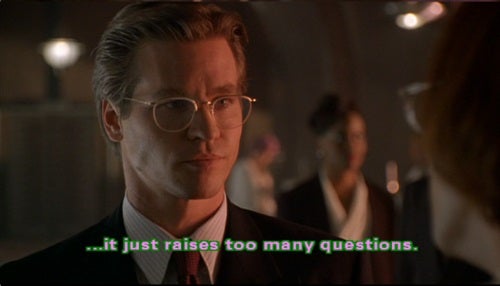
But then there's the big change that I think is comparable to the Mandarin twist in "Iron Man 3": in this film, Riddler is Hush. Much like in the comics, Riddler had used the Lazarus Pit to cure himself of a brain tumor, which enhanced his intelligence so he could deduce Bruce Wayne was Batman. In the film though, Riddler becomes Hush himself (wearing bandages to cover up a question mark scar) to finally destroy Batman and make fools out of the other villains used in the film. Thomas Elliot is still in the film, but only as an old friend of Bruce and the doctor who was unable to cure Riddler.
There are a few problems with this change. One, it downplays Bruce and Thomas' relationship, leaving out the flashbacks to their childhood friendship. In turn, this leaves out a lot of red herrings. Thomas would only be a suspect because he was Hush in the original story, but there's also the fact that Harvey Dent is still shown to be Two-Face in a cameo and Jason Todd doesn't exist in this universe, leaving Clayface to act as a decoy Riddler instead. To add to the Jason Todd part, Batman's brutal beatdown of Joker after believing him to have killed Thomas also doesn't have as much emotional punch because Bruce was also thinking back on how he killed Jason and crippled Barbara, wondering how much more hurt Bruce will allow himself to take from the clown.
On the other hand though, this does kind of work when you look at it as its own story. The whole thing about Riddler deducing Batman's identity was retconned sometime after the original story, so I think the film does a good job of doing something with that idea, showing the pit's enhancing properties as well as how deranged it can make a person. It's a good way to turn the tables on those familiar with the story, but I think this will piss off the purists.

Where it lacks in the mystery, they tend to focus more on the romance between Batman/Bruce Wayne and Catwoman/Selina Kyle. They capture the romance from the original story quite well, thanks in part to the voice acting of Jason O'Mara and Jennifer Morrison. I also think they took a lot of inspiration from the engagement period of the two from Tom King's run, where they're shown actually fighting crime together and even living in Wayne Manor as a couple. But like the comics, it's seemingly not meant to be. While the original "Hush" storyline began a period of Batman acting more paranoid and Tom King's run is working under the idea that "Batman can't be Batman if he's happy" crap, this film goes with Selina realizing that despite how much she's changed, Bruce may always put his personal crusade first. Still, they hope one day they can make it work.

Lastly, the action is pretty good, with my favorite fights being Batman vs. Superman and Batman vs. Hush in the climax. The Batman/Superman fight is a good but brief adaptation of the one from the comics, plus it's kind of nice to see them on somewhat equal footing in a fight compared to their first encounter way back in "War". The Hush fight is also a particularly brutal one, due in part to Hush using the Riddler cane in a scythe fashion.

Overall, "Batman: Hush" is a satisfying adaptation even if it doesn't adhere strictly to the source material. Between the identity misdirection and the romance, you could say it's similar to "Mask of the Phantasm". While not exactly groundbreaking, it's still an entertaining film with a wide cast of iconic characters.

Sunday, August 4, 2019

TV Review: Swamp Thing - Go Green...Or Else


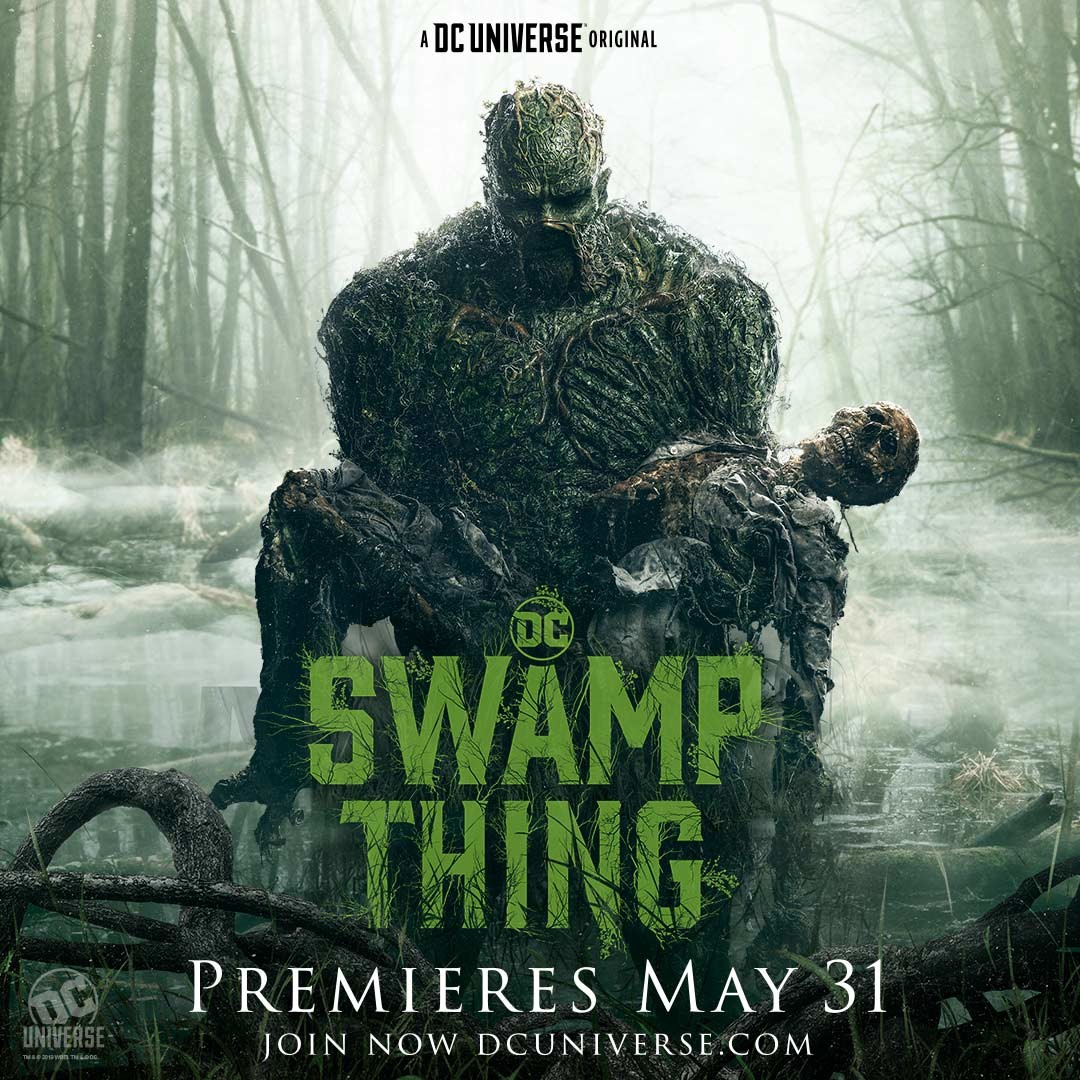
Swamp Thing is another character I've only really encountered in a widespread compacity, like when he appears as part of a crossover in comics, animation or video games. The best way to think of Swamp Thing is like a scarier version of Captain Planet, as he draws his power from the environment while also fighting to protect it. While the character has had solo adaptations outside of comics, it has been a few decades so he might not be as relevant nowadays. So much like Doom Patrol, Swamp Thing was prime material for the DC Universe streaming service, and focusing on the character's horror roots (no pun intended) would give it its own unique feel. "Swamp Thing" is another hit for DC Universe, but unfortunately is a short-lived one.

As mentioned, the series leans very heavily on the horror aspects of the character and his world. It's really the main highlight to me, as there's a great mix of practical and computer generated effects. There's a lot to fill viewers with fright, from jump scares, ghosts and hallucinations, and body horror (including transformation and mutilation). There's also one specific moment in episode four that made me very nauseous. Even if you don't read comics, true horror fans would get a real kick out of this series.

The cast of characters is rich and have a lot in terms of complexity. Many characters come off as likable people but also have a dark side. Honestly, the only main character that comes off as "obviously evil" from the get-go is Avery Sunderland (played by Will Patton). I also enjoy that there are a number of significant DC characters involved as well, including Phantom Stranger, Madame Xanadu, and Blue Devil.
When it comes to our titular character, Andy Bean and Derek Mears shine as both Alec Holland and Swamp Thing.
As Holland, Bean is able to deliver a significant performance, allowing his human form to be memorable and for viewers to become invested in him before the events that lead to the creation of his monstrous alter ego.
Derek Mears is mostly known for his stunt work, including playing Jason Vorhees in the 2009 "Friday the 13th" film, but he is probably the most surprising actor of the series as Swamp Thing. The Swamp Thing suit is heavily detailed and makes for one of the most comic accurate looks to come from the genre. The facial make-up is the best part as it allowed for Mears to speak and we can see his expressions coming through. Swamp Thing the character is a marvel to witness as we watch him grow, coming to terms with his existence, his powers, and his purpose. Coupling that with the delivery in Mears' voice also allows us to ride the emotional roller coaster he goes on. The relationship between him and Abby Arcane (played by Crystal Reed) is great to watch and I found it akin to "The Shape of Water" (though it doesn't go THAT far). Overall, Mears as Swamp Thing is probably the best comic book character performance I've seen since Josh Brolin as Thanos.
Another character that really stood out to me was Kevin Durand as Jason Woodrue. Woodrue was one of the few characters I was familiar with going into this series due to his villainous alter ego, so he was one character I was sure to keep my eye on. I haven't seen a lot of Kevin Durand's work, but what I have seen shows him in more brutish roles, so seeing him as more of scientist was as much as a surprise to me as Mears as Swamp Thing. He's an eccentric character with very noble intentions, though his drive to reach his goals eventually results in a psychotic break. He's just a character that's enjoyable to watch from beginning to end, and his fall from grace is somewhat heartbreaking, even if you're able to see it coming.

"Swamp Thing" was highly entertaining and another unique addition to DC's live action library. Sadly though, we must bid farewell as soon after greetings, as "Swamp Thing" was cancelled shortly after its first episode despite its acclaim. While a straight answer hasn't been given, the cancellation was most likely due to budgetary issues. It's a real shame because I saw a lot more potential to be had based on the final episode. Still, I can't help but think of another horror-based DC character whose solo series was unjustly cancelled. If Constantine can find new life within the Arrowverse, there could be hope for Swamp Thing in one way or another. Only time will tell.