Sunday, April 25, 2021

TV Review: The Falcon and the Winter Soldier - Agents of Shield


At the end of "Avengers: Endgame", we saw Steve Rogers passing on his shield and the mantle of Captain America to the Falcon, Sam Wilson. Before that would come to fruition though, there would be "The Falcon and the Winter Soldier" series on Disney+. Of all the initial Disney+ Marvel series announced, this is the one I was looking forward to most because of the legacy aspect, as they were no doubt setting the stage for Sam's own solo Captain America film. That in no way means "Falcon and Winter Soldier" is filler to that end though, as the series brings back the cinematic Marvel quality we've sorely been missing even more so than "WandaVision" did.

Style wise, the show is a political thriller much akin to the Russo Brothers' Captain America films with similar effects and fight choreography and even getting Henry Jackman back for the score. You really could consider the series "Captain America 3.5". On top of the political thriller though is a "buddy action film" as Anthony Mackie and Sebastian Stan have great chemistry in the begrudging friendship between Sam and Bucky.
Our two stars also shine in their own rights as they're able to show what makes them great characters outside of being supportive or antagonistic roles. With Sam, we finally get to see how he handles situations when he takes point with many fantastic feats throughout the series. His arc is also entertaining as he struggles with accepting the shield and if he's truly worthy of it. As the series goes on, there are many character moments where we see how similar Sam is to Steve and why he was the right choice to become the new Cap. Sam even gives a great speech in the final episode that would surely make his predecessor proud.
As for Bucky, we see him in a civilian setting for the first time since before World War II as he tries to live a normal life while also attempting to make amends for his past as a brainwashed assassin. Much like Wanda, there are a lot of issues he's still dealing with; by the end though, he seems to be in a better mindset which is a good start considering all he's gone through.

In regards to the legacy aspect, the show really does seem to have one foot in the past and one in the future.
Consequences play a big part in the show. Being set a few months after "Endgame", we see that despite the Avengers' good intentions, bringing back everyone snapped away by Thanos brought unforeseen problems. While we do see things eventually calm down by the time we get to "Spider-Man: Far From Home", it is interesting to see some real world logistics to how such events could play out. Besides that, we see ramifications still being felt from so far back as to "Age of Ultron" and even after the first Captain America film. All this together adds to the good commentary on social and racial inequality.
When it comes to the future, the show brings in many characters that Marvel appears to be setting up for the Champions/Young Avengers and Thunderbolts/Dark Avengers (I use the 'slash' because either names could be used for the type of teams that they're gearing up for).

Of course, one such new character is John Walker, played by Wyatt Russell. Even before I started watching, I knew how much hatred he was getting from the viewers, and I certainly get why. Sam had decided to retire the shield and donate it to the Smithsonian, only for the government to disregard that and give it a their own newly appointed Captain America. The government basically gave it to a guy who fits the Steve Rogers but failed to realize that Steve was great not because he was Captain America, but because he was Steve Rogers. Honestly, this MST3K clip fits their thought process and what it ultimately results in perfectly:


Now to be fair though, Walker does seem like a good guy who wants to live up to the job he was given. The problem is he lets it go to his head, acting like the biggest guy in the room and trying to buddy up to Sam and Bucky like there's no problem; it's like a self-insert fan fiction but the characters are aware he doesn't belong there. And I got to hand it to Russell; he plays the role well of the guy you hate to see show up but kind of love it when he gets his ass handed to him. While it would have been easy to have him go full villain by the end, it was actually nice to see him still teetering on the line and it will be interesting to see where he goes next.

Overall, "The Falcon and the Winter Soldier" is a great return to traditional superheroics for Marvel. The acting, character arcs, and action pieces are all done very well throughout as they culminate in an exciting and emotional finale. And with Sam's debut as the new Captain America (with a pretty snazzy suit to boot) and his solo film officially confirmed, I think it's safe to say that Marvel has a handle of passing down the mantles of the original Avengers and that the future is bright.

Friday, March 19, 2021

Movie Review: Zack Snyder's Justice League - The Gathering We Deserved


Zack Snyder began the DC Extended Universe with 2013's "Man of Steel", expanded it with 2016's "Batman v Superman: Dawn of Justice", and had intended to continue his story thread in 2017's "Justice League". After initial production however, Snyder stepped away from the film after the death of his daughter, with post-production being oversaw by Joss Whedon of Avengers and Buffy fame. What resulted was a serviceable film, but one that did not live up to expectations set by Snyder's previous films.
Since the theatrical cut's release, details about the troubled post-production period slowly came out overtime and made the film's shortcomings all the more evident. Script rewrites with a condensed story and forced humor, reshoots with unpolished CGI rushed to make its' release date, plot points and characters that were cut, and Joss Whedon's disrespectful behavior on set. Let's make it clear: Warner Bros., reacting to the shortcomings of "Batman v Superman" and the success of "Wonder Woman", took advantage of Snyder's family tragedy and basically neutered his vision in an attempt to capitalize on everything popular with superhero movies at the moment. If it weren't for the fact that several DCEU projects got derailed because of it, I'd say it served them right that their shameful plan blew up in their face.
For years, fans petitioned for the Snyder Cut. Some believed there was no such thing, despite the fact that Snyder did finish the initial filming, and some believed it would never come considering WB's efforts to move on from his vision. But much like the revival of "Young Justice" years after cancellation, never underestimate the power of the fans. The Snyder Cut of "Justice League" was announced last year for an HBO Max release, and it has finally arrived. So after nearly a decade of build up since "Man of Steel", does it live to the hype? While not a perfect film, "Zack Snyder's Justice League" is the epic I knew it was meant to be.

Everything about the Snyder Cut is consistent with his previous films, from the tone, cinematography, and even the music. Compared to Danny Elfman's in the theatrical cut, Junkie XL and Hans Zimmer deliver a score that matches the storytelling (although the chanting is a little weird sometimes). If you think music isn't important to film, compare some of Wonder Woman's fight scenes between the two cuts, and tell me her guitar theme doesn't amp you up more. The writing is more refined as well, with plot points being more elaborated on and characters actually having development. Throughout the whole film, it just made all the changes in Whedon's cut all the more baffling. There's more heart in the actors' performances, particularly Ben Affleck's Batman. The humorous moments (yes, it's not all joyless) come about more fluidly much like in Snyder's previous films. The climax is also handled much better and similar to the first Avengers film, giving each hero a pivotal moment in their victory rather than everyone just letting Superman handle it. Don't be mistaken, this is not just the same film but longer.

Many characters benefit more from the original version of the story.
*Jason Mamoa's Aquaman is a bit more serious here, which actually matches more with his portrayal in his solo film. On that note, the film includes more scenes with Atlanteans (including Willem Dafoe's Vulko with much longer hair) that were meant to foreshadow Orm's warmongering.
*Ezra Miller's Flash is still the comedic relief, not really putting to bed my view that he should have been Wally West instead of Barry Allen. However, his comedy isn't as grating here compared to the theatrical cut, coming off a bit more quirky like he's talking and thinking faster than he can handle. And while not always graceful, there's a bit more competence to his power use as he's still getting used to what he can do and looking into what he can potentially do, leading to his best moment in the film's climax. Plus, the CGI use of his superspeed doesn't look near as goofy anymore.
*Ray Fisher's Cyborg is the one who benefits most. He actually has an arc, coming to terms with his appearance and new abilities (bringing the classic man or machine identity crisis), along with his strained relationship with his father. Considering how all of this was barely glanced over or removed from Whedon's cut, it's no wonder Ray Fisher has been raising hell over what happened during reshoots, because they definitely did him and his character dirty. What I also like is some of his initial scenes where he's moving strangely, like he's still getting used to his mechanical body, only moving more human again as time goes on.
*Superman's arc is basically the same, being dead, resurrected, and returning to help save the world. But much like everything else in Snyder's version, it's not rushed. We actually take time to see Clark reacclimating to being alive again and reuniting with Martha and Lois (who I'm pretty sure is pregnant due to some hints). There's also a pivotal scene where Clark retrieves a new suit from the Kryptonian scout ship, thinking about the words of his fathers as he accepts his place in the world as Superman truly takes flight once again, mirroring the moment from "Man of Steel". And of course, his personality from the previous films carries over here.
*Steppenwolf is actually kind of scary in this version, with Snyder's original design brought back into use. He's more beastial with unique armor that's constantly moving and durable to a point. He also has better motivation than "destroy the world", as he's hoping to get back into Darkseid's good graces after a previous betrayal.

Speaking of which, Darkseid has finally made his live action debut in all his glory. As one of DC's biggest villains, whenever he's on screen, Darkseid brings an unsettling air of menace on par with Thanos (who was created in comics after Darkseid in case anyone thought differently). You can practically cut the tension with a knife when he's staring down at the League through his Boom Tube before it closes.

With the release greenlit, Snyder was allowed to film a new scene set in the Knightmare future not in the initial script. And though it's been explained in interviews that it's really a potential future, the films themselves really need to stop making it look like they're just strange dreams Bruce is having. While it's more for an epilogue and not integral to the main story, Snyder's main motive for the new scene was to finally bring Ben Affleck's Batman and Jared Leto's Joker on screen together in the DCEU. I don't think it will be enough for Leto to win everyone over, but it was definitely worth it in my opinion. Through Affleck and Leto conversing with each other for this brief scene, you can feel the history between the characters and their demented love/hate relationship. If anything, this further cements that Leto has all the right makings of the Joker when given the chance.

So who will end up enjoying this film? Of course, there are the Snyder fans who loved his previous films and worked hard to get this one released. If you're not a fan of Snyder's, there's a good chance you won't care for more of his style. Though from what I've seen, the Snyder cut is getting better reviews than not just the Whedon version, but also his own previous DC films. There's a part of me that feels that had some semblance of Snyder's version been released back in 2017, it would have been eviscerated by critics as well. Perhaps the benefit of hindsight is in play, as I've also been seeing more people starting to come around on "Man of Steel" and "Batman v Superman" as well. So if you're hesitant but curious, give it a shot. But I think the best reason to watch is to support an artist's true vision rather than one produced by corporate oversight.
There will probably be those who prefer Whedon's version (to each their own), but to me, there's only one live action Justice League movie now, and it's Snyder's. I'm also considering it canon to the DCEU since it doesn't contradict anything in the other DC films and even the directors of Wonder Woman and Aquaman, Patty Jenkins and James Wan, referred to Snyder's version in terms of continuity between films.
While this may unfortunately be the last we see of Zack Snyder's hand in the DCEU, the saying "never say never" certainly applies. We got the Snyder cut thanks to the fans' perseverance. Maybe if it's enough of a success, there's potential for sequels to Justice League and Man of Steel or Ben Affleck's solo Batman story will arrive in some fashion. But if this really is the end of the line, I thank Mr. Snyder for giving it his all.

My DC Extended Universe Film Rankings:
1. Aquaman
2. Wonder Woman
3. Zack Snyder's Justice League
4. Wonder Woman 1984
5. Shazam!
6. Batman v Superman: Dawn of Justice
7. Man of Steel
8. Birds of Prey
9. Suicide Squad

Monday, March 8, 2021

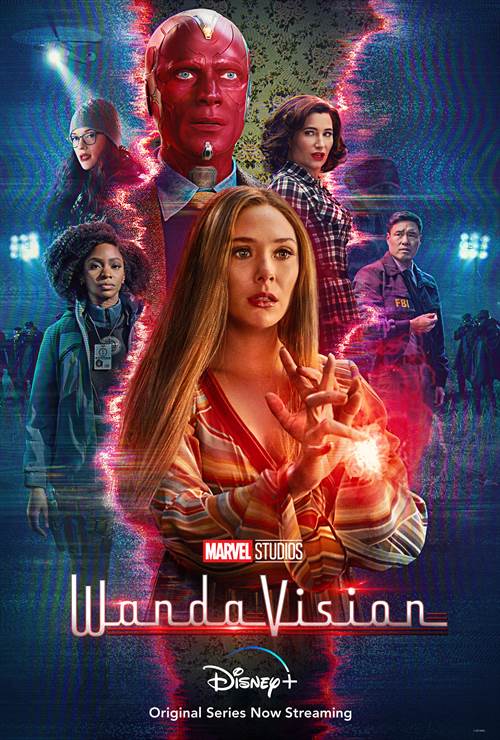
TV Review: WandaVision - I Want My M(arvel)TV


After an unexpected break in 2020, the Marvel Cinematic Universe is back; and with everything slated for 2021, it's with a vengeance. But before we hopefully return to the theaters to see "Black Widow" this May, we finally kick off Phase Four with the first Disney+ series, "WandaVision". While there have been plenty of TV series set in the MCU, "WandaVision" marks the first one produced by the proper Marvel Studios; this means more connectivity as the shows and movies will play off each other instead of seemingly happening in separate continuities.
Based on comics like "House of M" and Tom King's Vision series, "WandaVision" follows Wanda Maximoff and the seemingly revived Vision shortly after the events of "Endgame", the couple now married and living a simple life in suburbia with things playing out like a TV sitcom. While that concept may seem silly, what lies beneath is mystery and insight into a troubled mind.

First and foremost, the way the show is filmed as a sitcom is done brilliantly. Paying homage to shows ranging from "The Dick Van Dyke Show" to "Modern Family", the situations and jokes hit the mark and do feel like they come from the decade they're referencing. What's done even better though are the moments when reality comes creeping in, bringing about a feeling that's just as unsettling as the overall situation of the series. And the longer the sitcom goes on, the more complicated the format gets and the harder it becomes to keep reality out.

Elizabeth Olsen shines in her reprisal of Wanda as she is given the main focus, and damn it if she doesn't deserve some kind of award for her performance. In the sitcom, she plays the role well of the ideal housewife and mother. As we dig deeper though, we see just how much trauma Wanda has gone through in her life and learn what kind of power she truly has inside of her. "WandaVision" is essentially her breaking point as she takes her coping mechanism to the extreme, and it tragically makes her the villain of her own story (and even the other villains of the series are just playing off of Wanda's actions).

The rest of the cast is great as well. Paul Bettany's return as Vision is just as entertaining, showing him as the loving goofy husband and the altruistic hero he was made to be. Plus, his chemistry with Wanda is still on point from the films and the spotlight on them shows how deep their love is.
Returning characters from the films like Jimmy Woo (played by Randall Park) of "Ant-Man and the Wasp" and Darcy Lewis (played by Kat Dennings) of the Thor films are given more pivotal roles rather than just be the comedy relief, and it's a nice change of pace for those two. Monica Rambeau, seen as a child back in "Captain Marvel", is all grown up (now played by Teyonah Parris) and is just as strong as her mom and Aunt Carol; Parris brings a stellar performance that makes me look forward to Monica's future appearances in the MCU.
While I won't spoil their characters' identities, Kathryn Hahn and Evan Peters turn in performances that play well to their strengths and bring a lot of fun to the series.

Right from the opening logo and fanfare that I know we've all missed, "WandaVision" brings the MCU out of hibernation with a thunderous roar. With great characters and performances, the series never lets up from its' humorous start to its' emotional if somewhat clunky ending. As the inaugural Disney+ series, "WandaVision" hits it out of the park for Marvel with what will hopefully be the start of a winning streak when we come back for "The Falcon and Winter Soldier".

Friday, January 22, 2021

Changing of the Doctor: What Goes Into A Regeneration


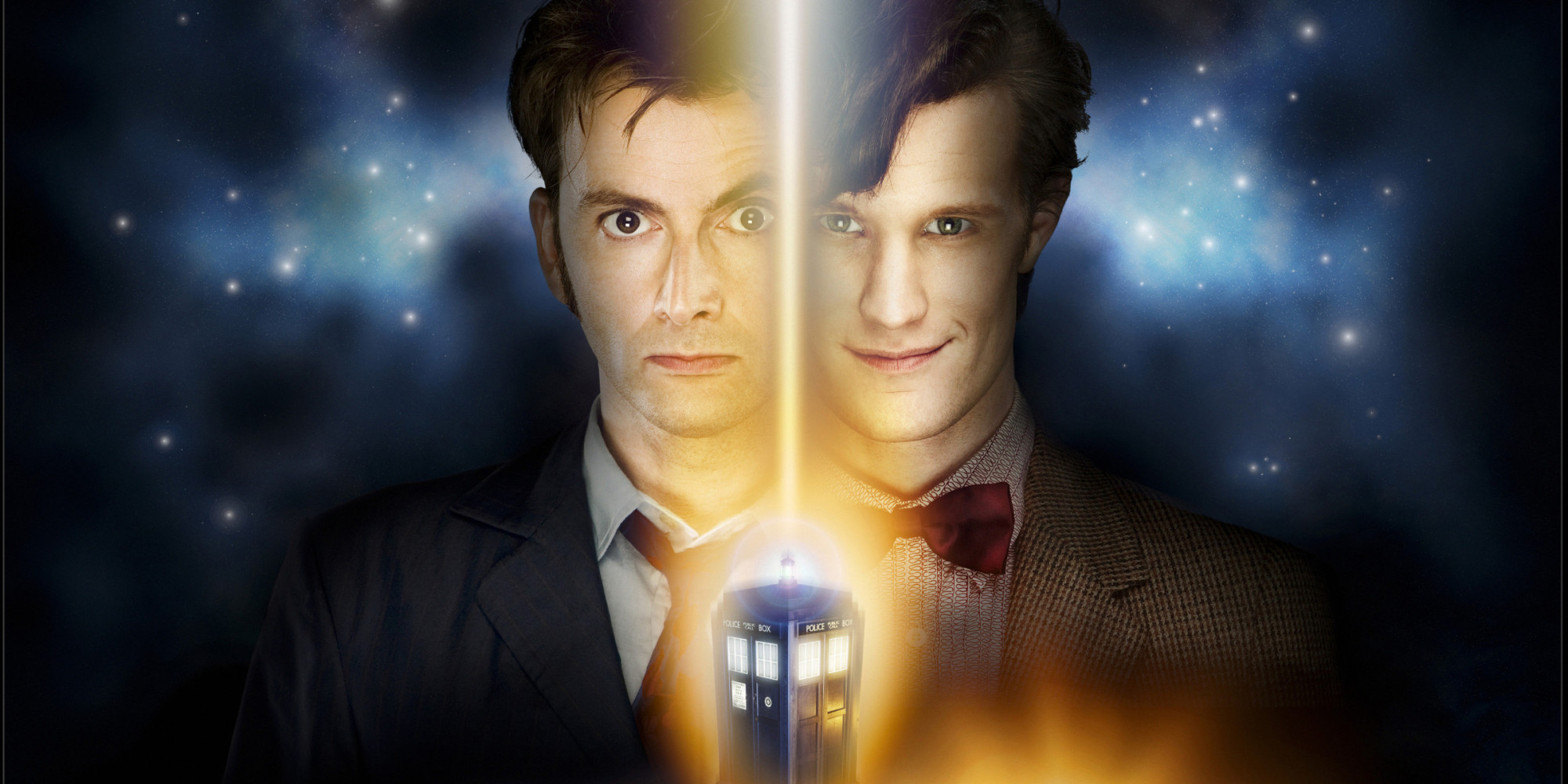
If you poll a group of Doctor Who fans who their first Doctor was, you'll probably get a good variety in the results. Since the show's inception in 1963, there have been thirteen incarnations of the Doctor. The recasting of the Doctor is done in-show through regeneration, an ability Time Lords possess where their entire person goes through a metamorphosis that changes them physically and mentally, usually triggered when they're near death. This allows each actor who has portrayed the Doctor to put their own spin on the character, and has helped the show retain the same continuity for nearly sixty years.
When I first decided to watch Doctor Who, it was David Tennant's Tenth Doctor that got me hooked. After his three seasons as the Time Lord, I was really hesitant to continue the show without him. I did give Matt Smith's Eleventh Doctor a chance, and I was still having a good time. I had similar reservations when it came to Peter Capaldi's Twelfth Doctor, and while it took a little longer, he won me over as well. As such, Capaldi was still the Doctor when I was finally caught up and watching new episodes as they aired, including his farewell and regeneration into Jodie Whittaker's Thirteenth Doctor. And as for Whitaker, I loved her from the start as she brought back the young energy that was present in Tenant and Smith's seasons.
So where am I going with all this? Well, between the recent holiday marathon on BBC and rewatching some episodes on HBO Max, I started to think more about the Doctor's regenerations. Along with outside factors and the implications of subconscious input from the Doctor while preparing for his next form, I thought back to where each of my Doctors were at the moment of regeneration and how it influenced the next incarnation.
So for this post, I'll be examining the progression of the Doctor's character and the transitions of Ten to Eleven, Eleven to Twelve, and Twelve to Thirteen.

TEN TO ELEVEN

"I don't want to go." That line has more connotations to the Eleventh Doctor than you may think.
There's no doubt that there are many similarities between the Tenth and Eleventh Doctors. Young guys with brown hair, fun personalities but knowing when to get serious, and both have some of my favorite epic and emotional moments of the show. It's probably why I always struggle with which one is my favorite. I know deep down it's Tennant, but Smith just knows how to but his way into my heart.
Ten's reluctance to regenerate most likely resulted in Eleven having such similarities, which made the change less overwhelming compared to other metamorphoses we've seen the Doctor go through. But I see that unwillingness to let go carrying over to the Eleventh Doctor, particularly when it came to his companions. As River Song put it, he doesn't like endings. While Ten had various companions and was dismayed when they departed, he seemed to bury the pain deep as he moved on to the next adventure. For two and a half seasons, the Eleventh Doctor travelled with Amy Pond and Rory Williams. While the couple had their own lives to live, the Doctor saw them as his family and wanted to be with them for as long as he could. So when he lost them in "The Angels Take Manhattan", it left the Doctor devastated, so much so that he briefly gave up travelling until coming across Clara Oswald and the Impossible Girl mystery.
This also plays into another difference between Ten and Eleven. While Ten had a more youthful personality and exuberated coolness, Eleven was more of an old man trapped in a young man's body trying harder to be cool and accepted by his companions. It certainly explains the suspenders and bow tie, even though he pulls them off beautifully (and of course bow ties are cool). Despite the thrill of travelling through time and space and constantly facing universal threats, the old soul of the Eleventh Doctor may have sought some stability, and he found that in Rory and Amy for quite some time.
In summation, the Eleventh Doctor came about out of a reluctance of change and fought it throughout his tenure as best he could, which culminated in his next regeneration.

ELEVEN TO TWELVE

Believing himself to be on his last incarnation and recent events having him revisit and coming to terms with his past, the Doctor was prepared to meet his end. But after being granted a new cycle of regenerations, the Doctor had come full circle as he prepared for his next change. Whereas Ten didn't want to go, Eleven bid farewell with full acceptance of what was coming. And his regeneration scene, from the Long Song instrumental in the background to the Doctor imagining Amy being there, is the one that always makes me tear up no matter how many times I watch it.
So gone were the youthful Doctors of Tennant and Smith as we welcomed the older Peter Capaldi as the Twelfth Doctor. This plays into the acceptance of Eleven's regeneration as he now looked as old as he felt; as Madame Vastra put it, the veil had lifted. The idea of acceptance also applied to his companion at the time, Clara Oswald. While Clara had known the Eleventh Doctor first and had encountered all the previous Doctors in a way due to some timey-wimey reasons, it took time for her to adjust to the new one. I myself took some time to get used to Capaldi's Doctor as during his first season, I found his bluntness, while funny at times, to be a little off putting; honestly, he could be kind of a dick. He got better in his subsequent seasons, which I attribute to Clara helping him form his moral compass. In any case, Capaldi had some great moments as the Doctor and I was sad to see him go in the end.
Upon rewatching his first season recently though, I understood better what they were going for when the Twelfth Doctor debuted. From facing his past and being granted a new regeneration cycle, it was almost like a hard reset. You could say it's an inverse of Eleven, being a young man in an old man's body (and you can see that in some of the activities Twelve enjoys). The Doctor was acting like he did when he first came to Earth in his original incarnation, and had to relearn how to be a part of humanity again. It almost seemed fitting then in Capaldi's final episode, "Twice Upon A Christmas" that his Twelfth Doctor encountered the First Doctor, which I believe played a factor in the next regeneration.


TWELVE TO THIRTEEN

On the cusp of his next regeneration, the Twelfth Doctor had had enough of all the losses he had suffered, his past selves included, and was willing to succumb to his injuries rather than change again and go on. But after facing his past self (the First Doctor approaching his first regeneration) and the memories of his past companions, he decides to give it one go around. Enter Jodie Whittaker's Thirteenth Doctor.
So how did we get from old Scotsman to a young woman? I think it comes down to two central themes. The first is open mindedness. Part of it has to do with his interactions with both his past self and his last companion, Bill Potts, in his final episode. I mean, we have an old man from the 60's with, shall we say, "old fashioned values" and a young gay woman from the 21st century. Twelve is visibly embarrassed by his former self's "not very PC" comments, especially in front of Bill. The change could be seen as the Doctor hoping to make amends for any past behavior that could be viewed as offensive.
But there's also the change in personality as well. Like Tennant and Smith, Whittaker brings back some youthful energy as the Doctor and is much more approachable than her predecessor, leading to a large travel entourage in Yaz, Graham, and Ryan as her tenure began. That brings us to the second theme: hope. As times got dark for Twelve, he wanted something better for his next incarnation and to be a symbol for good that the universe needed. This results in Thirteen's shining personality, positive nature, and her resilient chipper attitude which has all gotten her through some pretty touch scrapes so far.

While it's easy to see each Doctor as their own character, there's definitely progression from each regeneration to the next with a fundamental road map to the changes that occur. It'll be interesting to see where the Thirteenth Doctor goes and what events will influence the Fourteenth when the time comes. But no matter the face or personality, there is one constant: the Doctor is a wise, caring person who will always look for fun and stand up for what's right.

Tuesday, January 5, 2021

Retro Review: "Batman: Ego"


I'm very much looking forward to next year's "The Batman" film directed by Matt Reeves of Cloverfield and Planet of the Apes fame. Based on the first trailer, it'll feel like Christopher Nolan's Dark Knight trilogy with a new flare. And I really have faith Robert Pattinson will pull it off as the Caped Crusader and feel some people really need to let go of the Twilight hate, separate the actor from Edward, and give him a chance. 
The new film will be set during Bruce Wayne's second year as Batman. In addition to newer material like Scott Snyder's "Zero Year" and Geoff Johns' "Earth One" series, inspiration for the film will be taken from classic Batman stories "Year One" and "The Long Halloween", much like the Nolan series. But there's one story Matt Reeves is drawing from that may have been overlooked by fans compared to other well known Batman tales.
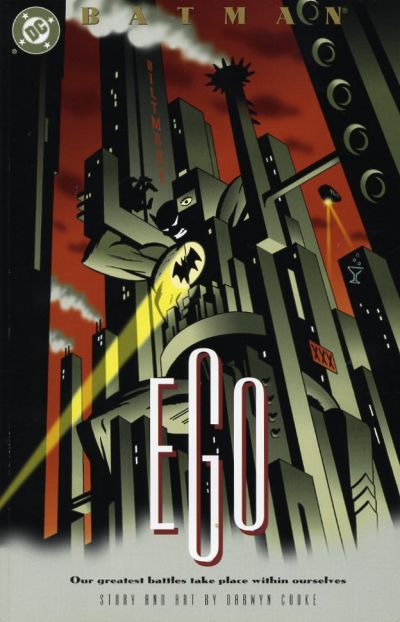
"Batman: Ego" was a one-shot graphic novel released in 2000 written and drawn by the late Darwyn Cooke. With this story playing a part of what will be the next cinematic version of Batman, I decided to give it a look. And boy we are in for something quite different next year.

The story takes place from what I surmise to be around Bruce's fourth year as Batman. After capturing the Joker again, a physically and mentally exhausted Batman is on the hunt for one left over Joker thug he had previously interrogated, Buster Snibbs, while wondering if his crusade against crime is making any real difference. Batman catches up to Buster, who is fearful of the Joker inevitably escaping yet again and coming after him and his family for his betrayal. Not wanting to face the clown's wrath, Buster reveals he had already killed his family before taking his own life in front of Batman. Bruce is shaken by the act as he returns back to the Batcave and contemplates giving up the cowl. It's at this point Bruce's mind splits and he finds himself speaking to a monstrous form of Batman, as the two spend the rest of the book discussing the creation and ramifications of Batman and what the best possible path ahead should be.

And that's all I'm saying about the plot without delving too far into spoilers. "Batman: Ego" is a deep dive into Bruce Wayne's psyche done in a very creative way as he questions the pledge he made on his parents' graves. Such a concept will be new territory in terms of Batman movies when the 2022 film comes out. Sure we've seen Michael Keaton's Batman brooding and Christian Bale's Batman mourning over Rachel's death while being shaken by Joker's actions. But any insight into Keaton's Batman is subtle since much focus went to his villains and Bale's Batman was active for only a short time before his eight year retirement. When we meet Robert Pattinson's Batman, he'll already be a seasoned vigilante and the events of the film are sure to put him through the wringer. You know that one scene in the trailer where we see Pattinson's Bruce removing his mask in the Batcave and looking so defeated, hair disheveled and the eye make-up still on?


People have made the emo jokes over it, but after reading "Ego", I see more clearly where the film is going and how vulnerable Bruce may be feeling in this moment.

The writing is no doubt good, but the art is where the story really comes to life. Darwyn Cooke was regarded as one of the best artists in the comic industry, and "Ego" is no exception. Not only are Bruce's conversations with his Batman persona (whose design is simple yet unsettling) done in a dynamic way, but the scenes in the city and flashbacks give the story a very timeless quality. It reminds me a lot of "Batman: The Animated Series", which actually makes sense after finding out Cooke worked on storyboards for that and other shows set in the DC Animated Universe.

For Batman fans, "Ego" truly is recommended reading and I'm sorry I overlooked it for so long. Hopefully this story is a harbinger of the kind greatness we can expect from "Battinson".

Friday, January 1, 2021

My Top 10 Favorite Nickelback Songs


Considering what a crapstorm 2020 was, I feel it's best to start off the new year with a little positivity. So let's talk about Nickelback.
That little joke aside, I never got the hate for Nickelback. They're far from my favorite band, but they're hardly the worst. When it comes to music in the 2000's, you couldn't listen to the radio or watch MTV or VH1 during their music video blocks without the band popping up. And from what I could remember, I and a lot of people enjoyed them (their chart performance and awards being the proof in the pudding). The significant wave of negativity towards them didn't really seem to come until the following decade, hating them just becoming the popular thing to do. It's like people who make "Aquaman sucks" jokes but know next to nothing about the character.
The main criticism is that their music is too formulaic. While there's some basis for that claim, you could arguably say the same about almost every band. Some artists just tend to create music they and their fans enjoy without straying too far from the norm, and there's nothing necessarily wrong with that. Ironically, the jokes people make over the band have gotten as repetitive as the music they criticize.
Look, if you don't like Nickelback, it's fine; you're entitled to your opinion. But the idea that they're the worst band ever is pure hyperbole. So I feel the need to talk about the songs that stand out with a good sound and lyrics with substance. These are my top 10 favorite Nickelback songs.

10. FEED THE MACHINE

I admittedly didn't follow Nickelback as much after their 2011 album "Here and Now", but when "Feed the Machine" came out in 2017, this song really lit up on my radar. I just never thought of Nickelback doing a political/revolutionary type of song, but here we are. And considering my love for stories like "Code Geass" and "V for Vendetta", I'm a sucker for songs like this. The only reason it's on the bottom of the list is how recent it is compared to the rest of the entries.
The heavy sound can really get you riled up while the lyrics do a good job of conveying the oppressive idea of society only working right if everyone does the job they're assigned without question. The way 2020 played out, I feel the themes of this song hit even harder than it did back in 2017. As Donald Trump's presidency was partial inspiration for the song, it seems poetic that this song came out when he first took office and I decided to do this list as he's on his way out.

9. PHOTOGRAPH

Man, there was no escape from this song when it came out. I mean, it is quite catchy with a good mix of acoustic and electric guitar, also being easy to sing along to. While this is more of a personal song for the band about looking back at their hometown lives and how things have changed since they became famous, the themes "Photograph" represents can be relatable to anyone. We can look back with fondness at both good and bad times in our lives as they make us who we are today, but it's important to not dwell on them and keep moving forward. Whatever it may invoke in you, "Photograph" should make you feel something.


8. FEELIN' WAY TOO DAMN GOOD

It's not one of their biggest hits, but "Feelin' Way Too Damn Good" has always spoke to me. In my younger days, I connected with it as a long-distance relationship song. And while that sentiment remains, listening to it again recently has me getting a "expectations vs. reality" vibe. I think we all have those moments where things are going so well in our lives, like a relationship as it applies to this song, but are cautious of something coming in to ruin it. Feelings like that can be self-sabotage in a way. In either case, "Feelin' Way Too Damn Good" is an underrated song that deserves a listen.
 

7. NEVER AGAIN

This is probably the Nickelback song with the darkest subject matter, detailing an abusive relationship that has reached its breaking point. The first two thirds of the song go into the worst it has ever been, touching on things like how it must be "her fault", worry from others, and covering it up at the hospital. It really takes a turn in the last third when it's time to go on the defensive and I just love the following stanza:

"Father's a name you haven't earned yet 

You're just a child with a temper

Haven't you heard don't hit a lady?

Kicking your ass would be a pleasure"

Following that, the next stanza is a parallel to how the song begins, only this time the woman is prepared, gun in hand, putting him down before he has the chance to do anything. To me, it really invokes a feeling of satisfaction and liberation.
Overall, the music and lyric composition of "Never Again" do well crafting the story it tells and shows Nickelback can deal with such a serious topic.

6. IF TODAY WAS YOUR LAST DAY

It seems like almost every Nickelback album has that one song that's motivational, uplifting, or a call for unity. While songs like "If Everyone Cared" and "When We Stand Together" are more about world peace, "If Today Was Your Last Day" is about inner peace. These days, that concept seems more probable to attain than the others. The message of the song still rings true and much like "Feed the Machine", it should hit a lot harder the way 2020 went. Tomorrow's not a guarantee for you or those you care about, so make peace with your past, do right by others, and take those risks that could lead to something grand.

5. BURN IT TO THE GROUND

Out of Nickelback's partying/drinking songs, "Burn it to the Ground" is the best in this regard. It's a real headbanger with energy from start to finish as the lyrics describe a night of debauchery. What I really like in the last third of the song is how Chad Kroeger's vocals start to calm down, signaling the good times are about over, only for him to get his second wind and close out the song even stronger than when it started. What also helps put this song high on the list for me is how much exposure it got, like being used as the theme song for WWE Raw for a time and included in "Transformers: Revenge of the Fallen"; and say what you will about that movie, but it had a damn good soundtrack.

4. GOTTA BE SOMEBODY

If there was an anthem for the hopeless romantics who believe in soul mates, "Gotta Be Somebody" is definitely a front runner. While it's definitely as "pop rock" as Nickelback can get, the song does well in describing the search for the ideal relationship, going so far as to compare it something out of a movie. And I really just like the song's hopeful message, urging those who have yet to find someone to grow old with not to give up.

3. ROCKSTAR

If you claim you weren't singing along to "Rockstar" (especially in a group) when it came out and was hitting its pique popularity, you might be lying. I mean, who hasn't in some point in their lives want to be a famous rockstar? Imagine my surprise while making this list when I found out that despite this song's popularity, it received a lot of negative reviews. Some people just really need to lighten up. It's a catchy and fun song about the perks of living the sweet life, slightly touching on its' dark side, with vocal cameos from Billy Gibbons of ZZ Top as the cherry on top.

2. SAVIN' ME

I unashamedly have this one in my emo playlist. The contents and the title itself are essentially a cry for help, seeking reassurance that their life has merit. Just for a few examples, "Savin' Me" can apply to dealing with mental illness or to find salvation from a self-destructive life style. Along with the message, I love the overall composition of the song, from the acoustic guitar in the beginning, the piano at the end, and the echo of the back-up vocals, signifying a distant call to anyone who will listen. It's definitely worth a listen.

And my favorite Nickelback song is...

HOW YOU REMIND ME

The song that first shot the band to super stardom. Even if you don't like Nickelback, how can you not be singing and/or headbanging along to this rocking classic? The guitar notes and drum beats alone make "How You Remind Me" iconic and easily identifiable. And as the song draws inspiration from a past dysfunctional relationship of Kroeger's, the song paints the ups and downs and struggle to let it go. It all builds to a finish that is climactic in sound and bittersweet in lyrics, coupled with Kroeger's explosive vocals during the final chorus. Will you be having fun listening to this one? Yeah. Yeah. Yeah.

And that's my top ten favorite Nickelback songs. If my selections and reasonings have given anyone any inklings to give the band a second chance, I'll consider that a win. Happy New Year and stay positive!

Wednesday, December 30, 2020

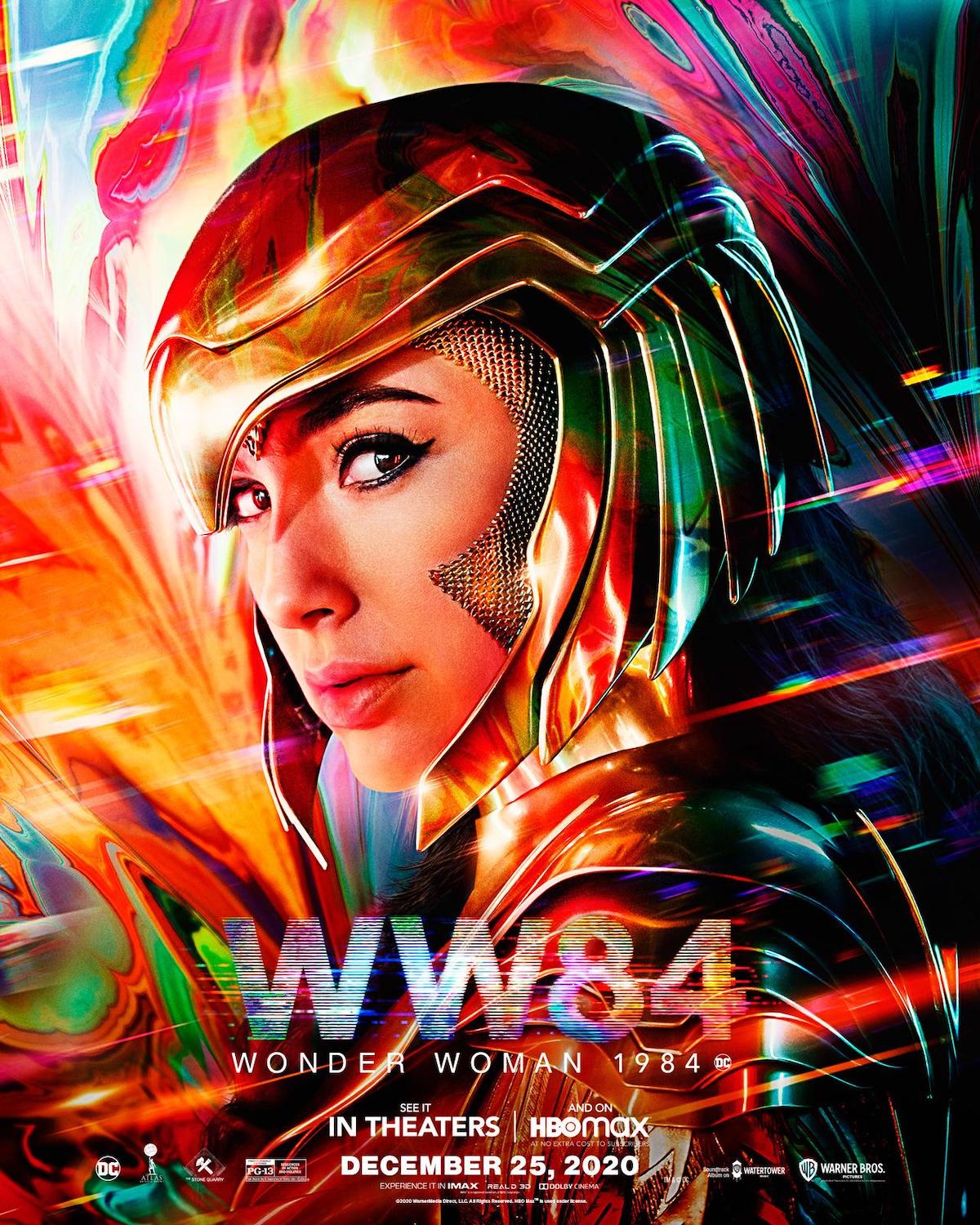
Movie Review: Wonder Woman 1984 - The Hope We Need Right Now


2020 has been quite a year to say the least, and we could really use something positive as it nears its end. Thankfully, we have a new Wonder Woman film to help with that. Her first film in 2017 was not only the first successful female lead superhero movie but also helped start the DCEU on a much needed winning streak (aside from that Whedon hiccup, but that will be rectified next year). With lead Gal Gadot and director Patty Jenkins guiding the ship again, they bring a film that delivers a message we could use heading into the new year.

For a film that was originally slated for a November 2019 release, the events that take place make it surprisingly more relevant now given all that has happened in 2020 as we see a world plunging further and further into chaos. Even Diana is affected by this, taking obvious physical damage compared to her other previous film appearances. The film shows that even someone like Wonder Woman can be vulnerable in more ways than one. And it ties in to the message of the film: life can't always be what we want it to be and shortcuts can have more consequences than we realize. To apply this to 2020, as much as we'd like things to go back to normal or just pretend like it is when it's not, it'll take time until we're truly there again.

As the trailers show, Chris Pine returns as Steve Trevor in a way more peculiar than how I thought it would happen. Nevertheless, it's great to see he and Diana reunited, with his future shock of being transported nearly 70 years entertaining and comparable to Diana's first visit to man's world. The two share some great heartfelt moments together, but from what we know in present day DCEU films, the borrowed time added to their story makes how it concludes all the more tragic.

Then we have our two main villains:
* I'm not that big of fan of Kristen Wiig, but she really surprised me as Barbara Minerva/Cheetah. Her transformation into the villain reminds me a lot of Michelle Pfiefer as Catwoman in "Batman Returns", going from meek to empowered with a touch of a psychotic break. In a moment where she first acts on her dark nature on someone who sexually harassed her earlier in the film, the score by Hans Zimmer accentuates it with a mix of triumph and terror.
* When it comes to Pedro Pascal as Maxwell Lord, Donald Trump was clear inspiration in his performance. And while it's not a bad performance, it honestly felt laid on a little too thick. Now, I'm all for a Trump lampooning as much as the next guy; I've even brought up comparisons before with Kingpin in "Daredevil" and Lex Luthor in "Young Justice". But those were more subtle jabs compared to how direct it got with Lord in this film. Lord does get some redemption by the end and it shows Diana's ability to bring out the good in people; whether it feels earned or if Diana could be able to do the same for Trump is a different story.

While I did enjoy 1984 as much as I did the first film, on an initial viewing, I think the original is still a little better. 1984 can get a little overboard with the "deus ex machina" moments that play out, but there's still some good in there. Along with the emotional moments between Steve and Diana, we also get the exciting action moments. The best examples are the car chase scene in Cairo and the battle between Diana in the Asteria armor and a full-blown Cheetah Barbara in the climax (though the CGI on Cheetah can get a little iffy in spots), which remind me a lot of the No Man's Land scene and the fight with Ares in the first film, respectively. All in all, Gadot and Jenkins have given us another enjoyable film in my eyes and I look forward to what they bring to the third one.

Whether you're able to safely view it in theaters or stream it on HBO Max, Wonder Woman 1984 is the blockbuster we've needed all year and one that should give us inspiration as we head into hopefully a better one.